Black hole caught zapping galaxy into existence?
November 30, 2009
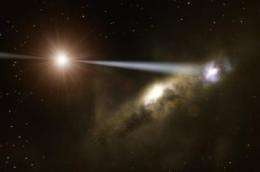
This artist's impression shows how jets from supermassive black holes could form galaxies, thereby explaining why the mass of black holes is larger in galaxies that contain more stars. Credit: ESO/L. Calçada
(PhysOrg.com) -- Which come first, the supermassive black holes that frantically devour matter or the enormous galaxies where they reside? A brand new scenario has emerged from a recent set of outstanding observations of a black hole without a home: black holes may be “building” their own host galaxy. This could be the long-sought missing link to understanding why the masses of black holes are larger in galaxies that contain more stars.
"The 'chicken and egg' question of whether a galaxy or its black hole comes first is one of the most debated subjects in astrophysics today," says lead author David Elbaz. "Our study suggests that supermassive black holes can trigger the formation of stars, thus 'building' their own host galaxies. This link could also explain why galaxies hosting larger black holes have more stars."
To reach such an extraordinary conclusion, the team of astronomers conducted extensive observations of a peculiar object, the nearby quasar HE0450-2958, which is the only one for which a host galaxy has not yet been detected. HE0450-2958 is located some 5 billion light-years away.
Until now, it was speculated that the quasar's host galaxy was hidden behind large amounts of dust, and so the astronomers used a mid-infrared instrument on ESO's Very Large Telescope for the observations. At such wavelengths, dust clouds shine very brightly, and are readily detected. "Observing at these wavelengths would allow us to trace dust that might hide the host galaxy," says Knud Jahnke, who led the observations performed at the VLT. "However, we did not find any. Instead we discovered that an apparently unrelated galaxy in the quasar's immediate neighbourhood is producing stars at a frantic rate."
These observations have provided a surprising new take on the system. While no trace of stars is revealed around the black hole, its companion galaxy is extremely rich in bright and very young stars. It is forming stars at a rate equivalent to about 350 Suns per year, one hundred times more than rates for typical galaxies in the local Universe.
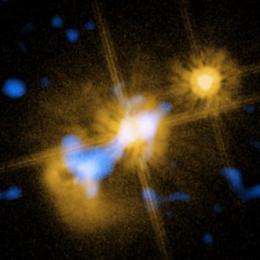
Colour composite image of a peculiar object, the nearby quasar HE0450-2958, which is the only one for which no sign of a host galaxy has yet been detected. A team of astronomers has identified black hole jets as a possible driver of galaxy formation, which may also represent the long-sought missing link to understanding why the mass of black holes is larger in galaxies that contain more stars. The mid-infrared part of this image was obtained with the VISIR instrument on ESO’s Very Large Telescope, while the visible image comes courtesy of the Hubble Space Telescope and the Advanced Camera for Surveys.
Earlier observations had shown that the companion galaxy is, in fact, under fire: the quasar is spewing a jet of highly energetic particles towards its companion, accompanied by a stream of fast-moving gas. The injection of matter and energy into the galaxy indicates that the quasar itself might be inducing the formation of stars and thereby creating its own host galaxy; in such a scenario, galaxies would have evolved from clouds of gas hit by the energetic jets emerging from quasars.
"The two objects are bound to merge in the future: the quasar is moving at a speed of only a few tens of thousands of km/h with respect to the companion galaxy and their separation is only about 22 000 light-years," says Elbaz. "Although the quasar is still 'naked', it will eventually be 'dressed' when it merges with its star-rich companion. It will then finally reside inside a host galaxy like all other quasars."
Hence, the team have identified black hole jets as a possible driver of galaxy formation, which may also represent the long-sought missing link to understanding why the mass of black holes is larger in galaxies that contain more stars.
"A natural extension of our work is to search for similar objects in other systems," says Jahnke.
Future instruments, such as the Atacama Large Millimeter/submillimeter Array, the European Extremely Large Telescope and the NASA/ESA/CSA James Webb Space Telescope will be able to search for such objects at even larger distances from us, probing the connection between black holes and the formation of galaxies in the more distant Universe.
More information: This research was presented in papers published in the journal Astronomy & Astrophysics: "Quasar induced galaxy formation: a new paradigm?" by Elbaz et al., and in the Astrophysical Journal "The QSO HE0450-2958: Scantily dressed or heavily robed? A normal quasar as part of an unusual ULIRG" by Jahnke et al. Research papers: http://www.aanda.org/10.1051/0004-6361/200912848/pdf and http://arxiv.org/abs/0906.0365
-
Black hole in search of a home
Sep 14, 2005 |
not rated yet |
0
-
Huge Black Holes Stifle Star Formation
Aug 23, 2006 |
not rated yet |
0
-
Colossal black holes common in early universe
Oct 16, 2008 |
not rated yet |
0
-
Chandra finds evidence for quasar ignition
Mar 23, 2006 |
not rated yet |
0
-
Simulations Show How Growing Black Holes Regulate Galaxy Formation
Feb 11, 2005 |
not rated yet |
0
-
Engineers build first sub-10-nm carbon nanotube transistor
Feb 01, 2012 |
4.9 / 5 (31) |
30
-
Something old, something new: Evolution and the structural divergence of duplicate genes
Jan 31, 2012 |
4.6 / 5 (7) |
1
-
The hidden nanoworld of ice crystals: Revealing the dynamic behavior of quasi-liquid layers
Jan 30, 2012 |
5 / 5 (3) |
1
-
Stock market network reveals investor clustering
Jan 27, 2012 |
3.9 / 5 (23) |
8
-
Of microchemistry and molecules: Electronic microfluidic device synthesizes biocompatible probes
Jan 26, 2012 |
5 / 5 (1) |
0
-
Scale of the Universe
1 hour ago
-
Titan's lack of impact craters
Feb 09, 2012
-
Real pictures of black hole eating a star?
Feb 08, 2012
-
Hypothetical way to travel faster than light, but not technically exceed lightspeed
Feb 06, 2012
-
How do scientists monitor the Sun's activity?
Feb 05, 2012
-
Search patterns in observational studies
Feb 05, 2012
- More from Physics Forums - General Astronomy
More news stories
NASA sees wide-eyed cyclone Jasmine
Cyclone Jasmine's eye has opened wider on NASA satellite imagery, as it moves through the Southern Pacific Ocean.
Space & Earth / Earth Sciences
50 minutes ago |
not rated yet |
0
NASA sees Giovanna reach cyclone strength, threaten Madagascar
Tropical Storm 12S built up steam and became a cyclone on February 10, 2012 as NASA's Terra satellite passed overhead. Residents of east-central Madagascar should prepare for this cyclone to make landfall ...
Space & Earth / Earth Sciences
49 minutes ago |
not rated yet |
0
Humans may have helped the decline of African rainforests 3000 years ago
(PhysOrg.com) -- Large areas of rainforests in Central Africa mysteriously disappeared over three thousand years ago, to be replaced by savannas. The prevailing theory has been that the cause was a change ...
Could Venus be shifting gear?
(PhysOrg.com) -- ESAs Venus Express spacecraft has discovered that our cloud-covered neighbour spins a little slower than previously measured. Peering through the dense atmosphere in the infrared, the ...
Space & Earth / Space Exploration
8 hours ago |
5 / 5 (7) |
7
|
Clam fields found at deep, low-temperature Mariana vents
(PhysOrg.com) -- Scientists have marveled at the unusual life forms thriving at high temperature hydrothermal vents of the deep ocean.
Space & Earth / Earth Sciences
9 hours ago |
not rated yet |
0
|
Google users warned of threat to smartphone wallets
Users of Google smartphone wallets were being warned on Friday that there is a way to crack pass codes intended to thwart thieves from going on illicit shopping sprees.
CIA website offline, Anonymous takes credit
The website of the Central Intelligence Agency was unresponsive on Friday after the hacker group Anonymous claimed to have knocked it offline.
Complex wiring of the nervous system may rely on a just a handful of genes and proteins
Researchers at the Salk Institute have discovered a startling feature of early brain development that helps to explain how complex neuron wiring patterns are programmed using just a handful of critical genes. ...
Putting the squeeze on planets outside our solar system
(PhysOrg.com) -- Using high-powered lasers, scientists at Lawrence Livermore National Laboratory and collaborators discovered that molten magnesium silicate undergoes a phase change in the liquid state, abruptly ...
The power of estrogen -- male snakes attract other males
A new study has shown that boosting the estrogen levels of male garter snakes causes them to secrete the same pheromones that females use to attract suitors, and turned the males into just about the sexiest ...
New error-correcting codes guarantee the fastest possible rate of data transmission
Error-correcting codes are one of the triumphs of the digital age. Theyre a way of encoding information so that it can be transmitted across a communication channel such as an optical fiber o ...

Nov 30, 2009
Rank: 5 / 5 (4)
The two papers referenced here offer some additional proof that the quasar does indeed have some type of host galaxy not directly associated with the jet or the companion galaxy.
Dec 01, 2009
Rank: 1 / 5 (1)
Dec 01, 2009
Rank: 1 / 5 (1)
Instead they offer as an exciting explanation a system consisting of a QSO nucleus spatially separated from its host, an ultraluminous infrared galaxy which produces stars at a "frantic" rate.
This is of course a scenario which does not (yet) fit into mainstream thinking. But it produces a whole bunch of new possibilities to look for answers to open questions.
The suggestion of the authors is a very decent idea indeed. It only takes some time to get used to it.
Dec 02, 2009
Rank: 1 / 5 (2)
"Black holes" (really massive neutron stars) may “build” their own host galaxy by neutron emission and neutron decay.
Oliver K. Manuel
Dec 02, 2009
Rank: 5 / 5 (1)
Mention is made of a few other systems that possibly exhibit jet induced star formation ( Minkowski's Object in Abell 194 and 3C 321, among others). Jet induced star formation has also been observed in Cen A, so this mode of star formation is now well documented.
Dec 02, 2009
Rank: 4 / 5 (1)
Dec 03, 2009
Rank: 1 / 5 (1)
http://tinyurl.com/yfbfpwv
It seems, the mechanism of matter formation and evaporation into radiation is completely reversible at sufficiently large scales: galaxies are forming from dark matter clouds and evaporating again like giant density fluctuations of gas or like quantum wave packets.
Dec 04, 2009
Rank: 1 / 5 (2)
... rather than coalescing, it seems appropriate to spend time studying repulsive nuclear forces that might explain these astronomical observations.
That's my opinion,
Oliver K. Manuel
Emeritus Professor of
Nuclear & Space Science
Former NASA PI for Apollo
Dec 08, 2009
Rank: not rated yet