Scientists find clue to mystery of biological clock
November 30, 2009
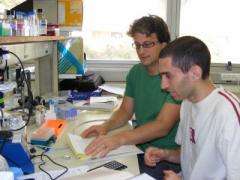
Dr. Sebastian Kadener (left) with his student, Uri Weissbein, at the Hebrew University of Jerusalem, who have done work on the mechanism of the biological clock. (Hebrew University photo)
How does our biological system know that it is supposed to operate on a 24-hour cycle? Scientists at the Hebrew University of Jerusalem have discovered that a tiny molecule holds the clue to the mystery.
Human as well as most living organisms on earth possess circadian a (24-hour) life rhythm. This rhythm is generated from an internal clock that is located in the brain and regulates many bodily functions, including the sleep-wake cycle and eating.
Although the evidence for their existence is obvious and they have been studied for more than 150 years, only recently the mechanisms that generate these rhythms have begun to be unraveled.
A researcher of the Alexander Silberman Institute of Life Sciences at the Hebrew University, Dr. Sebastian Kadener, and one of his students, Uri Weissbein, are among a collaborative group of researchers that have now found that tiny molecules known as miRNAs are central constituents of the circadian clock. Their discovery holds wide-ranging implications for future therapeutic treatment to deal with sleep deprivation and other common disorders connected with the daily life cycle.
The sleep-wake cycle, the most characterized manifestation of the circadian clock, is generated thanks to specialized neurons found both in humans and fruitflies. (The mechanism governing the circadian clock in fruitflies is almost identical to the one mammals -- and humans -- have.)
These neurons have the striking capability of counting time very accurately via a complex process of gene activation and repression that result in a tightly controlled process that takes exactly 24 hours.
The new research by Dr. Kadener and his colleagues, published in an article in the journal Genes and Development (and that was highlighted in Nature Review Neuroscience), has shown that a new mode of regulation has a pivotal importance for the ability of our internal clock to accurately count those 24 hours each day. Specifically, they have shown that the very tiny miRNA molecules are necessary for the circadian rhythms to function.
MiRNAs have recently been discovered and have been shown to be involved in different processes in animals. By the use of new state-of-the-art techniques (most of them developed in the present study) the authors demonstrate that one specific miRNA (called bantam) recognizes and regulates the translation of the gene clock.
This constitutes the first example of a defined miRNA-gene regulation in the central clock. Perhaps even more importantly, the researchers were among the first to prove that there is a clear role of miRNA regulation in the brain in general and behavior in particular.
Source: Hebrew University of Jerusalem
-
Phase of clock gene expression in human leukocytes correlates with habitual sleep timing
May 01, 2008 |
not rated yet |
0
-
Genetic link between body clocks and blood pressure
Aug 31, 2007 |
not rated yet |
0
-
Another reason to avoid high-fat diet -- it can disrupt our biological clock
Dec 29, 2008 |
not rated yet |
0
-
Molecular partnership controls daily rhythms, body metabolism
Nov 26, 2008 |
not rated yet |
0
-
New research alters concept of how circadian clock functions
Dec 13, 2007 |
not rated yet |
0
-
Engineers build first sub-10-nm carbon nanotube transistor
Feb 01, 2012 |
4.9 / 5 (31) |
30
-
Something old, something new: Evolution and the structural divergence of duplicate genes
Jan 31, 2012 |
4.6 / 5 (7) |
1
-
The hidden nanoworld of ice crystals: Revealing the dynamic behavior of quasi-liquid layers
Jan 30, 2012 |
5 / 5 (3) |
1
-
Stock market network reveals investor clustering
Jan 27, 2012 |
3.9 / 5 (23) |
8
-
Of microchemistry and molecules: Electronic microfluidic device synthesizes biocompatible probes
Jan 26, 2012 |
5 / 5 (1) |
0
-
Is Everyday Technology Killing Us?
Feb 08, 2012
-
Exercise and weight loss
Feb 08, 2012
-
Why do we have head aches? Our brains can't feel anything.
Feb 07, 2012
-
"The end of diseases" by David Agus, interview from Daily Show with Jon Stewart
Feb 04, 2012
-
Oncolytic adenovirus
Feb 04, 2012
-
Nutrition label stuffs and diets
Feb 02, 2012
- More from Physics Forums - Medical Sciences
More news stories
Complex wiring of the nervous system may rely on a just a handful of genes and proteins
Researchers at the Salk Institute have discovered a startling feature of early brain development that helps to explain how complex neuron wiring patterns are programmed using just a handful of critical genes. ...
2 hours ago |
5 / 5 (3) |
0
|
Human cognitive performance suffers following natural disasters, researchers find
Not surprisingly, victims of a natural disaster can experience stress and anxiety, but a new study indicates that it might also cause them to make more errors - some serious - in their daily lives. In their upcoming Human Fa ...
Medicine & Health / Psychology & Psychiatry
3 hours ago |
4 / 5 (1) |
0
New understanding of DNA repair could eventually lead to cancer therapy
A research group in the Faculty of Medicine & Dentistry at the University of Alberta is hoping its latest discovery could one day be used to develop new therapies that target certain types of cancers.
6 hours ago |
4.8 / 5 (4) |
0
|
Both maternal and paternal age linked to autism
Older maternal and paternal age are jointly associated with having a child with autism, according to a recently published study led by researchers at The University of Texas Health Science Center at Houston (UTHealth).
Medicine & Health / Psychology & Psychiatry
6 hours ago |
not rated yet |
0
|
Q&A: Obama and the birth control controversy
(AP) -- What birth control debate? A half-century after the introduction of the pill, acceptance of birth control by American women is virtually universal.
2 hours ago |
not rated yet |
0
Google users warned of threat to smartphone wallets
Users of Google smartphone wallets were being warned on Friday that there is a way to crack pass codes intended to thwart thieves from going on illicit shopping sprees.
CIA website offline, Anonymous takes credit
The website of the Central Intelligence Agency was unresponsive on Friday after the hacker group Anonymous claimed to have knocked it offline.
NASA sees wide-eyed cyclone Jasmine
Cyclone Jasmine's eye has opened wider on NASA satellite imagery, as it moves through the Southern Pacific Ocean.
NASA sees Giovanna reach cyclone strength, threaten Madagascar
Tropical Storm 12S built up steam and became a cyclone on February 10, 2012 as NASA's Terra satellite passed overhead. Residents of east-central Madagascar should prepare for this cyclone to make landfall ...
Putting the squeeze on planets outside our solar system
(PhysOrg.com) -- Using high-powered lasers, scientists at Lawrence Livermore National Laboratory and collaborators discovered that molten magnesium silicate undergoes a phase change in the liquid state, abruptly ...
The power of estrogen -- male snakes attract other males
A new study has shown that boosting the estrogen levels of male garter snakes causes them to secrete the same pheromones that females use to attract suitors, and turned the males into just about the sexiest ...