Brain Scan Study Shows Cocaine Abusers Can Control Cravings
November 30, 2009
Brain Scan Study Shows Cocaine Abusers Can Control Cravings

Enlarge

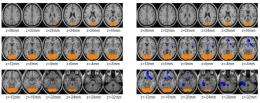
Left: When active cocaine users watched a video showing people taking cocaine and other cocaine-associated cues, the areas of the brain shown in orange "lit" up, or became more activated an indication that they were craving the drug. Right: When the subjects were told to inhibit their craving while watching the cocaine-cues video (cognitive inhibition), activity in the brain regions shown in blue decreased. The researchers say this deactivation is a way for the brain to "tune out" the cocaine cues and is an indication of their ability to inhibit craving.

(PhysOrg.com) -- When asked to inhibit their response to a "cocaine-cues" video, active cocaine abusers were, on average, able to suppress activity in brain regions linked to drug craving, according to a new study at the U.S. Department of Energy's Brookhaven National Laboratory. The results, to be published in an upcoming issue of NeuroImage, suggest that clinical interventions designed to strengthen these inhibitory responses could help cocaine abusers stop using drugs and avoid relapse.

"Exposure to drugs or stimuli associated with using drugs is one of the most common factors leading to relapse in drug-addicted individuals," said Nora Volkow, Director of the National Institute on Drug Abuse and lead author on the paper.

"We know from previous studies that drug cues can trigger dramatic changes in the that are linked to a strong craving response," added co-author Gene-Jack Wang, Chair of Brookhaven's medical department. "This study provides the first evidence that cocaine abusers retain some ability to cognitively inhibit their craving responses to drug-related cues."

Added Volkow, "Our findings provide enormous hope because they imply that cognitive interventions might be developed to maximize cocaine abusers' success in blocking the drug-craving response to help them avoid relapse."

The scientists used a brain-scanning technique called positron (PET) and a radioactively "tagged" form of glucose — the brain's main fuel — to measure brain activity in 24 active cocaine abusers during three different conditions: 1) while subjects simply lay in the scanner with eyes open; 2) while subjects watched a "cocaine-cues" video with scenes simulating the purchase, preparation, and smoking of crack cocaine; and 3) while subjects watched the video but were told to try to inhibit their craving response. Scans were performed in random order and on separate days.

In each scan, the PET camera tracked the radioactive signal from the tagged glucose as it was taken up by various regions of the brain. A stronger signal indicates higher metabolic activity in a particular brain region where more glucose is being used. This technique allows scientists to accurately monitor which brain regions are most active and how that activity changes with time or in response to different situations.

The scientists also monitored the research subjects' heart rate and blood pressure and asked them to describe their level of craving during the scans. Compared with the baseline condition, the cocaine-cues video triggered increases in brain activity in several brain regions associated with drug craving, as well as increases in research subjects' self-reports of craving.

When the research subjects were asked to inhibit their response to the video, and those scans were compared with the no-inhibition condition, metabolic activity decreased dramatically in brain regions involved in experiencing and anticipating rewards, and in a part of the brain that plays a role in assigning value, or salience, to different stimuli. During inhibition, research subjects also reported lower levels of craving compared with the no-inhibition video condition.

The researchers say the findings have significant clinical implications:

"Many current drug treatment programs help addicted individuals predict when and where they might be exposed to drug cues so that they can avoid such situations," Volkow said. "While this is a very useful strategy, in real-word situations, cues may come up in unexpected ways. Our findings suggest that a clinical strategy that trains to exert greater cognitive control could help them selectively inhibit the craving response whenever and wherever drug cues are encountered — whether expectedly or unexpectedly."

Because inhibitory control is crucial for regulating emotions and desires, the findings from this study could have implications for other disorders involving loss of behavioral control, such as gambling and obesity.

Source: Brookhaven National Laboratory (news : web)


Rank 5 /5 (1 vote)
Related Stories
Relevant PhysicsForums posts
  • Is Everyday Technology Killing Us?
    createdFeb 08, 2012
  • Exercise and weight loss
    createdFeb 08, 2012
  • Why do we have head aches? Our brains can't feel anything.
    createdFeb 07, 2012
  • "The end of diseases" by David Agus, interview from Daily Show with Jon Stewart
    createdFeb 04, 2012
  • Oncolytic adenovirus
    createdFeb 04, 2012
  • Nutrition label stuffs and diets
    createdFeb 02, 2012
  • More from Physics Forums - Medical Sciences

More news stories

Complex wiring of the nervous system may rely on a just a handful of genes and proteins

Researchers at the Salk Institute have discovered a startling feature of early brain development that helps to explain how complex neuron wiring patterns are programmed using just a handful of critical genes. ...

Medicine & Health / Research

created 1 hour ago | popularity 5 / 5 (3) | comments 0 | with audio podcast

Curry spice component may help slow prostate tumor growth

Curcumin, an active component of the Indian curry spice turmeric, may help slow down tumor growth in castration-resistant prostate cancer patients on androgen deprivation therapy (ADT), a study from researchers ...

Medicine & Health / Cancer

created 7 hours ago | popularity 4.6 / 5 (5) | comments 0 | with audio podcast

Both maternal and paternal age linked to autism

Older maternal and paternal age are jointly associated with having a child with autism, according to a recently published study led by researchers at The University of Texas Health Science Center at Houston (UTHealth).

Medicine & Health / Psychology & Psychiatry

created 6 hours ago | popularity not rated yet | comments 0 | with audio podcast

Team isolates nerve cells involved in storing long term memory and gene proteins associated with them

(Medical Xpress) -- A research team in Taiwan has succeeded in isolating two nerve cells in fruit fly brains that are believed to be the major players in allowing for the formation of long term memories. Furthermore, ...

Medicine & Health / Neuroscience

created 8 hours ago | popularity 5 / 5 (4) | comments 1 | with audio podcast report

Seeing colors in music, tasting flavors in shapes may happen in life's early months

Famed violinist Itzhak Perlman sees a deep forest green whenever he plays a B-flat on his Stradivarius' G string. The A on the E string is red.

Medicine & Health / Psychology & Psychiatry

created 9 hours ago | popularity 4.5 / 5 (2) | comments 1 | with audio podcast


Google users warned of threat to smartphone wallets

Users of Google smartphone wallets were being warned on Friday that there is a way to crack pass codes intended to thwart thieves from going on illicit shopping sprees.

NASA sees wide-eyed cyclone Jasmine

Cyclone Jasmine's eye has opened wider on NASA satellite imagery, as it moves through the Southern Pacific Ocean.

NASA sees Giovanna reach cyclone strength, threaten Madagascar

Tropical Storm 12S built up steam and became a cyclone on February 10, 2012 as NASA's Terra satellite passed overhead. Residents of east-central Madagascar should prepare for this cyclone to make landfall ...

CIA website offline, Anonymous takes credit

The website of the Central Intelligence Agency was unresponsive on Friday after the hacker group Anonymous claimed to have knocked it offline.

The power of estrogen -- male snakes attract other males

A new study has shown that boosting the estrogen levels of male garter snakes causes them to secrete the same pheromones that females use to attract suitors, and turned the males into just about the sexiest ...

New error-correcting codes guarantee the fastest possible rate of data transmission

Error-correcting codes are one of the triumphs of the digital age. They’re a way of encoding information so that it can be transmitted across a communication channel — such as an optical fiber o ...