The deciding factor: Empathy distinguishes modern humans from their primate ancestors
November 30, 2009
The deciding factor: Empathy distinguishes modern humans from their primate ancestors

Enlarge

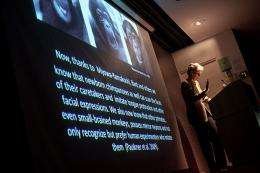
Sarah Hrdy, who received her A.B. in 1969 and Ph.D. in 1975 for work in Harvard’s Department of Anthropology, returned to speak on “Mothers and Others: The Origin of Emotionally Modern Humans.” Hrdy says our aptitude for imagining the emotions of other individuals is a powerful indicator of our humanity. Photo: Rose Lincoln

(PhysOrg.com) -- What, exactly, distinguishes humans from apes? It’s certainly more than just our genes, renowned anthropologist Sarah Blaffer Hrdy told a Harvard audience recently (Nov. 18).

“The line leading to the genus Homo split maybe 7 million years ago from other apes, and this helps explain why 99 percent of the DNA overlaps,” said Hrdy, professor emerita of anthropology at the University of California, Davis. “Humans and other apes are very similar.”

And that last 1 percent isn’t all about intelligence, Hrdy said, dispelling the idea that humans are universally smarter than apes.

“We share a lot of cognitive similarities,” she said. “That explains why a chimpanzee can test better than most graduate students at remembering series of numbers on a computer screen.”

Hrdy, who received her A.B. in 1969 and Ph.D. in 1975 for work in Harvard’s Department of Anthropology, returned to speak on “Mothers and Others: The Origin of Emotionally Modern Humans.” An audience of more than 300 listened to her discuss the fundamental differences between modern humans and apes.

Rather than simple cognitive ability, Hrdy said, our maturity sets us apart perhaps more than any other trait. While apes do cooperate, she said they lack something fundamentally human: empathy.

“Understanding what someone else might be thinking or just being interested in attributing a mental state to someone else is something humans do naturally, right from an early age,” she said.

Hrdy went on to explain the vital role of empathy in distinguishing from their primate ancestors, saying our aptitude for imagining the emotions of other individuals is a powerful indicator of our humanity. Our ability to cooperate stems directly from that ability to empathize.

“Humans are more eager to share. Sharing impulses lead to a more sophisticated transfer of information,” she said. “Cooperation behaviors like sharing are a reaction to competition from other groups.”

Cooperation and the capacity for empathy evolved from the special context of shared care of infants, she said. So the nursery was the cradle of our humanity.
Hrdy’s talk was co-sponsored by the Harvard Museum of Natural History, the Department of Human Evolutionary Biology, and Harvard University Press.

Provided by Harvard University (news : web)


Rank 5 /5 (1 vote)
Related Stories
Relevant PhysicsForums posts
  • Stem cell question.
    createdFeb 10, 2012
  • Protease cleavage
    createdFeb 10, 2012
  • Pertubance in a model
    createdFeb 10, 2012
  • Cancer drugs and Alzheimer's, Oh my!
    createdFeb 09, 2012
  • Squishing cells
    createdFeb 09, 2012
  • Any books/articles for evolutionary stable strategy models in humans?
    createdFeb 09, 2012
  • More from Physics Forums - Biology

More news stories

Entire genome of extinct human decoded from fossil

(PhysOrg.com) -- In 2010, Svante Pääbo and his colleagues presented a draft version of the genome from a small fragment of a human finger bone discovered in Denisova Cave in southern Siberia. The ...

Biology / Biotechnology

created Feb 07, 2012 | popularity 4.7 / 5 (58) | comments 44 | with audio podcast

Why are there so few fish in the Earth's oceans?

(PhysOrg.com) -- A Stony Brook University researcher has found that, contrary to popular belief, there are not plenty of fish in the sea.

Biology / Plants & Animals

created Feb 08, 2012 | popularity 4.3 / 5 (17) | comments 26 | with audio podcast

Miami battling invasion of giant African snails

No one knows how they got there. But an invasion of African giant snails has southern Florida in a panic over potential crop damage, disease and general yuckiness surrounding the slimy gastropods.

Biology / Ecology

created Feb 10, 2012 | popularity 4.5 / 5 (2) | comments 5

Deciding to go left or right: Researchers use device to determine that lower animals can navigate too

For decades, scientists have associated binary decision making — opting to go left or right — with higher-ranking animals, including humans. A team of Harvard researchers, however, is rewriting that ...

Biology / Plants & Animals

created Feb 09, 2012 | popularity 4 / 5 (1) | comments 4 | with audio podcast

Study shows chimps able to understand needs of others

(PhysOrg.com) -- By setting up a unique experiment, a small team of researchers has found that chimpanzees are able to understand need in other chimps, despite their general disinclination to offer aid when ...

Biology / Plants & Animals

created Feb 07, 2012 | popularity 5 / 5 (2) | comments 4 | with audio podcast report


Latin America mining boom clashes with conservation

Latin America is experiencing a mining boom as prices rise fuelled by a hike in global demand, but the region is also being hit by a wave of violent protests, strikes and rallies by environmentalists.

Love a click away in Indonesia's Twitter Republic

He was a geeky kid from Yogyakarta, she a glamorous city girl in Jakarta. In a country with one of the world's most vibrant social networking scenes they fell in love on Twitter.

Walney offshore wind farm is world's biggest (for now)

(PhysOrg.com) -- The Walney wind farm on the Irish Sea--characterized by high tides, waves and windy weather--officially opened this week. The farm is treated in the press as a very big deal as the Walney ...

GPS court ruling leaves US phone tracking unclear

A US Supreme Court decision requiring a warrant to place a GPS device on the car of a criminal suspect leaves unresolved the bigger issue of police tracking using mobile phones, legal experts say.

Europeans protest controversial Internet pact

Tens of thousands of people marched in protests in more than a dozen European cities Saturday against a controversial anti-online piracy pact that critics say could curtail Internet freedom.

Europe stakes billion-dollar bet on new rocket

A pencil-slim rocket is scheduled to lift into space from South America on Monday, carrying a billion-dollar bet that Europe can grab a juicy slice of the market to place satellites in low orbit.