Microscopy reveals structure of calcite shells
November 30, 2009 By Anne Ju Microscopy reveals structure of calcite shells

Enlarge

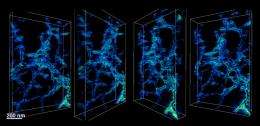
This image shows the 3-D nanoscale structure of the inside of a synthetic calcite crystal, which was grown in an agarose gel. In this environment, the crystal grows around the polymeric fibers. The structure gives insight into the formation of single crystals by biological organisms. Image: Estroff/Muller labs

(PhysOrg.com) -- Lara Estroff and colleagues have taken a deep, detailed look at the way lab-created calcite crystals, similar to those found in nature, grow in tandem with proteins and other large molecules.

Single crystals of the mineral calcite -- the chief material in limestone -- are predictable, homogeneous and, well, a little boring.

But scientists have long marveled at how biological crystals of calcite grow together with other organic materials to form, for example, shells and sea urchin spines. Biologists and materials scientists would love to know exactly how to re-create such natural composites in the lab.

Lara Estroff, assistant professor of materials science and engineering, and colleagues have taken a deep, detailed look at the way lab-created calcite crystals, similar to those found in nature, grow in tandem with proteins and other large molecules, and they report their findings in the Nov. 27 issue of the journal Science. The journal also features the work as a "Perspective" written by Kansas State University's Mark Hollingsworth.

"We knew the organics were in there, but what no one had been able to do up until now was actually see what that organic-inorganic interface looked like," said Estroff, whose lab focuses on the synthesis and characterization of bio-inspired materials.

Estroff and graduate student Hanying Li grew samples of calcite in a called agarose -- a common dessert additive -- that mimics the way calcite grows in living things. In previously published work, Li and Estroff had determined that this gel environment made the crystals grow very differently than in solution.

In collaboration with associate professor of applied and engineering physics David Muller and physics graduate student Huolin Xin, the researchers prepared their crystals with Focused (FIB) technology, which uses high-energy ions to slice samples thin enough for an to pass through for imaging.

Scanning transmission electron microscopy methods developed by Xin and Muller revealed detailed, three-dimensional pictures of the internal structure of calcite crystals grown in the gel. They found that the trap large molecules by growing around them.

Studying this complex natural process may be a key step toward giving materials scientists like Estroff clues on how to make and manipulate nature-inspired composite materials. Applications could range from electronics to photovoltaics to completely new classes of materials.

Provided by Cornell University (news : web)


Rate this story - 5 /5 (2 votes)


November 30, 2009 all stories

Comments: 0

5 /5 (2 votes)

  • hide
  • Related Stories

  • Sea Urchins' Digging Teeth are Designed to Stay Sharp
    created May 04, 2009 | popularity not rated yet | comments 0
  • Scientist Creates Liquid Crystals with High Metal Content
    created Apr 03, 2006 | popularity not rated yet | comments 0
  • Strange-behaving crystals could have impact on research, technology
    created Jan 03, 2008 | popularity not rated yet | comments 0
  • Sea urchin yields a key secret of biomineralization
    created Oct 27, 2008 | popularity not rated yet | comments 0
  • Scientists confirm how crystals form
    created Nov 03, 2005 | popularity not rated yet | comments 0


  • hide
  • Relevant PhysicsForums posts

Other News

Energy from light and water: New photocatalytic method for the clean production of hydrogen from water

Chemistry / Materials Science

created 20 hours ago | popularity 4.5 / 5 (13) | comments 10 | with audio podcast

(PhysOrg.com) -- Hydrogen-powered fuel cells and solar energy are the best hope for a more environmentally friendly and resource-sparing energy supply in the future. A combination of the two is considered to be particularly ...


New approach to treating breast and prostate cancers

Chemistry / Biochemistry

created 17 hours ago | popularity 2.5 / 5 (2) | comments 0

In a new approach to developing treatments for breast cancer, prostate cancer and enlarged hearts, Loyola University Chicago Stritch School of Medicine researchers are zeroing in on a workhorse protein called RSK.


New research rejects 80-year theory of 'primordial soup' as the origin of life

Chemistry / Biochemistry

created Feb 02, 2010 | popularity 4.3 / 5 (36) | comments 26 | with audio podcast

For 80 years it has been accepted that early life began in a 'primordial soup' of organic molecules before evolving out of the oceans millions of years later. Today the 'soup' theory has been over turned in a pioneering paper ...


It looks, feels and tastes like chicken, but it's made of soy

It looks, feels and tastes like chicken, but it's made of soy

Chemistry / Biochemistry

created Feb 04, 2010 | popularity 4.5 / 5 (18) | comments 14 | with audio podcast

Sure, some delicacies might taste just like chicken, but they usually feel and look much different. Soy meat alternatives, such as the soy burger, have become more popular recently, with increased sales of ...


Compound could become important new antidepressant

Chemistry / Other

created Feb 04, 2010 | popularity 4.9 / 5 (11) | comments 7 | with audio podcast

Chemists at Oregon State University have discovered and synthesized a new compound that in laboratory and animal tests appears to be similar to, but may have advantages over one of the most important antidepressant medications ...