Nearly half of Venice underwater
November 30, 2009
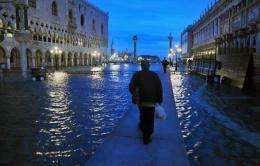
People walk on a plateform on the flooded Piazza San Marco (St Mark's square) in Venice. Much of the historic Italian city of Venice, including St. Mark's Square, was underwater Monday following a meteorological depression combined with natural tide waters, officials said.
Much of the historic Italian city of Venice, including St. Mark's Square, was underwater Monday following a meteorological depression combined with natural tide waters, officials said.
The tide monitoring centre said 45 percent of the Renaissance city was swamped when the lagoon rose 131 centimetres (more than four feet).
Venice was flooded 50 times between 1993 and 2002, with the worst 'acqua alta' on November 4, 1966, when the city was submerged by 1.94 metres of water amid catastrophic flooding throughout the country.
In February 1986, levels reached 1.58 metres above normal, and in December 2008 waters surged 1.56 metres.
The city has for years been wrestling with the problems posed by the threat of rising sea levels. Last year local authorities confirmed they were looking at a scheme to raise the city's buildings to meet the problem.
Under Operation "Rialto", local officials and engineers were looking at using piston-supported-poles placed at the bottom of each structure to lift buildings by up to a metre.
In April 2007, the United Nations cultural organisation UNESCO warned that Venice was one of its designated World Heritage sites that was threatened by climate change.
(c) 2009 AFP
-
Venice fights creeping Chinese seaweed
Jun 27, 2006 |
not rated yet |
0
-
Istanbul warned of potential earthquake
Jan 05, 2006 |
not rated yet |
0
-
Timing is everything: How vulnerable to flooding is New York City?
Jul 31, 2008 |
not rated yet |
0
-
Massive German floods monitored from space
Apr 13, 2006 |
not rated yet |
0
-
Pavlopetri -- the world's oldest known submerged town
Oct 21, 2009 |
not rated yet |
0
-
Engineers build first sub-10-nm carbon nanotube transistor
Feb 01, 2012 |
4.9 / 5 (31) |
30
-
Something old, something new: Evolution and the structural divergence of duplicate genes
Jan 31, 2012 |
4.6 / 5 (7) |
1
-
The hidden nanoworld of ice crystals: Revealing the dynamic behavior of quasi-liquid layers
Jan 30, 2012 |
5 / 5 (3) |
1
-
Stock market network reveals investor clustering
Jan 27, 2012 |
3.9 / 5 (23) |
8
-
Of microchemistry and molecules: Electronic microfluidic device synthesizes biocompatible probes
Jan 26, 2012 |
5 / 5 (1) |
0
-
Do some geologists actually act a lot like Randy Marsh?
Feb 11, 2012
-
Discrepancy between oxygen and carbon-dioxide levels
Feb 09, 2012
-
where gems are found in the world
Feb 09, 2012
-
Wind Waves in Reservoir ~ Wind run-up and Wind set-up
Feb 08, 2012
-
Balance of oxygen in the atmosphere
Feb 01, 2012
-
The case for a methanol-based economy
Jan 30, 2012
- More from Physics Forums - Earth
More news stories
Latin America mining boom clashes with conservation
Latin America is experiencing a mining boom as prices rise fuelled by a hike in global demand, but the region is also being hit by a wave of violent protests, strikes and rallies by environmentalists.
4 hours ago |
not rated yet |
0
Political leaders play key role in how worried Americans are by climate change: study
More than extreme weather events and the work of scientists, it is national political leaders who influence how much Americans worry about the threat of climate change, new research finds.
Feb 06, 2012 |
5 / 5 (6) |
72
NASA budget will axe Mars deal with Europe: scientists
US President Barack Obama's budget proposal to be submitted next week for 2013 will cut NASA's budget by 20 percent and eliminate a major partnership with Europe on Mars exploration, scientists said Thursday.
Space & Earth / Space Exploration
Feb 10, 2012 |
5 / 5 (3) |
55
Humans may have helped the decline of African rainforests 3000 years ago
(PhysOrg.com) -- Large areas of rainforests in Central Africa mysteriously disappeared over three thousand years ago, to be replaced by savannas. The prevailing theory has been that the cause was a change ...
High planetary tilt lowers odds for life?
Highly-tilted worlds would have extreme seasons, subjecting life to alternating periods of scorching and subzero temperatures. This could make the development of all but hardiest, simplest creatures a long ...
Space & Earth / Space Exploration
Feb 06, 2012 |
4.8 / 5 (12) |
14
|
Google might launch Drive for cloud storage soon
(PhysOrg.com) -- Google's next big move, according to the Wall Street Journal, is a cloud storage service called Drive. Hardly first to the plate, Google is simply catching up to introducing its cloud reposi ...
Walney offshore wind farm is world's biggest (for now)
(PhysOrg.com) -- The Walney wind farm on the Irish Sea--characterized by high tides, waves and windy weather--officially opened this week. The farm is treated in the press as a very big deal as the Walney ...
Love a click away in Indonesia's Twitter Republic
He was a geeky kid from Yogyakarta, she a glamorous city girl in Jakarta. In a country with one of the world's most vibrant social networking scenes they fell in love on Twitter.
Europeans protest controversial Internet pact
Tens of thousands of people marched in protests in more than a dozen European cities Saturday against a controversial anti-online piracy pact that critics say could curtail Internet freedom.
Navy to begin tests on electromagnetic railgun prototype launcher
The Office of Naval Research (ONR)'s Electromagnetic (EM) Railgun program will take an important step forward in the coming weeks when the first industry railgun prototype launcher is tested at a facility ...
Explained: Sigma
It's a question that arises with virtually every major new finding in science or medicine: What makes a result reliable enough to be taken seriously? The answer has to do with statistical significance -- but ...
Nov 30, 2009
Rank: 5 / 5 (1)
In fact, already it isn't since the increases were above that level. (unless i am reading it incorrectly, but it is still really pushing it)
Ideally it would be nice to have air-filled containers under the buildings and 4 guiding poles (or 2) to let it follow the height naturally.
This is obviously going to be bad if there was a storm, but this could be remedied by a sensor or 2 on the outside at a specific level and clamps to hold the building steady. If there is a specific pressure on the sensor (under water), release the clamps slowly.
And while it looks like a method like this won't work on buildings like the one pictured, remember that we have boats bigger than some towns that can easily float on water, we already mastered this problem.
It would be a shame to see "The Floating City" be swallowed by the sea.
Nov 30, 2009
Rank: 5 / 5 (1)
Nov 30, 2009
Rank: 5 / 5 (1)
Dec 01, 2009
Rank: not rated yet