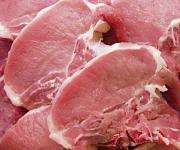
Pork meat grown in the laboratory
December 1, 2009 by Lin Edwards
(PhysOrg.com) -- Scientists from Eindhoven University in The Netherlands have for the first time grown pork meat in the laboratory by extracting cells from a live pig and growing them in a petri dish.
The scientists, led by Professor of Physiology Mark Post, extracted myoblast cells from a living pig and grew them in a solution of nutrients derived from the blood of animal fetuses (although they intend to replace the solution with a synthesized alternative in the future).
Professor Post said artificially cultured meat could mean the meat of one animal could be increased to a volume equivalent to the meat of a million animals, which would reduce animal suffering and be good for the environment. As long as the final product looks and tastes like meat, Post said he is convinced people will buy it.
At present the product is a sticky, soggy and unappetizing muscle mass, but the team is seeking ways to exercise and stretch the muscles to turn the product into meat of a more familiar consistency. Post described the current in-vitro meat product as resembling wasted muscle, but he is confident they can improve its texture. Nobody has yet tasted the cultured meat because laboratory rules prevent the scientists tasting the product themselves.
The research is partly funded by the Dutch government, but is also backed by the Dutch sausage-making firm Stegeman, which is owned by food giant Sara Lee. The scientists (and presumably, the sausage makers) believe the meat product may be available for use in sausages within five years.
Other groups are also working on trying to produce cultured meat. NASA has funded research in the US on growing fish chunks from cells and meat from turkey cells, with the idea that the technology could have wide application in future space travel, since growing edible muscle would allow future astronauts to avoid a range of problems associated with using live animals in space. In a June 29 paper in the journal Tissue Engineering another group of scientists proposed new techniques that could lead to industrial production of meat grown in cultures.
The reaction of vegetarian groups has been mixed. A representative of PETA (People for the Ethical Treatment of Animals) said as long as the meat was not the flesh of a dead animal there would be no ethical objection. Last year PETA even offered a prize of $1 million to the first person or group who could come up with a commercially viable cultured meat product. Other vegetarians have been more guarded, with a representative of The Vegetarian Society saying the main foreseeable problems would be labeling issues, as it would be difficult to label products containing cultured meat in a way that vegetarians would trust.
• Join PhysOrg.com on Facebook!
• Follow PhysOrg.com on Twitter!
© 2009 PhysOrg.com


And it might give a big push to growing spare parts for your own body (and all the blurring ethical issues that come with it)
Why? I'm not a hippie but only an idiot would suggest there is an unlimited amount of resources on this planet, so we might as well not interrupt the entire ecological system for something we can create artificially. We owe our environment that much respect at *least in order to sustain future centuries of our race without having to resort to post-apocalyptic scenarios.
I would go so far as to promote we mine foreign bodies such as moons and other planets for resources to use on earth, instead of having to rely on local resources.
These things would all be a fantastic endeavor for our species, we would push the limits of our technology and space travel in the process.
Science!
I'll take my synthetic steak medium rare, please!
Excellent research, but I doubt the pig farmers will take kindly to this bit of news and it will be a long long long long way till we actually stop or even reduce the mass slaughter of pigs (no drama implied, even though it would in part be justified after seeing some documentaries out there on meat and animal raising/processing).
My feeling is, while most people may fret about the state of our feedstock welfare, I doubt most people will change their behavior on an ethical/moral basis. But give them an equal product at a cheaper price, and heck yea all of the sudden everyone's a symbeef fan!
And since feedstock is a commodity (there is no brand preference for a live pig/cow/chicken), the only thing that needs to happen to get people to switch is to out perform on the 4 categories above.
Those who want the fat could add lard as required.:)
As for eating synthetic human, that could be an interesting debate. Since nobody was killed, and it could be made from ones own cells, I can't see any LEGAL problem. On the other hand, the ETHICS are highly debatable. I doubt that I'd try it, but there are almost certainly those who would.
Yeah, I must admit this one really threw me. Few things ever do, but this time I really don't know how I'd react to such a product. On the other hand, if they just label it "Soylent Green"...
I suppose the biggest thing here would be, as some of the cited vegetarians said, the labeling and the assurance of product purity and sourcing. I mean, what's to stop some unscrupulous crematory operator from running a little side business in "meat products"...? Or worse yet, some gang goon enterprise that "recycles" their enemies (or just random strangers) for cash? (Then again, what's to stop them from doing such things even with ordinary processed meat products?)
How do you control for absolute purity (i.e. ensure no questionable admixtures) even if you can bioengineer some fluorescent or otherwise easily detectable marker into the artificial meat?
Just amazing, good work, all these teams around the world working on this, should get enormous support now..
Maybe PETA will shut up about our treatment of veal!
Speaking of lard being from pigs, that's only partially true - when I was growing up my mom would be jars of chicken lard to use in recipes. Presumably, lard = fat by definition and isn't species specific.
Second, there will always be people who don't want to change. Unless someone makes it illegal to eat animals, many people will keep doing so.
Third, the grain and grass growers will find plenty of markets, including people food, biofuels, and nutrient production for the cultured meat.
At the worst, for many years to come, the growth of cultured meat should balance the number of farmers quitting the business and subdividing their land.
Eventually? Yes, it probably will replace all but the organic and hobby farms, but that will take many years, and society will have plenty of time to adjust. Besides, one good health scare could derail the whole idea for years, even if it isn't the process's fault.
Obviously human meat contains just that mix.
So if they make synthetic meat they might as well make meat that does best what it should do: nourish us.
Call it what you want. If it's health, nourishes me, and is tasty (and has a good consistency) then I won't have any ethical qualms about eating it just because it's based on some humam cell primers.
If it means that other animals aren't being killed then that is just an additional bonus.
From a logical point of view, this idea of eating synthetic meat is no problem, but ethics aren't always about logical thinking. However, when I think about the conditions many animals live with the only purpose to be killed - it really is a very difficult topic.
I am not a vegeterian, though I believe we should think about how much meat we really need to eat. Not because of the animals, but in order to live a healthy life.
What we'd really gain is greater and finer control over this important aspect of human life. Control being the key word here. Almost anyone can grow pigs, with a little training. You need some serious scientific background to understand the above process, not to mention entire industries to provide the tools.
Centralisation, hyper-specialisation, integration, mass culture...Seems to be the predominant trend. Let's hope our bodies won't fail our minds.
kasen: Meat production by raising animals is incredibly inefficient. Animals do a lot of things that require energy which doesn't go into meat production at all (thinking/breathing alone requires the better part of all energy the animal takes up). Then there's all the lost stuff during defecation and methane expulsion (which is a greenhouse gas which is significant given the size of today's meat-animal herds)
I think putting some voltage through a petri dish would have a better energy balance by far.
Would that it were! But the entire process sounds a lot more complicated. Also, unlike traditional sources, it's very linear and interconnected. Power failures, stray bacteria, ill intentioned employees, computer errors. One misbehaving element could mean starvation for an entire city, should things develop that big, that fast. Every redundancy that needs to be implemented draws more energy.
As for space-borne applications, I'm pretty sure it's cheaper to grow plants, GM or not. Or send robots...
Of course you need to feed the stuff nutrients. Probably we could get those from fermentation of grass (just like animals do). I'm no biochemist so I don't know how many different things they need. But given that all of that is going towards builing meat instead of 70%+ being wasted on other organs and unrelated activities...
Power failures aren't a biggie unless you live in a banana republic and have never heard of backup generators or batteries (and so what if the stuff doesn't get 'excercise' for a day? We grow plants in greenhouses on artificial soil substitutes with nutrient feed drips - that's not so much different.
I'm just playing devil's advocate, here, really. My point is that all that extra technology eats up roughly as much energy as nature's inefficiencies, gives a far greater control of the product, but also decreases overall system "robustness". Technology achieves, nature persists.
Finally, we mustn't forget that very little of a modern day pig goes to waste. Today's food industry has become grotesquely efficient, especially from a purely economical standpoint.
Genetic abnormalities aren't a problem, either: we can eat pigs with mutations just fine (and do so almost every day). DNA is destroyed by cooking and doesn't affect us anyways - even were we eat the meat raw. But since we're talking about controlled meat production it would likely be 'clone meat' so the genetic variability would be zero (genetic variability happens only when sex or mutagens are involved - not in controlled clone dishes)
Petri dishes: we grow plants in their own compartments all over the world. The compartments can be sterilized and reused.
Power failures do NOT fry chips or cause software to go haywire. A lightning bolt might - but then again: how likely is that (and you can easily protect against it). How do I know this? I'm a biomedical electrical engineer (developing image-based diagnostics software)
I doubt that. If you can grow a pork chop in 14 days it will be more efficient than supporting a pig for 6 months. Pigs require a lot of energy input, too (someone needs to farm the food crops, trasnport them, distribute them, ... )
The 'robustness' of 'natural' pig farming is bought at a high price: Constant feeding with antibiotica and supplements. Stuff I'd rather not have in my meat.
So why not spend all the energy on producing only high quality products instead of a lot of bone, lard and gristle?
Diagnostics vs QA. Diagnostics needs to know WHAT is wrong. A chip only needs to know THAT something is wrong. This is much easier to accomplish.
How about acquiring some scientific knowledge and actually aiding the process yourself? There's a job for ya
Because then you just get a blob of cells and no fibers with a preferred direction. Fibers are important for texture.
The problem is that these don't need just water, they also need foetus blood. So you have to synthesise that, process the nutrients beforehand and add them in right amounts, maybe add taste enhancers and various control chemicals, all in a finely-tuned ambient. And the stuff needs exercise. By the way, doesn't that require motor neurons along with muscle fiber?
So most of the process would be computer controlled, probably a pretty big, multi-core computer. The more complex a system, the more potential sources of breakdown. The traditional method just needs a pig and sunshine, both self-controlled.
Since each would be in its individual jar only one jr would 'spoil'. And in the absence of mutagens that chance is pretty low.
Yes and no. you can enervate muscle tissue directly if you want to. But since they're aiming to grow an entire muscle (which isn't too much harder) I'd guess it contains nervous tissue as well.
When's the last time your server at work went down? I mean down to the point that caused some sort of damage? Stuff in petri dishes can survive without surveillance/excercise for a few days if need be (and this system is not complex - its just very parallel). And if all fails: throw out a batch, or use it as nutrient base for the next batch.
You wouldn't even need a computer - a regular hospital drip and a two cents flip flop with attached capacitors could do the job. It isn't like petri dish X suddenly needs twice as much nutrient as petri dish Y. If all are grown from cloned cells under identical conditions then the nutrient requirements and excercise regimes should be fairly identical. Hook up a pH sensor in every dish to an alarm and your basically set (I'm oversimplifying a bit but not by much)
Well, personally I'd spend all that energy on developing an alternative for the human body. We can reach the stars, manufacture life, create intelligence and we're wasting all that potential on satisfying basic instincts and dodging self-imposed guilt. The epitome of biochemical engineering: artificial steaks.
Now, if this was the only sustainable food source alternative, I'd concede. But there are simpler, more resilient methods, the ones of modern food industries not being amongst them. If we want to stay on Earth, we need to adapt ourselves to it, not the other way around. The same goes for space.
I mean, seriously, if you were on a spaceship, gazing on the wonders of the cosmos, would you really give a damn about the lunch menu?
I really think you're over-simplifying. It's not bacteria, it's something that would normally be part of a living organism. Some circulation system should be required, at the very least. Oxygen levels need to be kept within certain levels and the stuff can't get too dry, either.
If my box fails, I lose some data, maybe have to reinstall. If the mainframe of the local food source decides to ignore the fact that the current batch has been infected and approves distribution, it's a whole different story. It's a very unlikely scenario, true, but I just don't trust computers.
Has anyone ever thought to just inject the nutrients directly into a person rather than go through the hassle of creating meat that the person has to digest. I know most people live for food, but there are those who don't and it would really save them a lot of money and environmental impact if they could cut out the "middle man" so to speak. Ultimately, we do seem to be headed towards this "Matrix" style culture, what with shrinking living spaces, the drive for efficiency and the creation of virtual worlds. In 100 years there will probably be a significant number of people living in their own self-created matrix, absorbing cheap nutrients intravenously. Yum!
There's the issue of the gastrointestinal system starting to atrophy, with all the complications arising from that. Like it or not, our bodies have evolved in response to specific environmental factors and they can't change by themselves over-night, or even in a lifetime. The mind is far more plastic, though.
Drip feeds in hospitals? Think coma patients or intensive care. It's been done routinely for quite a few decades.
Also your teeth need excercise or they rot/fall out (this is why texture is so important in artificial meat)
Think about a romantic lunch with Scarlett Johansson, in space, gazing out at the cosmos. Would be a bit of a downer if you were spoon feeding each other a mixture of lard and sawdust, and drinking sewage.