Typhoon Nida's cloud tops dropping as it zigzags in wind shear
December 1, 2009 Typhoon Nida's cloud tops dropping as it zigzags in wind shear

Enlarge

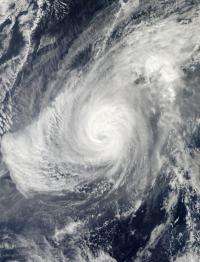
NASA's Aqua satellite's Moderate Imaging Spectroradiometer instrument captured an image of Typhoon Nida on November 30 at 4:15 UTC. The image showed the eye is now cloud-filled, one sign of a weakening storm. Credit: NASA, MODIS Rapid Response

Nida is battling to keep its typhoon strength in the Western Pacific Ocean as wind shear continues to tear at the storm and weaken it. NASA's CloudSat satellite noticed that Nida's cloud tops are not as high as they were over the weekend, and lower cloud tops mean less powerful thunderstorms.

Over the last few days, satellites have shown forecasters that Nida has zigzagged between 18 and 20 degrees North Latitude on its somewhat erratic northern track. It has moved west, then east, and now back in a westward direction on its general track north.

After a westward movement, Nida is expected to now travel to the west of the islands of Iwo To and Chichi Jima over the next several days.

On December 1 at 4 a.m. ET (0900 UTC), Nida was now a Category One typhoon, with near 86 mph (75 knots). Winds are still gusting near 100 mph near the center of the . The range for typhoon storm-force winds now extend to 45 miles from the center, while tropical storm-force winds extend up to 135 miles from the center.

Nida is located about 335 miles southwest of the island of Iwo To (formerly known as Iwo Jima), near 20.6 North and 137.3 East. Nida is still trudging along at a slow rate near 5 mph in a west-northwesterly direction, but is expected to move in a more westerly direction over the next couple of days before turning north.

NASA's Aqua satellite's Moderate Imaging Spectroradiometer (MODIS) instrument captured an image of Typhoon Nida on November 30 at 4:15 UTC. The image showed the eye is now cloud-filled, one sign of a weakening storm, and since that image, Nida had weakened from a Category Two Typhoon to a Category One storm.

Forecasters at the Joint Warning Center noted that infrared imagery like that from NASA's Atmospheric Infrared Sounder on NASA's Aqua satellite, has shown that Nida's eye has degenerated. Satellite imagery also has shown that Nida is elongating in a southwest to northeast direction, a sign that the storm can't maintain its shape and strength. Satellite imagery has also shown that dry air is entering the system, and it will wick up moisture and weaken the storm further.

NASA's CloudSat satellite gives forecasters a unique look at tropical cyclones because its Cloud Profiling Radar basically "cuts a storm in half" and looks at it from the side. What CloudSat saw in the latest imagery was that Nida's cloud tops have dropped from over 9 miles high (15 kilometers) to around 8 miles (13 kilometers) high. Those dropping cloud heights indicate that Nida doesn't have the uplift, or strong convection that it had earlier, and that's also reflected in its slowing sustained winds. There were still some areas of cloud ice (indicating highest thunderstorm tops with strongest uplift), but the areas of heavy precipitation have diminished.

Nida is expected to re-curve northeast and become an extra-tropical low within 2 to 3 days.

Source: JPL/NASA (news : web)


Rate this story - 3 /5 (1 vote)


December 1, 2009 all stories

Comments: 0

3 /5 (1 vote)

  • hide
  • Related Stories

  • NASA captures Typhoon Nida's clouds from 2 angles
    created Nov 30, 2009 | popularity not rated yet | comments 0
  • Super Typhoon Nida to pass east of Iwo To and Chichi Jima
    created Nov 30, 2009 | popularity not rated yet | comments 0
  • NASA's Aqua satellite sees Nida explode into a category 5 Super typhoon
    created Nov 25, 2009 | popularity not rated yet | comments 0
  • NASA's infrared satellite sees warmer cloud tops in Tropical Storm Marty
    created Sep 17, 2009 | popularity not rated yet | comments 0
  • Typhoon Choi-Wan swinging by Japan on weekend
    created Sep 18, 2009 | popularity not rated yet | comments 0


  • hide
  • Relevant PhysicsForums posts

  • Carbon Dioxide emissions question
    created Feb 08, 2010
  • Photosynthesis vs. carbonization
    created Feb 07, 2010
  • Sheep's footprints
    created Feb 05, 2010
  • How did Victorians estimate the ages of fossils?
    created Feb 03, 2010
  • More from Physics Forums - Earth

Other News

Rho Ophiuchus cloud

Professor: We have a 'moral obligation' to seed universe with life

Space & Earth / Astronomy

created 18 hours ago | popularity 3.2 / 5 (23) | comments 47 | with audio podcast report

(PhysOrg.com) -- Eventually, the day will come when life on Earth ends. Whether that’s tomorrow or five billion years from now, whether by nuclear war, climate change, or the Sun burning up its fuel, the last ...


Climate 'Tipping Points' May Arrive Without Warning, Says Top Forecaster

Space & Earth / Environment

created 7 hours ago | popularity 3.4 / 5 (5) | comments 5 | with audio podcast

(PhysOrg.com) -- A new University of California, Davis, study by a top ecological forecaster says it is harder than experts thought to predict when sudden shifts in Earth's natural systems will occur -- a worrisome finding ...


A new 3-D map of the interstellar gas within 300 parsecs from the sun

A new 3D map of the interstellar gas within 300 parsecs from the Sun

Space & Earth / Astronomy

created 10 hours ago | popularity 5 / 5 (4) | comments 0 | with audio podcast

(PhysOrg.com) -- Astronomy & Astrophysics is publishing new 3D maps of the interstellar gas in the local area around our Sun. A French-American team of astronomers presents new absorption measurements toward ...


38 percent of world's surface in danger of desertification

38 percent of world's surface in danger of desertification

Space & Earth / Environment

created 4 hours ago | popularity 2.3 / 5 (3) | comments 4

A team of Spanish researchers has measured the degradation of the planet's soil using the Life Cycle Assessment (LCA), a scientific methodology that analyses the environmental impact of human activities, and ...


Russian Soyuz TMA-17 rocket blasts off to the International Space Station

Russia wants to charge more for rides to space: report

Space & Earth / Space Exploration

created 21 hours ago | popularity 5 / 5 (2) | comments 5

Russia, which is set to hold a monopoly on flights to the international space station (ISS), wants to charge more for rides on its Soyuz rocket, the space agency head said Tuesday.