Bacterial gut symbionts are tightly linked with the evolution of herbivory in ants
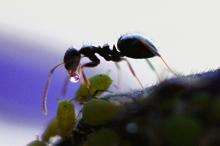
Broadly speaking, ants have two different feeding strategies. A large proportion of all species are "carnivorous," meaning that they are generalist predators feeding on other small animals or scavenging on their remains. Some, however, are "herbivorous".
This is not to say that they only eat plants; rather, the bulk of their diets consist of plant-derived matter. For example, some forage on sticky fluids produced by plants to attract ants, called extra-floral nectar; others feed on the processed plant sap excreted by plant-sucking insects such as scale insects and aphids. Herbivorous ants are likely to be a highly under-estimated component of the global fauna as there are many tropical forest canopy specialists among them, and the forest canopy remains to this day surprisingly unexplored.
It has long been a mystery how herbivorous ant species gain all the nutrients they need. Their plant-derived diet comprises essentially water and sugars; it is deficient in protein and/or the nitrogen-based compounds that are the building blocks of proteins. Carnivorous ants face few such nutritional difficulties, as their diet tends to contain all the chemical compounds they require. Most ants are not renowned for being associated with microbes—the most famous suite of on-board microbial symbionts in insects is found in termites, whose guts harbor bacteria that facilitate the digestion of the woody material that constitutes the termite diet—but it has been recently hypothesized that herbivorous ants might host a set of indigenous symbionts that provide the missing components of the herbivorous ants' diets.
We tested this hypothesis by using molecular genetic techniques to look for the presence of microbes in 283 species of ants from 18 of the 21 ant subfamilies. We were able to classify each ant species as carnivorous or herbivorous based on the amount of heavy and light nitrogen (15N/14N) within the ants' tissues. By uniting the two datasets, we were then able to determine whether microbial symbionts were particularly associated with herbivorous ants.
The short answer is, yes. Bacteria from an order called Rhizobiales tend to be present in the guts of herbivorous ants but not carnivorous ones. Remarkably, this group of bacteria is well known for containing microbes that associate with leguminous plants and are capable of nitrogen fixation—converting atmospheric nitrogen into compounds that are biologically accessible and useful. So herbivorous ants likely make up for their dietary deficiencies by hosting an on-board squadron of bacteria in their guts capable of enriching nitrogen through fixation or alternative routes.
To determine whether the observed trends of gut symbionts in herbivorous ants was confounded in some way by the ants' history, we analyzed the distribution of herbivory and gut symbionts on the ant family tree—or phylogeny—and assessed how often these had evolved. A very striking pattern emerged: herbivory has arisen multiple times in the ants, and at least five of these unrelated herbivorous lineages associate symbiotically with Rhizobiales bacteria. It, thus, seems likely that the acquisition of nutritional gut bacteria has enabled the evolution and maintenance of herbivorous, nitrogen-poor diets across the ants.
We are still just beginning to gauge the centrality of microbes in ecology, especially in systems like this one where their role has been under-appreciated. This is a good example of how microbes once again provide the missing piece of the evolutionary jigsaw puzzle.
More details:
Stable isotope analyses have shown that ants can range from 'herbivorous' species, feeding primarily on exudates produced by plants and sap-feeding insects, to 'carnivorous' species feeding primarily on insect prey or scavenged arthropods. The low level of available nitrogen in the diets of herbivorous ants has led to the hypothesis that they obtain additional nutrition from bacterial symbionts. In this paper, we test this hypothesis by surveying bacteria associated with 283 species of ants from 18 of the 21 described subfamilies to identify novel symbionts of potential nutritional significance. Using a combination of tissue dissections, experimental analyses, and molecular methods, we show that:
• Ants contain a wealth of novel bacterial lineages.
• Microbes from several ant-exclusive clades are specialized, symbiotic residents of their hosts' guts.
• Ants in the herbivorous clade Cephalotini (turtle ants) typically contain microbes from at least 5 orders, the Burkholderiales, • Pseudomonadales, Verrucomicrobiales, Xanthomonadales and Rhizobiales
• Rhizobiales have a wide distribution and are prevalent within, and almost entirely confined to, "herbivorous" ant hosts whose tissues have low ratios of heavy to light nitrogen isotopes. These ants feed primarily on nitrogen poor exudates of plants and sap-feeding insects.
• Associations between Rhizobiales and herbivorous ants have evolved independently at least 5 times.
• The symbiotic gut flora of several species of herbivorous ants contain genes involved in atmospheric nitrogen fixation (nifH), and two herbivorous genera in the Camponotini that are free of Rhizobiales instead harbor Blochmannia symbionts that have been shown to provide nutritional enrichment.
This research is significant because the discovery of multiple independent associations between Rhizobiales and herbivorous ants provides strong evidence that symbiotic bacteria have facilitated the evolution of nectar and exudate-feeding life histories in ants and their radiation into otherwise inhospitable rainforest canopy habitats, providing a novel instance of innovation through symbiosis.
Our findings should fuel further research on the nature of associations between symbionts and ants, as well as the specific mechanisms by which symbionts affect the nutritional ecologies of their host ants.
Source: Field Museum


