Shape shifters: Researchers create new breed of antennas
December 1, 2009 Shape shifters: Researchers create new breed of antennas

Enlarge

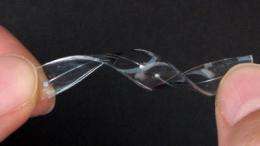
The antennas consist of liquid metal injected into elastomeric microchannels. The antennas can be deformed (twisted and bent) since the mechanical properties are dictated by the elastomer and not the metal. Credit: Ju-Hee So, North Carolina State University

(PhysOrg.com) -- Antennas aren't just for listening to the radio anymore. They're used in everything from cell phones to GPS devices. Research from North Carolina State University is revolutionizing the field of antenna design - creating shape-shifting antennas that open the door to a host of new uses in fields ranging from public safety to military deployment.

Modern antennas are made from copper or other metals, but there are limitations to how far they can be bent - and how often - before they break completely. NC State scientists have created antennas using an alloy that "can be bent, stretched, cut and twisted - and will return to its original shape," says Dr. Michael Dickey, assistant professor of chemical and biomolecular engineering at NC State and co-author of the research.

The researchers make the new antennas by injecting an alloy made up of the metals and , which remains in liquid form at , into very small channels the width of a human hair. The channels are hollow, like a straw, with openings at either end - but can be any shape. Once the alloy has filled the channel, the surface of the alloy oxidizes, creating a "skin" that holds the alloy in place while allowing it to retain its liquid properties.
Shape shifters: Researchers create new breed of antennas
Enlarge

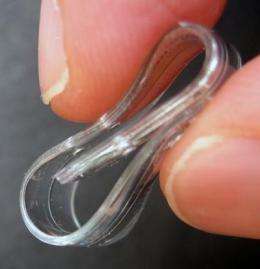
Elongating the wires by stretching changes the resonant frequency and is therefore a wireless sensor of mechanical deformation. Credit: Ju-Hee So, North Carolina State University

"Because the alloy remains a liquid," Dickey says, "it takes on the mechanical properties of the material encasing it." For example, the researchers injected the alloy into elastic silicone channels, creating wirelike antennas that are incredibly resilient and that can be manipulated into a variety of shapes. "This flexibility is particularly attractive for antennas because the frequency of an antenna is determined by its shape," says Dickey. "So you can tune these antennas by stretching them."

While the alloy makes an effective antenna that could be used in a variety of existing electronic devices, its durability and flexibility also open the door to a host of new applications. For example, an antenna in a flexible silicone shell could be used to monitor civil construction, such as bridges. As the bridge expands and contracts, it would stretch the antenna - changing the frequency of the antenna, and providing civil engineers information wirelessly about the condition of the bridge.

Flexibility and durability are also ideal characteristics for military equipment, since the could be folded or rolled up into a small package for deployment and then unfolded again without any impact on its function. Dickey thinks these new applications are the most likely uses for the new antennas, since the alloy is more expensive than the copper typically used in most consumer electronics that contain antennas.
Shape shifters: Researchers create new breed of antennas
Enlarge

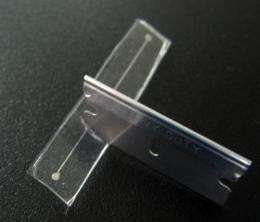
The liquid wires self-heal after being cut in half by a razor blade. Credit: Ju-Hee So, North Carolina State University

More information: The research, "Reversibly Deformable and Mechanically Tunable Fluidic Antennas," is published in Advanced Functional Materials.

Source: North Carolina State University (news : web)


Rate this story - 4.7 /5 (13 votes)

Rank Filter

Move the slider to adjust rank threshold, so that you can hide some of the comments.


Display comments: newest first

  • SincerelyTwo - Dec 01, 2009
    • Rank: not rated yet
    Indium isn't exactly cheap. :\ Let's hope we see some corrections in favor of these new techs, make the materials cheaper so the technology can become more widespread!

    Science is moving to slow, FASTER!!

    I wonder how much of a bottleneck financing is in technology, we should be wasting billions on science and not war. I'd rather see craptastic technology to increase the odds of discovering amazingly badass technology over throwing it all away in places we will never see a return.
  • Dreadneck - Dec 01, 2009
    • Rank: not rated yet
    SincerelyTwo wrote "...we should be wasting billions on science and not war."

    Apparently you are unaware that a large percentage of scientists in the world are involved in military R&D - it's where the money is at.
  • ArtflDgr - Dec 01, 2009
    • Rank: not rated yet
    ah, lack of capital is what oft prevents most good ideas from other than business today. and our new states lovely choices in helping things has made capital so scarce.
  • AdrianMiller - Dec 02, 2009
    • Rank: 5 / 5 (1)
    Hi guys, thanks for the interest in this story. If you'd like more information on the science behind it, we've set the original research paper free to access for the next few weeks; you can find it here: http://www.materi...282/TEXT

    Adrian Miller
    Advanced Functional Materials

December 1, 2009 all stories

Comments: 4

4.7 /5 (13 votes)

  • hide
  • Related Stories


  • hide
  • Relevant PhysicsForums posts

  • How to calculate section constants for rectangular tubes?
    created 1hour ago
  • how to welding thin SS foil (0.002")?
    created Feb 08, 2010
  • Civil Engineering is hazardous to your career prospects
    created Feb 06, 2010
  • hot water circulator, kitchen faucet, ? mixing
    created Feb 06, 2010
  • Static or dynamic pressures in duct
    created Feb 06, 2010
  • Nuclear Engineering in Australia??
    created Feb 06, 2010
  • More from Physics Forums - General Engineering

Other News

The power of 'random'

The power of 'random': 'Seemingly loopy' technique could dramatically improve communications networks

Technology / Computer Sciences

created 19 hours ago | popularity 4.8 / 5 (9) | comments 5 | with audio podcast

A radical new approach to the design of communications networks, called "network coding," promises to make Internet file sharing faster, streaming video more reliable, and cell-phone reception better -- among ...


'Revolutionary' water treatment units on their way to Afghanistan

Technology / Engineering

created 13 hours ago | popularity 4.4 / 5 (7) | comments 5 | with audio podcast

The United States Army has taken delivery of the first two units of a "revolutionary" waste-water treatment system that will clean putrid water within 24 hours and leave no toxic by-products, according to scientists at Sam ...


Android

Google developing a translator for smartphones

Technology / Software

created 20 hours ago | popularity 4.8 / 5 (9) | comments 3 | with audio podcast report

(PhysOrg.com) -- Google is developing a translator for its Android smartphones that aims to almost instantly translate from one spoken language to another during phone calls.


Imec and Holst Centre achieve breakthrough in battery-less radios

Imec achieves breakthrough in battery-less radios

Technology / Semiconductors

created 14 hours ago | popularity 4.9 / 5 (14) | comments 1 | with audio podcast

At today's International Solid State Circuit Conference, Imec and Holst Centre report a 2.4GHz/915MHz wake-up receiver which consumes only 51µW power. This record low power achievement opens the door to battery-less ...


In Utah, company aims to store energy in air

Technology / Energy

created 23 hours ago | popularity 3.4 / 5 (10) | comments 2

A Utah company plans to dig a series of underground caverns that it hopes to one day fill with compressed air, releasing it to generate electricity by turning a turbine and solving one of the most vexing problems facing the ...