Mathematical model of a simple circuit in a chicken brain raises fundamental questions
December 1, 2009 By Diana Lutz
A mathematical model of a simple circuit in a chicken brain raises fundamental questions about our understanding of neural circu

Enlarge

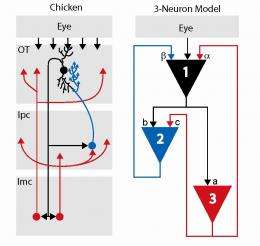
Model circuit (right) duplicates the anatomy of the chicken microcircuit studied in Ralf Wessel's WUSTL lab (left). The complexity of the neuron's response arises from feedback loops in the circuit.

(PhysOrg.com) -- The Web site Neuroanthropology asks visitors to complete this quote, "One of the difficulties in understanding the brain is ...". In addition to the typical facetious remarks, such as "so few of us seem to have one" and "the damn thing is smart enough to realize what you are doing, and contrary enough to change the way it reacts just to spite you...," there are more serious ones, such as "... it's not a computer" and the methods we have available "are not enough accurate in saying how neural mechanisms correlates to behavior."

That's it in a nutshell. On the one hand, there are the individual whose membrane depolarization is at the basis of everything and on the other hand, there's lyric poetry, serial murder and the calculus. In between there are hundreds of billions of nerve cells, with hundreds of trillions of connections. Scientists understand the bottom end and can say useful things about the top end, but getting from one end to the other is another story.

As they try, they argue continually and sometimes bitterly about levels of abstraction. If a model of the brain or part of the brain doesn't abstract at all, it is quickly snarled in unintelligible complexity. On the other hand, if it abstracts too much, it offers little insight into the organ it purports to represent.

In work published in the online edition of Physical Review E on November 25th, biophysicists and theoretical physicists at Washington University in St. Louis describe an elegant compromise. They devised a simple that accurately represents a three-cell microcircuit in a chicken's brain. They then found, to their surprise, that they could collapse their model mathematically to one equation with two parameters, which are derived from but not the same as the strength of the connections between neurons (the synaptic strength) that neural models usually emphasize.

This mathematical exploration raises interesting questions about the living microcircuit in the chicken's tiny skull, such as how embryonic development wires it up in the first place. It may also explain why it is difficult to understand the brain by measuring the strength of its synaptic connections in the lab.

Lobster stomachs and chicken eyes

Neuroscientists have tried all sorts of different combinations of fidelity and abstraction in their efforts to understand the brain, but one fruitful approach has been to analyze a microcircuit consisting of a few neurons all of whose interconnections can be traced.

Microcircuits that have been analyzed in this way include the network that controls the chewing rhythm of a lobster's stomach (yes, it has teeth in its stomach), the reflex arc that allows a fruit fly to dodge a fly swatter and the timing network that controls the heartbeat of a medicinal leech.

Looking for a way to explain to the students in his Physics of the Brain class how delayed feedback produces complexity in a circuit, Ralf Wessel, Ph.D., associate professor of physics in Arts & Sciences, came up with a toy neural circuit simple enough to be stepped through time iterations at the blackboard. He used it to show his students that if there was feedback among the neurons, simple constant inputs could produce a long-period oscillation in their outputs.

Wessel then asked Matthew S. Caudill, Ph.D., graduate research assistant in physics, to create a computer model of the circuit so that it could be explored more thoroughly. As they worked with three-neuron microcircuit they realized it was very like one students in Wessel's neurophysiology lab were studying.

That circuit, which consists of three neurons and their feedback projections, has a simple task: to detect motion in the chicken's field of view. One neuron in the area called the optic tectum because it sits on the "roof" of the brain, sends axons to others in a knob of tissue called the nucleus isthmi. The neurons in the isthmi send projections back to the optic tectum, either directly to the neuron from which they got their input or back to the rest of the tectum (the crucial feedback loops).

There are similar microcircuits in the optical processing areas of reptilian and mammalian brains.

The microcircuit's behavior could be captured mathematically by three equations, each of which describes one neuron's output in terms of its inputs and parameters called synaptic weights, the standard way of expressing the strength of the connection between two neurons. Looking at the equations, Wessel and Caudill recognized that they could be reduced by algebraic substitution to one equation with two parameters (derived from the original five synaptic weights).

"It is as if," says Caudill, "the system of three neurons was reduced to one abstract neuron that does the same thing, follows the same rule, as the more complicated circuit. "
A mathematical model of a simple circuit in a chicken brain raises fundamental questions about our understanding of neural circu
Enlarge

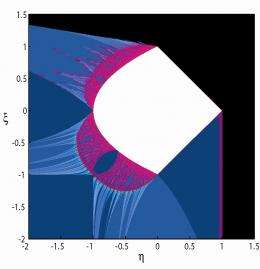
Because the model of the circuit collapsed to one equation with two parameters, the scientists were able to easily visualize its solutions. Oscillatory solutions are shown in blue and purple, steady value solutions are white and divergent solutions, where the activity steadily increases, are shown in black. The circuit is probably stuck in the white region most of the time but the fans of periodic solutions may also be useful biologically.

A Beautiful Parameter Space

This was an elegant outcome because all the possible solutions of an equation with two parameters can be mapped on a plane — which is what they did next, with the help of Zohar Nussinov, Ph.D., assistant professor of physics in Arts & Sciences.

When the output of the abstract neuron is mapped in the parameter space it looks like a colorful angelfish swimming in a black ocean.

"The blue regions are where the output is oscillating, the large white region is where it just goes to a steady value, and the black region is where the output diverges, or steadily increases," says Caudill. "The fans are areas where the period of oscillation changes quickly from one point to the next."

If you zoom in on the fans, Nussinov adds, the parameter space reveals more structure. Each time you zoom in, even more structure appears.

But what does this mean for the chicken? Why might an animal want a circuit to be stable most of the time but oscillate at others?

Weakly electric fish, says Wessel, have neural networks whose output oscillates in response to stimuli that affect the animal's whole body but is constant when the fish is touched in one spot (as it might be by the fin of a prey fish). The change in output allows the fish to distinguish instantly between global and local touch.

But Wessel is most interested in the way the work de-emphasized individual synaptic weights — even to the point of suggesting that focusing on these weights has gotten in the way of understanding brain function.

"Imagine you're an embryo and your brain is growing, he says, and the synaptic weights are being established. The brain doesn't need to establish the synaptic weights for each individual synapse in isolation. What it needs to establish is the combination of weights." But then he adds ruefully, "although how it would do that is not clear."

The finding also suggests why it might be difficult to achieve insight into neural circuits in the lab. Neurophysiologists probing neuronal circuits by inserting a glass electrode in one neuron, stimulating it, and recording the electrical activity of another neuron are likely to be baffled by physiological variations from animal to animal. The chicken microcircuit suggests that to understand a neural circuit they would have to measure combinations of synaptic weights. But the catch is they can't know which ones to measure unless they already know the rule the circuit follows.

What do the three scientists, who have simplified their microcircuit to the equivalent of one neuron, think of the Blue Brain project, an attempt funded by the Swiss government to create a synthetic brain by the brute force method of simulating roughly a million biologically realistic neurons with the help of a supercomputer?

Wessel says that perhaps the microcircuit is the orange clownfish Marlin and the Blue Brain is the blue regal tang Dory and together they are searching for Nemo: an understanding of how consciousness emerges from the soggy three-pound mass of nerve and glial cells we call the .

As you can tell, he has young children.

Provided by Washington University in St. Louis (news : web)

4.6 /5 (28 votes)  

Filter


Move the slider to adjust rank threshold, so that you can hide some of the comments.


Display comments: newest first

SincerelyTwo
Dec 01, 2009

Rank: 2.5 / 5 (6)
recursive models clearly guide the complexities of the mind. our children are born of simple materials we consume, from that point on it only grows more complex over time. i am confident science will expose consciousness as a natural phenomena of information. i think what allows us to realize ourselves is our ability to use our senses to detect ourselves. every mechanism is there and understandable, we only need to continue researching how these systems are initiated in nature and shelter those organisms as they grow.

i'm confident we will be able to create conscious beings. memristors look like a good starting point for exploring more complex ai.
VOICEOFTRUTH
Dec 01, 2009

Rank: 4 / 5 (5)
One of the difficulties in understanding the brain is not udestading what consciosness is
SincerelyTwo
Dec 01, 2009

Rank: 1.3 / 5 (4)
VOICEOFTRUTH,

What I'm talking about is creating an artificial mind which displays the thinking behaviors of conscious beings.

I guess you didn't read the article, because that's exactly the point of all of this.

(as for *what consciousness *is... my money is on something that will be demonstrated as an information phenomena, as opposed to spiritual in nature. but that's aside my comment above which actually summarizes the article anyway. ... pay attention.)
googleplex
Dec 01, 2009

Rank: 5 / 5 (5)
So when one hypnotizes a chicken with that trick hand motion is one putting its neurons into a devergent feedback loop. Perhaps one has put the chickens brain into a divergent state to which it never converges to a simple solution. It would be interesting to do a timeseries of MRIs on a chuck brain to determine if it has simply crashed or is stuck in an crazy feedback loop.
Highlander
Dec 01, 2009

Rank: 4.8 / 5 (5)
SincerelyTwo,
WTF? Kudos on the fluff. I especially like that gem concerning metabolism and reproduction. How dare you denigrate a fellow poster without writing anything of substance in either of your posts?

VoiceOfTruth is closer to the mark than you are... at least with regard to consciousness. It's both misunderstood and ill-defined (and a little too broad to be relevant to this article).

The significance of this research lies in the fact that it represents a shift in paradigm from computational models dependent on individual synaptic weights (complicated), to a broader model derived from the overarching 'rule' a circuit follows (less complicated). If we know the rule, we can simplify the math. The limiting factor in the past has been the complexity of the model if synaptic weights are treated independently- each synapse represented by a unique equation, the inputs/ouputs of which are extremely dynamic- and all of the above irritatingly augmented by feedback loops.
Smellyhat
Dec 01, 2009

Rank: not rated yet
Anyways, kudos to Diana Lutz for producing a really quite decently written science article, much superior to our usual fare. Don't think we didn't notice the effort!
PauloFalcao
Dec 01, 2009

Rank: 5 / 5 (3)
"If you zoom in on the fans, Nussinov adds, the parameter space reveals more structure. Each time you zoom in, even more structure appears."
Fractal?!
http://en.wikiped.../Fractal
Ober
Dec 01, 2009

Rank: 5 / 5 (2)
Of course it's Fractal!!!
When you feed the outputs back into the inputs you get fractals!!!!
magpies
Dec 01, 2009

Rank: 2.5 / 5 (2)
Heh I don't think they get what a mind is yet.
SincerelyTwo
Dec 02, 2009

Rank: 2.7 / 5 (3)
I have a right to speculate, as you do in assuming consciousness is ill-defined. The circuits expressed in the article demonstrate the computational models that can give rise to an extremely high degree of complexity. It's on this basis I make the assertion that consciousness may likely be shown to be a natural phenomena of specific information processing models|configurations.

If you find that too difficult to understand, then the problem may be you're afraid to accept the idea things may be simplier than *you *like.

If it exists and it's something we can experience or interact with, then it must be something that can be described and ties back to reality.

We are just an organic mass with sensors, the complexities of intention and awareness are obviously something defined within that mass, and that mass was initiated from little else than some DNA.

Suck on that fluff.
chelbos
Dec 02, 2009

Rank: 5 / 5 (1)
Basically ur saying that we are complex computers acting based on past conditioning. So we are a reference to a reference to a reference ... to what? Based on this assumption where is the free will coming from?
SincerelyTwo
Dec 02, 2009

Rank: 1 / 5 (2)
chelbos, study complexity, recursive processing models, hell just study discrete mathematics and logic in general. I can't afford the time to educate you, if you actually care start with the basics and move up.

http://en.wikiped...ue_brain

"It is hoped that it will eventually shed light on the nature of consciousness."

Blue Brain, as cited int he article, has every intention to discover what it is I think they will discover.

I've been working to hardware accelerate some ANN's to experiment and explore some basic aspects of how meta-rules and memory could form. The usual way people react to the things I say seems to mock or distort what I write with some weird ass interpretations, but that doesn't make you correct about any thing. >:]
chelbos
Dec 02, 2009

Rank: 3.3 / 5 (3)
I hope they will find from where consciousness arises.
My intention was not to be against the research, but to make you question yourself what's consciousness, you have it, so you should be able to look into it. Recently I've been interested into what awareness is and science has field for now to bring light over this subject. So the only way to look was to some people that took that in their hands and went till the bottom of it ... and I'm not talking here about religion, even if some may think so. I would say take this with an open mind and don't be limited by ur knowing. Take a look at this video with an open mind: http://www.youtub...hjLaspIo
SkepticalOptimist
Dec 02, 2009

Rank: not rated yet
Very interesting and tantalizing news. To speculate a bit on consequences that could emerge from achieving analytical understanding of human brain operation (not a given):

- psychology could become a hard science
- fundamental understanding of many mental illnesses
- ability to measure mental health (or even verify effectiveness of cure)
- much more human like AI (it may pass Turing test)

Whether we as a society will accept this analytical description of mind/soul is another matter - probably not within our lifetime. Of course, we will readily embrace any technological benefits originating from this understanding without questions.
chelbos
Dec 02, 2009

Rank: 4 / 5 (1)
the minute they will be able to measure mental health we will find out that we are all crazy :D
that would be a nice application
otto1923
Dec 05, 2009

Rank: 4 / 5 (1)
What I'm talking about is creating an artificial mind which displays the thinking behaviors of conscious beings
You would have to give it a sense of self-preservation and the ability to sense threats to it's well-being. Most of what we call consciousness can be reduced to concerns about the defense of this container of ours, and of it's prospects for reproduction. The consciousness or self-awareness of a machine without these concerns may be unrecognizable as such.
BenRayfield
Dec 06, 2009

Rank: not rated yet
"if there was feedback among the neurons, simple constant inputs could produce a long-period oscillation in their outputs."

"three neurons was reduced to one abstract neuron that does the same thing, follows the same rule, as the more complicated circuit."

some abstractly defined (I don't completely understand how to define it) group of neurons in my brain does not allow as much reverse information flow because I choose for the idea it represents to never change, to be "closed minded" about that one thing because I know it is true and do not want to lose that correct knowledge. An example of that knowledge is "5 * 7 = 35". There will be some reverse information flow so other patterns and groups of neurons can learn to use "5 * 7 = 35" or learn not to use it or learn new ways to use it, but the point is I can choose for my neurons that represent "5 * 7 = 35" to have more or less reverse feedback.

Longer comment at:
http://www.kurzwe...D=167266
Rank 4.6 /5 (28 votes)
Relevant PhysicsForums posts
  • Physical laws .... are they material?!!
    created1 hour ago
  • increasing time of daylight
    created1 hour ago
  • Light & Sight
    created2 hours ago
  • Wind Turbine Power
    created5 hours ago
  • Steam Table issues
    created7 hours ago
  • electrostatic induction in a conductor should be immpossible
    created10 hours ago
  • More from Physics Forums - General Physics

More news stories

Putting the squeeze on planets outside our solar system

(PhysOrg.com) -- Using high-powered lasers, scientists at Lawrence Livermore National Laboratory and collaborators discovered that molten magnesium silicate undergoes a phase change in the liquid state, abruptly ...

Physics / Condensed Matter

created 29 minutes ago | popularity not rated yet | comments 0 | with audio podcast

Hovering not hard if you're top-heavy, researchers find

Top-heavy structures are more likely to maintain their balance while hovering in the air than are those that bear a lower center of gravity, researchers at New York University's Courant Institute of Mathematical Sciences ...

Physics / General Physics

created 1 hour ago | popularity 5 / 5 (1) | comments 1 | with audio podcast

SLAC, Stanford team focuses on high-energy electrons to treat cancer

Accelerator physicists at SLAC and cancer specialists from Stanford are working on a new technology that could dramatically reduce the time needed for cancer radiation treatments. The team ran an initial experiment ...

Physics / General Physics

created 4 hours ago | popularity 5 / 5 (1) | comments 0

Measurements from high-energy collisions lead to better understanding of why meson particles disappear

For several years, physicists at the Relativistic Heavy Ion Collider (RHIC) at Brookhaven National Laboratory (BNL), USA, have studied an unusual state of matter called the quark–gluon plasma, which they ...

Physics / General Physics

created 5 hours ago | popularity 5 / 5 (1) | comments 0

Quantum physicist explains $100K offer for proof scaled-up quantum computing is impossible

(PhysOrg.com) -- MIT researcher Scott Aaronson has certainly riled the physics community with his offer this past Friday, of $100,000 to anyone who can prove that scaled-up quantum computing is impossible. ...

Physics / Quantum Physics

created Feb 08, 2012 | popularity 4.1 / 5 (11) | comments 32 | with audio podcast weblog


Employers feel no love for unscrupulous practice of 'service sweethearting'

A new study led by two Florida State University marketing professors finds that some frontline service employees who are rewarded for hikes in customer loyalty and satisfaction also may engage in "service ...

US issues guidelines to avoid heparin contamination

Four years after US drug-maker Baxter International's blood thinner heparin was contaminated in China, causing dozens of deaths, US regulators on Friday issued draft guidelines for safe production.

Expat French get Internet vote for first time

French citizens will for the first time this year be able to vote in a parliamentary election over the Internet, an experiment that could be extended to other elections if successful.

"Twisted Metal" gamers get shot at real gunplay

Fans of "Twisted Metal" will get to welcome a long-awaited sequel of the car-battle videogame with a real-world bang by blasting an ice cream truck to bits with a machine gun.

The power of estrogen -- male snakes attract other males

A new study has shown that boosting the estrogen levels of male garter snakes causes them to secrete the same pheromones that females use to attract suitors, and turned the males into just about the sexiest ...

New error-correcting codes guarantee the fastest possible rate of data transmission

Error-correcting codes are one of the triumphs of the digital age. They’re a way of encoding information so that it can be transmitted across a communication channel — such as an optical fiber o ...