Down Syndrome becoming more prevalent in the U.S.
December 2, 2009 by Lin Edwards weblog
Down Syndrome

Enlarge

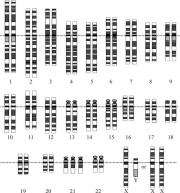
Karyotype for trisomy Down syndrome. Notice the three copies of chromosome 21. Courtesy: National Human Genome Research Institute

(PhysOrg.com) -- A new study, aimed at estimating the prevalence of Down Syndrome in newborns, children and teenagers in 10 areas of the U.S., has found an increase in prevalence of more than 30 percent over the last 24 years.

Down syndrome is a condition in which the person has an extra , and is often associated with and other problems such as heart abnormalities.

The major part of the study, by Dr Mikyong Shin and colleagues, was a cross-sectional analysis of live births from 1979 to 2003. The researchers analyzed data from 10 population-based registries of in 10 regions of the U.S., along with data for children from 0 to 19 years old, and calculated the prevalence of Down Syndrome for newborns, children and teenagers in each of the areas and in the total pool.

The data were also analyzed for the prevalence of Down Syndrome in specific , for each gender, for different ethnic and racial groups, and for association with heart defects.

The researchers found an increase in prevalence of Down Syndrome at birth over the period from 9.0 to 11.8 per 10,000 live births, which represents an increase of 31.1%. The pooled data of 0-19-year-olds also indicated a higher prevalence in white non-Hispanic people than in black non-Hispanic people. More males than females were affected in all groups. The prevalence rose over time in each age group, but decreased with age within the birth cohorts.

The prevalence of Down Syndrome babies increased significantly with the age of the mother, with 7.8 per 10,000 born to mothers under 35, and 38.6 per 10,000 for mothers 35 or older. Maternal age has long been known to be a risk factor for Down Syndrome, and many researchers are trying to find out the specific reason for this.

Overall, the study found the prevalence of Down Syndrome at birth is increasing, and so are survival rates. In 1983 the median age at death was 25, while in 1997 it had climbed to 49.

The findings of the study may have implications for the allocation of resources for Down Syndrome patients in the future because sufferers often have associated conditions such as vision problems and congenital heart defects, which means they can require a high degree of care.

The findings in the U.S. are not reflected in the U.K., where a recent study found the prevalence remains steady. This was attributed to terminations of pregnancies after screening and diagnosis. Without the terminations, the prevalence would also have increased in the U.K., since after a positive diagnosis around 92 percent of the pregnancies were terminated. Data available for California suggests the equivalent figurer there is 60 percent.

The U.S. paper was published online in the Pediatrics journal on November 30, and will appear in the December issue of the print edition.

More information: Prevalence of Among Children and Adolescents in 10 Regions of the United States, PEDIATRICS Vol. 124 No. 6 December 2009, pp. 1565-1571; doi:10.1542/peds.2009-0745

© 2009 PhysOrg.com

4.7 /5 (9 votes)  

Filter


Move the slider to adjust rank threshold, so that you can hide some of the comments.


Display comments: newest first

ArtflDgr
Dec 02, 2009

Rank: 3.4 / 5 (5)
Feminism drives womens mating choices in the modern era, and so they tell the girls that its just as good having a kid late in life than it is having one in the prime of life.

end result is that their policy results in a marked increase in downs and other genetic problems, a decrease in population fecundity (along race line as sanger wanted), extinction of family lines, impovrishment of children, early menses and precocious behavior, and other things (we are not supposed to face, think of, or recognize, discuss, or even contemplate this. so shhhhhh. dont tell)

as the age of birthing increases do to social engineering, the quality of genetic stock in the population declines due to policies who deny any such effects.

Rick69
Dec 02, 2009

Rank: 3.3 / 5 (3)
Why didn't this story provide a more direct comparison between the average age of mothers now versus the average age of mothers 24 years ago? That seems to be where it was heading but it didn't answer the question.
CarolinaScotsman
Dec 02, 2009

Rank: not rated yet
Another recent study seemed to show there's more of a connection with the age of the father than of the mother. As men age, the quality of their sperm decreases. As there is no definitive answer at this time, research should be directed in both directions.
otto1923
Dec 03, 2009

Rank: not rated yet
@artfldgr
Right you are. Women are encouraged to put education and career before marriage and family. Women instinctively know that the dangers of reproduction increase with age. This greatly reduces the window in which women are willing to conceive. The result? First gen immigrants have more opportunity to grow the large families they dreamed of back home, thereby adding to the rich genetic mix that was America and is now the greater western world; and helping to approach demographic goals set by the Shepherds of us all. The ultimate goal is of course a rate of growth in keeping with the means to sustain it; in order to accomplish this women have to be given something to do more seemingly satisfying than the thing that they were designed for, ie making babies.
Rank 4.7 /5 (9 votes)
Relevant PhysicsForums posts

More news stories

Team isolates nerve cells involved in storing long term memory and gene proteins associated with them

(Medical Xpress) -- A research team in Taiwan has succeeded in isolating two nerve cells in fruit fly brains that are believed to be the major players in allowing for the formation of long term memories. Furthermore, ...

Medicine & Health / Neuroscience

created 55 minutes ago | popularity 5 / 5 (3) | comments 0 | with audio podcast report

News of plaque-clearing drug tops week of major advances against Alzheimer's disease

In the last eight days, scientists have delivered a powerful one-two punch in the fight to defeat Alzheimer's disease. At the same time, the White House and members of Congress are proposing increases in Alzheimer's research ...

Medicine & Health / Diseases

created 51 minutes ago | popularity not rated yet | comments 1

To avoid early labor and delivery, weight and diet changes not the answer

One of the strongest known risk factors for spontaneous or unexpected preterm birth – any birth that occurs before the 37th week of pregnancy, most often without a known cause – is already having had one. For women ...

Medicine & Health / Health

created 4 minutes ago | popularity not rated yet | comments 0 | with audio podcast

Joint patent for using the BRCA1 gene as a therapy for cardiovascular disease

St. Michael's Hospital and King Saud University have received their first joint U.S. patent to use the BRCA1 gene as a therapy for cardiovascular disease.

Medicine & Health / Genetics

created 20 minutes ago | popularity not rated yet | comments 0

S.Africa in $208 mln AIDS drug venture with Swiss Lonza

South Africa on Friday unveiled plans for a 1.6 billion rand ($208 million, 157 million euro) pharmaceutical plant, in a joint venture with Swiss biochemicals group Lonza to produce anti-AIDS drugs.

Medicine & Health / HIV & AIDS

created 1 hour ago | popularity not rated yet | comments 0


The power of estrogen -- male snakes attract other males

A new study has shown that boosting the estrogen levels of male garter snakes causes them to secrete the same pheromones that females use to attract suitors, and turned the males into just about the sexiest ...

Could Venus be shifting gear?

(PhysOrg.com) -- ESA’s Venus Express spacecraft has discovered that our cloud-covered neighbour spins a little slower than previously measured. Peering through the dense atmosphere in the infrared, the ...

Experts reveal how plants don't get sunburn

(PhysOrg.com) -- Experts at the University of Glasgow have discovered how plants survive the harmful rays of the sun.

Fool's gold may prove an unlikely alternative to overexploited catalytic materials

Catalytic materials, which lower the energy barriers for chemical reactions, are used in everything from the commercial production of chemicals to catalytic converters in car engines. However, with current catalytic materials ...

SLAC, Stanford team focuses on high-energy electrons to treat cancer

Accelerator physicists at SLAC and cancer specialists from Stanford are working on a new technology that could dramatically reduce the time needed for cancer radiation treatments. The team ran an initial experiment ...

Unpicking HIV’s invisibility cloak

Drug researchers hunting for alternative ways to treat human immunodeficiency virus (HIV) infections may soon have a novel target—its camouflage coat. HIV hides inside a cloak unusually rich in a sugar ...