Balancing protein intake, not cutting calories, may be key to long life
December 2, 2009
Balancing protein intake, not cutting calories, may be key to long life

Enlarge

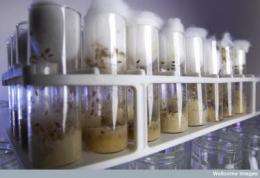
Rows of jars containing Drosophila, also known as fruitflies, being bred in laboratory conditions. As Drosophila can be bred easily in mass and have a short lifespan, scientists frequently use them in research, particularly in the study of genes. Credit: Wellcome Library, London

Getting the correct balance of proteins in our diet may be more important for healthy ageing than reducing calories, new research funded by the Wellcome Trust and Research into Ageing suggests.

The research may help explain why 'dietary restriction' (also known as ) - reducing whilst maintaining sufficient quantities of vitamins, minerals and other important nutrients - appears to have health benefits. In many organisms, such as the fruit fly (drosophila), mice, rats and the , these benefits include living longer. Evidence suggests that dietary restriction can have health benefits for humans, too, though it is unclear whether it can increase longevity.

Dietary restriction can have a potentially negative side effect, however: diminished fertility. For example, the female fruit fly reproduces less frequently on a low calorie diet and its litter size is reduced, though its reproductive span lasts longer. This is believed to be an evolutionary trait: in times of famine, essential nutrients are diverted away from reproduction and towards survival.

To understand whether the health benefits of dietary restriction stem from a reduction in specific nutrients or in calorie intake in general, researchers at the Institute of Healthy Ageing, UCL (University College London), measured the effects of manipulating the diet of female . The results of the study are published today in the journal Nature.

The fruit flies were fed a diet of yeast, sugar and water, but with differing amounts of key nutrients, such as vitamins, lipids and . The researchers found that varying the amount of amino acids in the mixture affected and fertility; varying the amount of the other nutrients had little or no effect.

In fact, when the researchers studied the effect further, they found that levels of a particular amino acid known as methionine were crucial to maximising lifespan without decreasing fertility. Adding methionine to a low calorie diet boosted fertility without reducing lifespan; likewise, reducing methionine content in a high calorie diet prolonged lifespan. Previous studies have also shown that reducing the intake of methionine in rodents can help extend lifespan.

"By carefully manipulating the balance of amino acids in the diet, we have been able to maximise both lifespan and fertility," explains Dr Matthew Piper, one of the study authors. "This indicates that it is possible to extend lifespan without wholesale dietary restriction and without the unfortunate consequence of lowering reproductive capacity."

Amino acids are the building blocks of life as they form the basis of proteins. Methionine is one of the most important amino acids at it is essential to the formation of all proteins. Whilst proteins are formed naturally in the body, we also consume proteins from many different food types, including meat and dairy products, soy-derived food such as tofu, and pulses. The relative abundance of methionine differs depending on the food type in question; it occurs in naturally high levels in foods such as sesame seeds, Brazil nuts, wheat germ, fish and meats.

"In the past, we have tended to think that the amount of protein is what is important to our diet," says Dr Piper. "We've shown here that in flies - and this is likely to be the case for other organisms - the balance of amino acids in the diet can affect health later in life. If this is the case for humans, then the type of protein will be more important.

"It's not as simple as saying 'eat less nuts' or 'eat more nuts' to live longer - it's about getting the protein balance right, a factor that might be particularly important for high protein diets, such as the Atkins diet or body builders' protein supplements."

Because the effects of dietary restriction on lifespan appears to be evolutionarily conserved - occurring in organisms from yeast to monkeys - scientists believe that the mechanisms may also be conserved. This opens up the possibility of using these organisms as models to study how works.

Although the human genome has around four times the number of genes as the fruit fly genome, there is a close relationship between many of these genes. Since it is easy to create mutants and carry out experiments on fruit flies, the functions of many fly genes have been established and newly discovered human genes can often be matched against their fly counterparts. Therefore, even though the fruit fly does not on the surface resemble humans, many findings about its basic biology can be interpreted for human biology.

Source: Wellcome Trust (news : web)

4.8 /5 (18 votes)  

Filter


Move the slider to adjust rank threshold, so that you can hide some of the comments.


Display comments: newest first

nanotech_republika_pl
Dec 02, 2009

Rank: 5 / 5 (1)
"In the past, we have tended to think that the amount of protein is what is important to our diet," says Dr Piper. "We've shown here that in flies - and this is likely to be the case for other organisms..."

I looked up the Methionine on Wikipedia and at the end it refers to another paper published 4 years ago that shows "Methionine restriction without energy restriction extends mouse lifespan." So.... it is not just _likely_ but it _was shown_ for mice.
nevermark
Dec 02, 2009

Rank: not rated yet
Where do I get my Methionine free meat?
CarolinaScotsman
Dec 02, 2009

Rank: not rated yet
The article at http://www.fighta...mals.php goes into more detail about the effects of methionine.
psommerfeld
Dec 03, 2009

Rank: not rated yet
Why would they extrapolate from the diet of a fruit fly (which seem to eat lots of fruit and very little protein to begin with) to the diet of humans? It's as if, after doing studies on dogs eating chocolate, it's determined that chocolate is highly detrimental, so humans should not eat chocolate.
wiserd
Dec 03, 2009

Rank: not rated yet
psommerfeld - The trait seems conserved in other animals, including mice, as other commenters mentioned.
Rank 4.8 /5 (18 votes)
Relevant PhysicsForums posts
  • Is Everyday Technology Killing Us?
    createdFeb 08, 2012
  • Exercise and weight loss
    createdFeb 08, 2012
  • Why do we have head aches? Our brains can't feel anything.
    createdFeb 07, 2012
  • "The end of diseases" by David Agus, interview from Daily Show with Jon Stewart
    createdFeb 04, 2012
  • Oncolytic adenovirus
    createdFeb 04, 2012
  • Nutrition label stuffs and diets
    createdFeb 02, 2012
  • More from Physics Forums - Medical Sciences

More news stories

Seeing colors in music, tasting flavors in shapes may happen in life's early months

Famed violinist Itzhak Perlman sees a deep forest green whenever he plays a B-flat on his Stradivarius' G string. The A on the E string is red.

Medicine & Health / Psychology & Psychiatry

created 42 minutes ago | popularity 5 / 5 (1) | comments 0 | with audio podcast

Study suggests girls can 'rewire' brains to ward off depression

(Medical Xpress) -- What if you could teach your brain to respond differently to things that make you feel sad, down or stressed out? What if doing that helped ward off depression?

Medicine & Health / Psychology & Psychiatry

created 1 hour ago | popularity 5 / 5 (1) | comments 0

UNC investigator issues call to action for schizophrenia research

(Medical Xpress) -- Much of medical research is aimed at figuring out what role a single gene or molecule plays in the development of disease.

Medicine & Health / Psychology & Psychiatry

created 1 hour ago | popularity 5 / 5 (1) | comments 0

What does love look like?

What does love look like? A dozen roses delivered on an ordinary weekday? Breakfast in bed? Or just a knowing glance between lovers?

Medicine & Health / Psychology & Psychiatry

created 1 hour ago | popularity not rated yet | comments 0

Numeracy: The educational gift that keeps on giving?

(Medical Xpress) -- Cancer risks. Investment alternatives. Calories. Numbers are everywhere in daily life, and they figure into all sorts of decisions. A new article published in Current Directions in Psychological Science, a journal of the Association for Psychological Science, examin ...

Medicine & Health / Psychology & Psychiatry

created 56 minutes ago | popularity not rated yet | comments 0 | with audio podcast


Mars Science Laboratory computer issue resolved

(PhysOrg.com) -- Engineers have found the root cause of a computer reset that occurred two months ago on NASA's Mars Science Laboratory and have determined how to correct it.

Advanced power-grid model finds low-cost, low-carbon future in West

(PhysOrg.com) -- The least expensive way for the Western U.S. to reduce greenhouse gas emissions enough to help prevent the worst consequences of global warming is to replace coal with renewable and other ...

Small modular reactor design could be a 'SUPERSTAR'

(PhysOrg.com) -- Though most of today's nuclear reactors are cooled by water, we've long known that there are alternatives; in fact, the world's first nuclear-powered electricity in 1951 came from a reactor ...

Clam fields found at deep, low-temperature Mariana vents

(PhysOrg.com) -- Scientists have marveled at the unusual life forms thriving at high temperature hydrothermal vents of the deep ocean.

Could Venus be shifting gear?

(PhysOrg.com) -- ESA’s Venus Express spacecraft has discovered that our cloud-covered neighbour spins a little slower than previously measured. Peering through the dense atmosphere in the infrared, the ...

The question of life in the ancient world

There’s a general feeling that we don’t get the Greeks – ancient or modern. Many, including heads of state like Angela Merkel, visibly shake their head in exasperation, rightly or wrongly, at ...