Newly discovered star one of hottest in Galaxy (w/ Video)
December 2, 2009
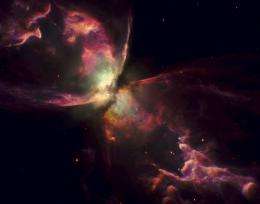
Image of the Bug Nebula taken with the new Wide Field Camera 3 on the Hubble Space Telescope. Credit: Anthony Holloway, JBCA.
(PhysOrg.com) -- Astronomers at The University of Manchester's Jodrell Bank Centre for Astrophysics have discovered one of the hottest stars in the Galaxy with a surface temperature of around 200,000 degrees - 35 times hotter than the Sun.
Despite numerous attempts by astronomers across the world, the mysterious dying star at the heart of the Bug nebula - one of the brightest and most beautiful of the planetary nebulae - has never been seen before.
"This star was so hard to find because it is hidden behind a cloud of dust and ice in the middle of the nebula", explained Professor Albert Zijlstra from The University of Manchester.
This video is not supported by your browser at this time.
The images in this video were taken with the UK Schmidt Telescope (wide-field, monochrome) and the Hubble Space Telescope (central nebula, colour). Credit: Tim O'Brien & Anthony Holloway, University of Manchester.
"Planetary nebulae like the Bug form when a dying star ejects much of its gas back into space and are among the most beautiful objects in the night sky.""Our own Sun will do this in about 5 billion years time. The Bug nebula, which is about 3500 light years away in the constellation Scorpius, is one of the most spectacular of all planetary nebulae."
Using the recently refurbished Hubble Space Telescope (HST), a team of astronomers led by Professor Zijlstra have shed new light on the nebula with a set of spectacular images.
The images were taken to show off the new improved HST after it began work again in September this year and will be published in the Astrophysical Journal next week.
The Manchester astronomers were amazed to find that the images unexpectedly revealed the missing central star.
Cezary Szyszka, lead author on the paper and a research student at the University of Manchester currently working at the European Southern Observatory, said: "We are extremely lucky that we had the opportunity to catch this star near its hottest point, from now on it will gradually cool as it dies. This is truly an exceptional object."
Professor Zijlstra added: "It's extremely important to understand planetary nebulae such as the Bug Nebula, as they are crucial to understanding our own existence on Earth".
That is because the elements necessary for life, especially carbon, are created inside stars, and ejected into space as part of these planetary nebulae.
Planets such as the Earth form from small dust particles, which also form within planetary nebulae. The cloud of dust and ice in the Bug Nebula contains the seeds of a future generation of planets."
Finding the star was made possible by the Space Shuttle's final servicing mission of the HST, earlier this year. During the mission, astronauts installed the new Wide Field Camera 3 which was used to take these images.
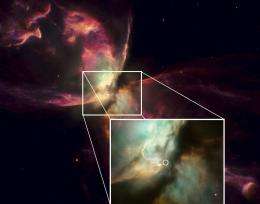
Image of the Bug Nebula with zoomed in section showing the newly discovered central star. Credit: Anthony Holloway & Tim O'Brien, JBCA.
"How a star ejects a nebula like this is still a mystery", added Dr Tim O'Brien from The University of Manchester."It seems most stars, including the Sun, will eject as much as 80 per cent of their mass when they finally run out of nuclear fuel at the end of their lives. Material that then goes on to help form the next generation of stars and planets.
"These observations have shown that the star at the heart of the Bug Nebula is only about 2/3 as heavy as the Sun, but was several times heavier before it threw off its outer layers to form the nebula which had previously hidden it from our
view.
"Images like these are remarkable not only for their beauty but also for what they tell us about our own origins."
More information: The research will be published in a paper entitled "Detection of the Central Star of the Planetary Nebula NGC~6302", by Cezary Szyszka, Jeremy Walsh, Albert Zijlstra, and Yannis Tsamis in The Astrophysical Journal.
-
The Colorful Demise of a Sun-Like Star
Feb 13, 2007 |
not rated yet |
0
-
Dying star creates fantasy-like sculpture of gas and dust
Sep 09, 2004 |
not rated yet |
0
-
Hubble Captures Stars Going Out in Style
Sep 11, 2007 |
not rated yet |
0
-
The Last Confessions of a Dying Star
Mar 04, 2008 |
not rated yet |
0
-
One Star's Life Ends With A Ring
Aug 19, 2004 |
not rated yet |
0
-
Engineers build first sub-10-nm carbon nanotube transistor
Feb 01, 2012 |
4.9 / 5 (31) |
30
-
Something old, something new: Evolution and the structural divergence of duplicate genes
Jan 31, 2012 |
4.6 / 5 (7) |
1
-
The hidden nanoworld of ice crystals: Revealing the dynamic behavior of quasi-liquid layers
Jan 30, 2012 |
5 / 5 (3) |
1
-
Stock market network reveals investor clustering
Jan 27, 2012 |
3.9 / 5 (23) |
8
-
Of microchemistry and molecules: Electronic microfluidic device synthesizes biocompatible probes
Jan 26, 2012 |
5 / 5 (1) |
0
-
Scale of the Universe
13 hours ago
-
Titan's lack of impact craters
Feb 09, 2012
-
Real pictures of black hole eating a star?
Feb 08, 2012
-
Hypothetical way to travel faster than light, but not technically exceed lightspeed
Feb 06, 2012
-
How do scientists monitor the Sun's activity?
Feb 05, 2012
-
Search patterns in observational studies
Feb 05, 2012
- More from Physics Forums - General Astronomy
More news stories
Humans may have helped the decline of African rainforests 3000 years ago
(PhysOrg.com) -- Large areas of rainforests in Central Africa mysteriously disappeared over three thousand years ago, to be replaced by savannas. The prevailing theory has been that the cause was a change ...
Could Venus be shifting gear?
(PhysOrg.com) -- ESAs Venus Express spacecraft has discovered that our cloud-covered neighbour spins a little slower than previously measured. Peering through the dense atmosphere in the infrared, the ...
Space & Earth / Space Exploration
20 hours ago |
5 / 5 (7) |
8
|
NASA budget will axe Mars deal with Europe: scientists
US President Barack Obama's budget proposal to be submitted next week for 2013 will cut NASA's budget by 20 percent and eliminate a major partnership with Europe on Mars exploration, scientists said Thursday.
Space & Earth / Space Exploration
23 hours ago |
5 / 5 (2) |
20
Mars Science Laboratory computer issue resolved
(PhysOrg.com) -- Engineers have found the root cause of a computer reset that occurred two months ago on NASA's Mars Science Laboratory and have determined how to correct it.
Space & Earth / Space Exploration
21 hours ago |
4.7 / 5 (6) |
4
|
Two new moons for Jupiter
Advances in technology have lead to the discovery of new planets outside of our Solar System, and now even new moons in our own backyard.
Space & Earth / Space Exploration
20 hours ago |
4 / 5 (1) |
7
Anonymous knocks CIA website offline (Update)
The website of the Central Intelligence Agency was inaccessible on Friday after the hacker group Anonymous claimed to have knocked it offline.
New error-correcting codes guarantee the fastest possible rate of data transmission
Error-correcting codes are one of the triumphs of the digital age. Theyre a way of encoding information so that it can be transmitted across a communication channel such as an optical fiber o ...
Small modular reactor design could be a 'SUPERSTAR'
(PhysOrg.com) -- Though most of today's nuclear reactors are cooled by water, we've long known that there are alternatives; in fact, the world's first nuclear-powered electricity in 1951 came from a reactor ...
New power source discovered
(PhysOrg.com) -- Researchers at the Massachusetts Institute of Technology (MIT) and RMIT University have made a breakthrough in energy storage and power generation.
The power of estrogen -- male snakes attract other males
A new study has shown that boosting the estrogen levels of male garter snakes causes them to secrete the same pheromones that females use to attract suitors, and turned the males into just about the sexiest ...
Google users warned of threat to smartphone wallets
Users of Google smartphone wallets were being warned on Friday that there is a way to crack pass codes intended to thwart thieves from going on illicit shopping sprees.

Dec 03, 2009
Rank: not rated yet
Dec 03, 2009
Rank: 1 / 5 (2)
The Bug Nebula looks much like the event that produced the sun and the solar system by the axial explosion of an earlier, more massive star.
With kind regards,
Oliver K. Manuel