Newly explored bacteria reveal some huge RNA surprises
December 2, 2009
Newly explored bacteria reveal some huge RNA surprises

Enlarge

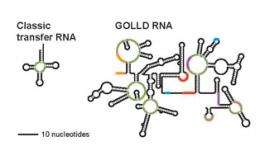
A representation of relative size of a typical RNA molecule involved in transfer of genetic information and newly discovered RNA molecule GOLLD, the third largest and most complex RNA discovered to date. GOLLD appears to be used by viruses that infect bacteria.

(PhysOrg.com) -- Yale University researchers have found very large RNA structures within previously unstudied bacteria that appear crucial to basic biological functions such as helping viruses infect cells or allowing genes to "jump" to different parts of the chromosome.

These exceptionally large RNA molecules have been discovered using DNA sequence data available within the past few years. The findings, reported in the December 3 issue of the journal Nature, suggest many other unusual RNAs remain to be found as researchers explore the genes of more species of bacteria, said Ronald Breaker, senior author of the paper and professor of Molecular, Cellular and Developmental Biology.

"Our work reveals new classes of large RNAs exist, which would be akin to protein scientists finding new classes of enzymes," said Breaker, a Howard Hughes Medical Institute investigator. "Since we have only scratched the surface when it comes to examining microbial DNA that is covering the planet - there will certainly be many more large RNAs out there to discover and these newfound RNAs are also likely to have amazing functions as well."

The RNA molecules rank among the largest and most sophisticated RNAs yet discovered and may act like enzymes or carry out other complex functions in bacteria. The RNAs are found in bacteria which have yet to be grown in labs and so have been difficult to study.

RNA, or ribonucleic acid, is a chemical related to DNA. (Move definition up) are best known for carrying information from genes encoded in DNA to ribosomes, which are the protein-manufacturing machines of cells. However, some RNAs are not passive messengers, but form intricate structures that function like enzymes. For example, ribosomes are constructed using the two largest structured RNAs in bacteria that together function as the chemical factory for producing proteins. Yale University's Thomas Steitz won the 2009 for his work to solve the atomic-resolution structure of ribosomes from bacterial cells. His work helped prove that ribosomes stitch together amino acids to make proteins using large RNAs like enzymes.

Nearly all of the largest structured RNAs previously known had been discovered in the 1970s or earlier. The scientists discovered these new RNAs by analyzing genetic data from poorly studied bacteria that in many cases cannot yet be grown in laboratory conditions. Only a tiny fraction of bacteria in the wild can now be grown in the lab, and scientists have only recently been able to collect genetic data from uncultivated bacteria. Consequently, there is a vast array of bacteria for which genetic data remains unavailable. Many other RNAs likely remain hidden in these under-studied bacteria that also have unusual characteristics that will greatly expand the known roles of RNA in biology.

The Breaker laboratory has used the explosion of DNA sequence information and new computer programs to discover six of the top twelve largest bacterial RNAs just in the last several years. One of the newly discovered RNAs, called GOLLD, is the third largest and most complex RNA discovered to date, and appears to be used by viruses that infect bacteria. Another large RNA revealed in the study, called HEARO, has a genetic structure that suggests it is part of a type of "jumping gene" that can move to new locations in the bacterial chromosome. They also found other RNAs in species of bacteria abundant in the open ocean, and some of these had been identified near Hawaii by researchers from the Massachusetts Institute of Technology. These RNAs are also very common in that live near the shore of the North American east coast, and so organisms that carry this are likely to be very common in the waters of all the earth's oceans.

More information: The authors of this paper are Zasha Weinberg, Jonathan Perreault, Michelle M. Meyer and Ronald R. Breaker. All are from Yale. The title of the paper is "Exceptional Structured Noncoding RNAs Revealed by Bacterial Metagenome Analysis."

Source: Yale University (news : web)

4.9 /5 (12 votes)  

Filter


Move the slider to adjust rank threshold, so that you can hide some of the comments.


Display comments: newest first

PinkElephant
Dec 02, 2009

Rank: not rated yet
Seems like exciting findings for the "RNA world" hypothesis of life origins.
Rank 4.9 /5 (12 votes)
Related Stories
Relevant PhysicsForums posts
  • Pertubance in a model
    created3 hours ago
  • Cancer drugs and Alzheimer's, Oh my!
    created11 hours ago
  • Squishing cells
    created12 hours ago
  • Any books/articles for evolutionary stable strategy models in humans?
    created23 hours ago
  • Science behind the bore feeling?
    createdFeb 09, 2012
  • Homo Sapien vs. Chimpanzee - Divergence Timeline
    createdFeb 09, 2012
  • More from Physics Forums - Biology

More news stories

The power of estrogen -- male snakes attract other males

A new study has shown that boosting the estrogen levels of male garter snakes causes them to secrete the same pheromones that females use to attract suitors, and turned the males into just about the sexiest ...

Biology / Plants & Animals

created 1 hour ago | popularity not rated yet | comments 0 | with audio podcast

Experts reveal how plants don't get sunburn

(PhysOrg.com) -- Experts at the University of Glasgow have discovered how plants survive the harmful rays of the sun.

Biology / Cell & Microbiology

created 1 hour ago | popularity 5 / 5 (1) | comments 0 | with audio podcast

Miami battling invasion of giant African snails

No one knows how they got there. But an invasion of African giant snails has southern Florida in a panic over potential crop damage, disease and general yuckiness surrounding the slimy gastropods.

Biology / Ecology

created 5 hours ago | popularity not rated yet | comments 2

New drugs schedule makes horse racing a sure thing

What do Gai Waterhouse and Anthony Cummings have in common with Queen Elizabeth II?

Biology / Plants & Animals

created 1 hour ago | popularity not rated yet | comments 0

Ultraviolet protection molecule in plants yields its secrets

Lying around in the sun all day is hazardous not just for humans but also for plants, which have no means of escape. Ultraviolet (UV) radiation from the sun can damage proteins and DNA inside cells, leading ...

Biology / Plants & Animals

created 19 hours ago | popularity 5 / 5 (5) | comments 0 | with audio podcast


Fool's gold may prove an unlikely alternative to overexploited catalytic materials

Catalytic materials, which lower the energy barriers for chemical reactions, are used in everything from the commercial production of chemicals to catalytic converters in car engines. However, with current catalytic materials ...

Curry spice component may help slow prostate tumor growth

Curcumin, an active component of the Indian curry spice turmeric, may help slow down tumor growth in castration-resistant prostate cancer patients on androgen deprivation therapy (ADT), a study from researchers ...

What lies beneath: Mapping hidden nanostructures

The ability to diagnose and predict the properties of materials is vital, particularly in the expanding field of nanotechnology. Electron and atom-probe microscopy can categorize atoms in thin sheets of material, ...

Netflix light on flicks as viewers soak up TV shows

Like most fresh faces that arrive in Hollywood, Netflix wanted to be a movie star. But now it's learning what many in Tinseltown have known for decades: Movies are sexy, but the real money is in television.

To avoid early labor and delivery, weight and diet changes not the answer

One of the strongest known risk factors for spontaneous or unexpected preterm birth – any birth that occurs before the 37th week of pregnancy, most often without a known cause – is already having had one. For women ...

Arthritic knees, but not hips, have robust repair response

Researchers at Duke University Medical Center used new tools they developed to analyze knees and hips and discovered that osteoarthritic knee joints are in a constant state of repair, while hip joints are not.