Engineering professor creates mobile lab for testing bridges
December 2, 2009
Engineering professor creates mobile lab for testing bridges

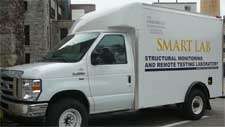
(PhysOrg.com) -- Civil engineering students at the University of Rhode Island will soon take to the roadways to apply what they have learned in the classroom in real-world analyses of bridges, buildings and other structures, thanks to the creation of a mobile testing laboratory.

Funded with a $95,500 Champlin Foundations grant, the Structural Monitoring and Remote Testing (SMART) Laboratory includes the high-tech instrumentation and processing power necessary to measure and analyze structures in natural conditions, all contained in a van for easy access to sites around Rhode Island.

“The lab will enable students to work together in small groups designing experiments on challenging problems related to structural health monitoring, and then gain experience obtaining real-world measurements that can be applied in their future careers,” explained Mayrai Gindy, associate professor of civil engineering who developed the mobile lab.

According to Gindy, one of the most important challenges facing structural engineers today is the development and implementation of effective techniques for detecting, diagnosing and treating structural damage. The SMART lab will help students gain a clearer understanding of the behavior of structures under various conditions.

Among the equipment in the lab is a laser Doppler vibrometer, which measures the speed and of a vibrating structure; various strain gauges that assess the stress, strain and loading on a structure; and an impulse hammer that measures how much force is applied in tests under controlled conditions. Also available are accelerometers, linear variable differential transducers, and a portable weigh-in-motion system.

“Some of the equipment is wireless, so students can be sitting here in a computer lab on campus and continually monitor the stress levels on a almost anywhere,” Gindy said.

The Rhode Island Department of Transportation, which supported the grant application, also benefits from the new lab. When students prepare to conduct bridge tests, they coordinate with DOT engineers who identify particular bridges they would like tested, and the results of the tests are shared with the state agency, which does not own some of the equipment available in the SMART lab.

In addition, Gindy envisions using the lab for outreach activities at local high schools. She said that the equipment can be used to test the structural integrity of school flagpoles, windshields and other structures that will provide valuable mathematics, science and technology lessons to students.

The mobile lab will be in use beginning next semester, and will become a regular part of the junior-level structural engineering lab course next fall.

Provided by University of Rhode Island (news : web)


Rank not rated yet
Relevant PhysicsForums posts
  • Empirical data regarding shower heads and water
    created8 hours ago
  • feed hold button on CNC lathe
    createdFeb 09, 2012
  • RFAC in Fortran
    createdFeb 09, 2012
  • dynamics 2/32
    createdFeb 08, 2012
  • dynamics
    createdFeb 08, 2012
  • Vibration Absorbtion Problem
    createdFeb 08, 2012
  • More from Physics Forums - General Engineering

More news stories

Sony's Hirai refuses to abandon dire TV business

Struggling Japanese entertainment giant Sony will not abandon its cash-bleeding television business, its incoming CEO says, but he acknowledges tough decisions lie ahead including over redundancies.

Technology / Business

created 6 minutes ago | popularity not rated yet | comments 0

New error-correcting codes guarantee the fastest possible rate of data transmission

Error-correcting codes are one of the triumphs of the digital age. They’re a way of encoding information so that it can be transmitted across a communication channel — such as an optical fiber o ...

Technology / Computer Sciences

created 2 hours ago | popularity 5 / 5 (2) | comments 2 | with audio podcast

Small modular reactor design could be a 'SUPERSTAR'

(PhysOrg.com) -- Though most of today's nuclear reactors are cooled by water, we've long known that there are alternatives; in fact, the world's first nuclear-powered electricity in 1951 came from a reactor ...

Technology / Energy & Green Tech

created 2 hours ago | popularity 5 / 5 (4) | comments 7 | with audio podcast

Advanced power-grid model finds low-cost, low-carbon future in West

(PhysOrg.com) -- The least expensive way for the Western U.S. to reduce greenhouse gas emissions enough to help prevent the worst consequences of global warming is to replace coal with renewable and other ...

Technology / Energy & Green Tech

created 2 hours ago | popularity 5 / 5 (1) | comments 3 | with audio podcast

Engineering images bring life to submerged city

(PhysOrg.com) -- Photo-realistic 3D mapping and digital reconstruction of an ancient underwater city in Greece have earned a team from the University of Sydney's Faculty of Engineering and Information Technologies ...

Technology / Engineering

created 1 hour ago | popularity not rated yet | comments 1


The power of estrogen -- male snakes attract other males

A new study has shown that boosting the estrogen levels of male garter snakes causes them to secrete the same pheromones that females use to attract suitors, and turned the males into just about the sexiest ...

Could Venus be shifting gear?

(PhysOrg.com) -- ESA’s Venus Express spacecraft has discovered that our cloud-covered neighbour spins a little slower than previously measured. Peering through the dense atmosphere in the infrared, the ...

Experts reveal how plants don't get sunburn

(PhysOrg.com) -- Experts at the University of Glasgow have discovered how plants survive the harmful rays of the sun.

Team isolates nerve cells involved in storing long term memory and gene proteins associated with them

(Medical Xpress) -- A research team in Taiwan has succeeded in isolating two nerve cells in fruit fly brains that are believed to be the major players in allowing for the formation of long term memories. Furthermore, ...

Fool's gold may prove an unlikely alternative to overexploited catalytic materials

Catalytic materials, which lower the energy barriers for chemical reactions, are used in everything from the commercial production of chemicals to catalytic converters in car engines. However, with current catalytic materials ...

SLAC, Stanford team focuses on high-energy electrons to treat cancer

Accelerator physicists at SLAC and cancer specialists from Stanford are working on a new technology that could dramatically reduce the time needed for cancer radiation treatments. The team ran an initial experiment ...