STPSat-1 successfully completes extended mission
The STPSat-1, built for the Department of Defense (DoD) Space Test Program (STP) and operated by the DoD STP for the first year then transitioned to NRL for the last 16 months, was decommissioned on October 7th after completing almost 2 ½ years of successful on-orbit operation. The satellite's two payloads, both designed and built by the Naval Research Laboratory (NRL), provided unique measurements of middle atmospheric hydroxyl, polar mesospheric clouds and the low latitude ionosphere.
The DoD STP launched STPSat-1 on March 8, 2007, into Low Earth Orbit as one of the payloads on the demonstration flight of the EELV Secondary Payload Adapter (ESPA) ring aboard an Atlas V launch vehicle (AV-013) as part of the STP-1 mission. It was built by Comtech AeroAstro, a subsidiary of Comtech Telecommunications Corp. The primary payload was the Spatial Heterodyne Imager for Mesospheric Radicals (SHIMMER); the PI was Dr. Christoph Englert of the NRL Space Science Division. SHIMMER's objective was to demonstrate the viability of a new optical technique, Spatial Heterodyne Spectroscopy (SHS), for satellite-borne observations of the Earth's atmosphere from space. SHS is an optical technique which combines the high throughput and high spectral resolution of a Fourier transform spectrometer with the relatively simpler optical and mechanical design associated with more conventional grating spectrometers. NRL is a key institution in the development of this novel technique and is pioneering SHS applications from ultraviolet to infrared spectroscopy and in measuring air motions (winds). SHIMMER's key scientific objective was to make high resolution spectral measurements, using UV resonance fluorescence, of mesospheric hydroxyl (OH), an atmospheric trace constituent which is important for ozone chemistry. The first space-based measurements of middle atmospheric OH had been obtained by NRL during the 1990s; however, the earlier measurements were limited in scope and were made with a spectrograph so large it could only be delivered to orbit using the space shuttle. SHIMMER's distinguishing feature was the use of a monolithic interferometer that enabled the required very high spectral resolution measurements to be made with an instrument package many times smaller and lighter than the earlier shuttle experiment.
The second payload was the Scintillation and Tomography Receiver in Space (CITRIS); the PI was Dr. Paul A. Bernhardt of the NRL Plasma Physics Division. The CITRIS system was completely fabricated at NRL by the Plasma Physics Division and the Space Systems Development Department. It was a multi-frequency receiver/antenna system that measured the effects of ionospheric electron densities on radio wave propagation. The Chief of Naval Operations (CNO) has identified radio scintillations and total electron content (TEC) as the most important engineering data records (EDRs) needed from space-based sensors and CITRIS was designed to provide these EDRs over both the ocean and land. CITRIS uses existing radio beacons both on the ground and in low-earth-orbit to provide global measurements of ionospheric propagation disturbances over a broad frequency range covering VHF, UHF, L-Band and S-Band. Because the equatorial ionosphere produces the strongest effects on radio propagation from satellites, CITRIS was operated at low latitudes using ground radio beacon transmitters that are part of the international network of Doppler Orbitography and Radiopositionning Integrated by Satellite (DORIS) beacons provided by France and multiple beacons in low earth orbit that include the NRL constellation of Coherent Electromagnetic Radio Tomography (CERTO) beacons. The primary objectives of CITRIS were (1) to detect when and where radio propagation is adversely affected by scintillation and refraction and (2) to provide a global map of ionospheric densities and irregularities to improve current models of the ionosphere.
Both SHIMMER and CITRIS performed flawlessly during the nominal one year mission of STPSat-1. After one year however, STP's charter required that the fiscal responsibility for the satellite to be transferred to another agency in order for it to continue operations. In collaboration among the NRL Space Science Division, the NRL Plasma Physics Division and the NRL Spacecraft Engineering Department, NRL demonstrated a novel, highly automated, low cost approach to running the satellite out of its Blossom Point facility near LaPlata, Maryland in southern Charles County. With the success of this demonstration, the STP transferred ownership of STPSat-1 to NRL on June 1, 2008.
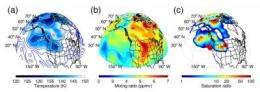
The STPSat-1 extended mission, co-sponsored by both NASA and ONR, was designed to meet two goals. First SHIMMER would continue to make measurements of Polar Mesospheric Clouds (PMCs). PMCs are earth's highest clouds, forming in the rarefied air at 82 km, each summer over latitudes poleward of 50o. They are of great interest because they may be harbingers of upper atmospheric climate change and also have been linked to water vapor plumes deposited in the upper atmosphere during space shuttle launches. NASA already has a satellite, AIM, dedicated to PMC measurements, however, the unique, relatively low inclination orbit of STPSat-1 allowed SHIMMER to make measurements of PMCs at different local times. By contrast, most satellites are in a polar sun-synchronous orbit which limits their observations to a single local time. SHIMMER has shown that PMCs do vary throughout the day and that this variation can change from year to year. In addition, SHIMMER measurements can be used to validate SSD's new high altitude extension of the Navy's Operational Global Atmospheric Prediction System (NOGAPS). The Advanced Level Physics High Altitude (ALPHA) extension of NOGAPS goes from the ground up to 90 km. NOGAPS-ALPHA provided saturation fields on a 6 hourly basis throughout the SHIMMER mission; preliminary results suggested that SHIMMER data agree with regions of high saturation as given by the model (see Figure A).
The primary objective of the extended mission for CITRIS was to make coordinated ionospheric observations with the NRL CERTO beacon on the Communications/Navigation Outages and Forecasting (C/NOFS). C/NOFS is an Air Force satellite, launched in April 2008, which, like STPSat-1, is in a low inclination orbit. Navy beacons operating at VHF, UHF and L-Band frequencies can be found on C/NOFS as well as Transit/NIMS, DMSP/F15, and the six FORMOSAT-3 Satellites provided by Taiwan. The many close approaches between STPSat-1, the NRL CERTO beacon on C/NOFS, and other satellites allowed extraordinarily precise measurements of the total electron content of the ionosphere in a line of sight column linking the two spacecraft. In addition, in situ electron density fluctuations detected by the C/NOFS satellite were compared with the radio scintillations recorded by C/NOFS-CITRIS links to develop models for predicting degradation of satellite communication and navigation.
"NRL's SHIMMER and CITRIS, the two instruments onboard STPSat-1, exceeded all of their primary mission goals providing high-quality, long-duration science data and proving key new instrument capabilities for DoD applications," said Dr. Jill Dahlburg, Superintendent of the Space Science Division at NRL, and Chair of the Department of the Navy Space Experiments Review Board.
"We are using information gained from the STPSat-1 mission to advance understanding and near-term predictive capability of the space domain, towards exploiting the extended operational environment and its impact on Navy and Department of Defense activities including: Naval command, control, computers, communications, intelligence, surveillance, and reconnaissance; precision navigation and timing; and, maritime domain awareness. I wish to express sincerest appreciation to the DoD Space Test Program for their outstanding participation and support in this endeavor."
Source: Naval Research Laboratory


