Fears mount over giant carp reaching Great Lakes
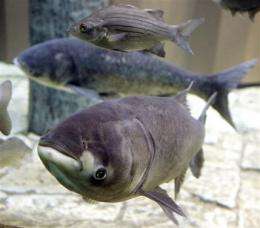
(AP) -- Fears that giant, voracious species of carp will get into the Great Lakes and wipe out other fish have led to rising demands that the government close the waterway connecting the lakes to the Mississippi River - an unprecedented step that could disrupt the movement of millions of tons of iron ore, coal, grain and other goods.
The dispute could become an epic clash of competing interests: commerce, environmentalists and fishermen.
Michigan Gov. Jennifer Granholm and five environmental groups threatened on Wednesday to sue the U.S. Army Corps of Engineers to force it to temporarily shut three shipping locks near Chicago because of evidence that Asian carp may have breached the electrical barrier that is supposed to hold them back from the lakes.
The environmental groups went further than the governor and said the Great Lakes and the Mississippi should be permanently separated to avert what Granholm called "ecological disaster."
Col. Vincent Quarles, commander of the Corps' Chicago district, said the agency is considering all options but would not close the locks without first studying the possible effects.
Environmentalists fear that the fish, which consume up to 40 percent of their body weight daily in plankton, could starve out smaller and less aggressive competitors and cause the collapse of the $7 billion-a-year Great Lakes sport and commercial fishing industry.
The carp - which can grow to 4 feet long and 100 pounds and are known for leaping out of the water when boats are near - were imported by Southern fish farms but escaped into the Mississippi in large numbers during flooding in the 1990s and have been making their way northward ever since.
The Mississippi and the Great Lakes are connected by a complex, 250-mile network of rivers and canals engineered more than a century ago. It runs from Chicago, on the southern edge of Lake Michigan, to a spot on the Mississippi just north of St. Louis.
The American Waterways Operators, a trade association representing the tug and barge industry, said closing the locks would lead to higher shipping costs because commodities would have to be sent overland via truck or train across Illinois before being put back onto vessels.
"The impact is going to be large," said Lynn Muench, the group's senior vice president for regional advocacy in St. Louis. "It could definitely impact day-to-day living."
Tens of millions of tons of goods are moved annually along the shipping canals or through the locks that lead into Lake Michigan. Muench had no estimate of the value of the cargo, which includes salt, sugar, molasses, cement, scrap metal and petroleum.
In the continuing struggle to keep the fish out, Illinois environmental officials planned to dump poison Wednesday night in a nearly six-mile stretch of the Chicago Sanitary and Ship Canal near Lockport to kill off the carp while the electrical barrier is turned off for maintenance. Crews planned to use large cranes with nets to scoop up an estimated 200,000 pounds of dead fish, which will be taken to a landfill.
The electrical barrier, which was installed in 2002 to repel fish with a non-lethal jolt, has long been the only thing standing between the carp and Lake Michigan, the gateway to the four other lakes. But officials said two weeks ago that DNA from Asian carp had been found between the barrier and one of the locks on the lake. No actual carp have been found in Lake Michigan.
Environmentalists and Granholm said the locks should be closed while the scope of the problem is established.
"This is an immediate threat to the Great Lakes, to our sport and commercial fishery, and as such it requires some emergency actions appropriate to the level of that threat," said Ken DeBeaussaert, director of Michigan's Office of the Great Lakes. "Closing the locks to prevent the possible spread of the Asian carp into the Great Lakes is an appropriate response on an emergency basis."
The environmental groups also said the government should find a way to permanently separate - through physical barriers or other means - the Great Lakes and Mississippi watersheds so the invasive species has no way of passing between the two.
Last fall, environmental groups offered several possible solutions, including erecting concrete walls, constructing more locks, even lifting barges over the locks.
The issue "takes on a whole new urgency because of the Asian carp emergency," said Andy Buchsbaum of the National Wildlife Federation. "We don't know where the carp are, and the risk of their being in the canals is too great."
Some fishing enthusiasts doubt the government will consider closing the locks. Dan Thomas, president of the Elmhurst, Ill.-based Great Lakes Sport Fishing Council, said too many industries and too many jobs would probably be affected.
"Ideally it's the way to go, but many things that are ideal don't always come to fruition because there are too many other circumstances," he said. "They can still be contained, but only with concerted effort and a sense of urgency to do what is necessary on a timely basis."
Scientists say more than 180 invasive species have entered the Great Lakes, multiplying rapidly and feeding on native species or competing with them for food. Millions of dollars have been spent trying to control the zebra mussel and the round goby fish, which already have moved between the Great Lakes and Mississippi River basins.
©2009 The Associated Press. All rights reserved. This material may not be published, broadcast, rewritten or redistributed.


