Sweden allows first wolf hunt in 45 years
December 2, 2009
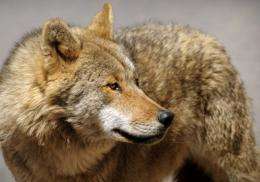
Sweden will this winter allow its first wolf hunt in 45 years following a decision by the Scandinavian country's parliament to limit their number.
Sweden will this winter allow its first wolf hunt in 45 years following a decision by the Scandinavian country's parliament to limit their number, authorities said on Wednesday.
The Swedish Environmental Protection Agency is to announce by mid-December its quota for the wolf cull, expected to be between 20 and 40 animals, Susanna Loefgren of the agency told AFP.
"That (number is) what (experts) have offered us, we're working on it and a decision will be taken mid-December," Loefgren said.
The regions where the hunt will be allowed are the province of Dalarna, Gaevleborg county and Oerebro county in the country's centre as well as the provinces of Vaestergoetland in the southwest and Vaermland in the west.
The Swedish parliament decided in October to limit the wolf population to 210 animals, spread out in 20 packs, for the next five years by issuing hunting permits in regions where wolves have reproduced in the past three years.
"The main reason for the decision is to raise the (public's) acceptance of wolves" in Sweden by limiting their number, Loefgren said.
The animal's presence is controversial in the Nordic country as domestic and wild animals are increasingly attacked by wolves, which have been sighted recently near residential areas, including near the capital Stockholm.
The environmental protection agency estimated Sweden's wolf population to be between 182 and 217 animals last winter.
It said the hunt would start in January and end before mating season begins in mid-February.
Wolves almost became extinct in Sweden in the 1970s but their number has increased steadily since efforts were made to reintroduce the animal to the country.
Like some other European countries, Sweden allows the hunt of protected species, such as the brown bear and the lynx, in order to cull stocks.
(c) 2009 AFP
-
Wolves making comeback in Germany
Oct 27, 2007 |
not rated yet |
0
-
Grey wolf withdrawn from US endangered list
May 04, 2009 |
not rated yet |
0
-
Wolf hunt is on in Idaho -- for now (Update)
Sep 01, 2009 |
not rated yet |
0
-
Appetite spells three wolves' doom in Switzerland
Aug 28, 2009 |
not rated yet |
0
-
Feds want wolves taken off endangered list
Feb 02, 2006 |
not rated yet |
0
-
Engineers build first sub-10-nm carbon nanotube transistor
Feb 01, 2012 |
4.9 / 5 (33) |
30
-
Something old, something new: Evolution and the structural divergence of duplicate genes
Jan 31, 2012 |
4.6 / 5 (7) |
1
-
The hidden nanoworld of ice crystals: Revealing the dynamic behavior of quasi-liquid layers
Jan 30, 2012 |
5 / 5 (4) |
1
-
Stock market network reveals investor clustering
Jan 27, 2012 |
3.9 / 5 (23) |
8
-
Of microchemistry and molecules: Electronic microfluidic device synthesizes biocompatible probes
Jan 26, 2012 |
5 / 5 (2) |
0
-
Factors affecting beet root cell membrane
18 hours ago
-
Stem cell question.
Feb 10, 2012
-
Protease cleavage
Feb 10, 2012
-
Pertubance in a model
Feb 10, 2012
-
Cancer drugs and Alzheimer's, Oh my!
Feb 09, 2012
-
Squishing cells
Feb 09, 2012
- More from Physics Forums - Biology
More news stories
Integrated pest management recommendations for the southern pine beetle
The southern pine beetle, Dendroctonus frontalis Zimmermann, is a chronic insect pest within pine forests in the southeastern United States. Under favorable environmental and host conditions, it is an agg ...
10 minutes ago |
not rated yet |
0
A mitosis mystery solved: How chromosomes align perfectly in a dividing cell
Although the process of mitotic cell division has been studied intensely for more than 50 years, Whitehead Institute researchers have only now solved the mystery of how cells correctly align their chromosomes during symmetric ...
14 hours ago |
4.5 / 5 (22) |
0
|
Researchers find extensive RNA editing in human transcriptome
In a new study published online in Nature Biotechnology, researchers from BGI, the world's largest genomics organization, reported the evidence of extensive RNA editing in a human cell line by analysis of RNA-seq data, demons ...
14 hours ago |
5 / 5 (4) |
0
|
The proteins ensuring genome protection
Researchers from the University of Geneva (UNIGE), Switzerland, have discovered the crucial role of two proteins in developing a cell 'anti-enzyme shield'. This protection system, which operates at the level of molecular ...
14 hours ago |
5 / 5 (3) |
0
|
Entire genome of extinct human decoded from fossil
(PhysOrg.com) -- In 2010, Svante Pääbo and his colleagues presented a draft version of the genome from a small fragment of a human finger bone discovered in Denisova Cave in southern Siberia. The ...
Feb 07, 2012 |
4.7 / 5 (60) |
51
|
Japan's Fukushima reactor may be reheating: operator
Temperature readings at one of the crippled Fukushima nuclear reactors have risen above Japan's stringent new safety standard but there was no immediate danger, its operator said Sunday.
Botox developer rues missing out on billions
Botox developer Alan Scott says he rues the day he handed over rights to the best-selling wrinkle-smoothing drug to a US company for just $4.5 million, saying he might have become a billionaire.
Australian women reject 'I love u' texts
Australian women may have embraced the digital era, but they prefer a face-to-face declaration of affection to an "I love u" text and find men addicted to their mobile phones a major turnoff.
Many lung cancer patients get radiation therapy that may not prolong their lives
A new study has found that many older lung cancer patients get treatments that may not help them live longer. Published early online in CANCER, a peer-reviewed journal of the American Cancer Society, the findings suggest that p ...
Young adults allowed to stay on parents' health insurance have improved access to care
Researchers from Mount Sinai School of Medicine have found that laws permitting children to stay on their parents' health insurance through age 26 result in improved access to health care compared to states without those ...
Cancer rate 4 times higher in children with juvenile arthritis
New research reports that incident malignancy among children with juvenile idiopathic arthritis (JIA) is four times higher than in those without the disease. Findings now available in Arthritis & Rheumatism, a journal publis ...