ARS Explores Ways to Keep Carbon in the Soil
December 3, 2009 By Dennis O'Brien
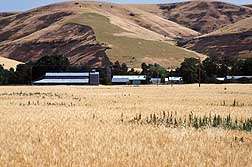
ARS scientists are testing whether using different ways of tilling the soil or changing crop rotations will help winter wheat farmers sequester more carbon in the soil and reduce greenhouse gas emissions. Photo courtesy of NRCS.
(PhysOrg.com) -- Agricultural Research Service (ARS) scientists are testing out alternative ways of tilling the soil and rotating crops to see if they can help wheat farmers in Oregon sequester more carbon in the soil and reduce greenhouse gas emissions.
Soil organic carbon plays a major role in how well a cultivated field holds moisture, provides nutrients and remains productive. That can be a problem in eastern Oregon because the soils are relatively low in organic carbon. Wheat farmers there traditionally plant winter wheat one year and leave the field fallow for a season, using traditional methods to plow before planting.
Hero Gollany, a soil scientist at the ARS Columbia Plateau Conservation Research Center in Pendleton, Ore., is looking at three scenarios that may help. In one field, she is comparing levels of carbon dioxide, methane and nitrous oxide emissions released from the traditional 2-year rotation with an alternative 3-year cycle of no-till winter wheat, followed by a second crop of no-till winter wheat, followed by sorghum. She is measuring residue yields, soil conditions, and greenhouse gas emissions, taking measurements throughout the year. Because precipitation usually increases nitrous oxide emissions, she also collects data after any rain or snowfall.
She also is examining whether two other cropping systems sequester more carbon. In one, she grows winter wheat continuously and seeds the untilled soil directly each year. In the other, she grows wheat one year, leaves the plot fallow the next year and uses sweep tillage and a rod-weeder to control weeds. This is a low-impact method of plowing 4 to 5 inches into the soil. It is less destructive to soil structure than conventional tillage, and helps retain water and organic matter. Previous experiments show a 14 percent increase in soil organic carbon if growers use sweep tillage rather than the traditional moldboard plowing.
Results are being evaluated as part of an ARS project known as GRACEnet (Greenhouse gas Reduction through Agricultural Carbon Enhancement network) in which researchers at more than 32 sites are examining strategies to help reduce agriculture's climate change footprint. The project supports the U.S. Department of Agriculture (USDA) priority of responding to climate change.
Read more about the research in the November/December 2009 issue of Agricultural Research magazine.
Provided by USDA Agricultural Research Service
-
Reducing Agriculture's Climate Change Footprint
Nov 04, 2009 |
not rated yet |
0
-
Studying Fertilizers to Cut Greenhouse Gases
Nov 18, 2009 |
not rated yet |
0
-
Nitrous oxide emissions respond differently to no-till depending on the soil type
Oct 22, 2008 |
not rated yet |
0
-
Crop Residue May Be Too Valuable to Harvest for Biofuels
Jul 15, 2008 |
not rated yet |
0
-
Before selling carbon credits, read this
May 18, 2007 |
not rated yet |
0
-
Engineers build first sub-10-nm carbon nanotube transistor
Feb 01, 2012 |
4.9 / 5 (31) |
30
-
Something old, something new: Evolution and the structural divergence of duplicate genes
Jan 31, 2012 |
4.6 / 5 (7) |
1
-
The hidden nanoworld of ice crystals: Revealing the dynamic behavior of quasi-liquid layers
Jan 30, 2012 |
5 / 5 (3) |
1
-
Stock market network reveals investor clustering
Jan 27, 2012 |
3.9 / 5 (23) |
8
-
Of microchemistry and molecules: Electronic microfluidic device synthesizes biocompatible probes
Jan 26, 2012 |
5 / 5 (1) |
0
-
Discrepancy between oxygen and carbon-dioxide levels
Feb 09, 2012
-
where gems are found in the world
Feb 09, 2012
-
Wind Waves in Reservoir ~ Wind run-up and Wind set-up
Feb 08, 2012
-
Balance of oxygen in the atmosphere
Feb 01, 2012
-
The case for a methanol-based economy
Jan 30, 2012
-
Weather in a rotating cylinder
Jan 25, 2012
- More from Physics Forums - Earth
More news stories
Humans may have helped the decline of African rainforests 3000 years ago
(PhysOrg.com) -- Large areas of rainforests in Central Africa mysteriously disappeared over three thousand years ago, to be replaced by savannas. The prevailing theory has been that the cause was a change ...
Could Venus be shifting gear?
(PhysOrg.com) -- ESAs Venus Express spacecraft has discovered that our cloud-covered neighbour spins a little slower than previously measured. Peering through the dense atmosphere in the infrared, the ...
Space & Earth / Space Exploration
20 hours ago |
5 / 5 (7) |
8
|
NASA budget will axe Mars deal with Europe: scientists
US President Barack Obama's budget proposal to be submitted next week for 2013 will cut NASA's budget by 20 percent and eliminate a major partnership with Europe on Mars exploration, scientists said Thursday.
Space & Earth / Space Exploration
23 hours ago |
5 / 5 (2) |
20
Mars Science Laboratory computer issue resolved
(PhysOrg.com) -- Engineers have found the root cause of a computer reset that occurred two months ago on NASA's Mars Science Laboratory and have determined how to correct it.
Space & Earth / Space Exploration
21 hours ago |
4.7 / 5 (6) |
4
|
Two new moons for Jupiter
Advances in technology have lead to the discovery of new planets outside of our Solar System, and now even new moons in our own backyard.
Space & Earth / Space Exploration
20 hours ago |
4 / 5 (1) |
7
Anonymous knocks CIA website offline (Update)
The website of the Central Intelligence Agency was inaccessible on Friday after the hacker group Anonymous claimed to have knocked it offline.
New error-correcting codes guarantee the fastest possible rate of data transmission
Error-correcting codes are one of the triumphs of the digital age. Theyre a way of encoding information so that it can be transmitted across a communication channel such as an optical fiber o ...
Small modular reactor design could be a 'SUPERSTAR'
(PhysOrg.com) -- Though most of today's nuclear reactors are cooled by water, we've long known that there are alternatives; in fact, the world's first nuclear-powered electricity in 1951 came from a reactor ...
New power source discovered
(PhysOrg.com) -- Researchers at the Massachusetts Institute of Technology (MIT) and RMIT University have made a breakthrough in energy storage and power generation.
The power of estrogen -- male snakes attract other males
A new study has shown that boosting the estrogen levels of male garter snakes causes them to secrete the same pheromones that females use to attract suitors, and turned the males into just about the sexiest ...
Google users warned of threat to smartphone wallets
Users of Google smartphone wallets were being warned on Friday that there is a way to crack pass codes intended to thwart thieves from going on illicit shopping sprees.