A (nano-) window that washes itself?
December 3, 2009
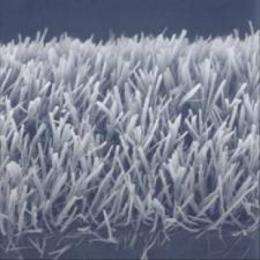
Tel Aviv University's nanosized "forest of peptides" can be used as the basis for self-cleaning windows and more efficient batteries. Credit: AFTAU
A coating on windows or solar panels that repels grime and dirt? Expanded battery storage capacities for the next electric car? New Tel Aviv University research, just published in Nature Nanotechnology, details a breakthrough in assembling peptides at the nano-scale level that could make these futuristic visions come true in just a few years.
Operating in the range of 100 nanometers and even smaller, graduate student Lihi Adler-Abramovich and a team working under Prof. Ehud Gazit in TAU's Department of Molecular Microbiology and Biotechnology have found a novel way to control the atoms and molecules of peptides so that they "grow" to resemble small forests of grass. These "peptide forests" repel dust and water -- a perfect self-cleaning coating for windows or solar panels which, when dirty, become far less efficient.
"This is beautiful and protean research," says Adler-Abramovich, a Ph.D. candidate. "It began as an attempt to find a new cure for Alzheimer's disease. To our surprise, it also had implications for electric cars, solar energy and construction."
As cheap as the sweetener in your soda
A world leader in nanotechnology research, Prof. Gazit has been developing arrays of self-assembling peptides made from proteins for the past six years. His lab, in collaboration with a group led by Prof. Gil Rosenman of TAU's Faculty of Engineering, has been working on new applications for this basic science for the last two years.
Using a variety of peptides, which are as simple and inexpensive to produce as the artificial sweetener aspartame, the researchers create their "self-assembled nano-tubules" in a vacuum under high temperatures. These nano-tubules can withstand extreme heat and are resistant to water.
"We are not manufacturing the actual material but developing a basic-science technology that could lead to self-cleaning windows and more efficient energy storage devices in just a few years," says Adler-Abramovich. "As scientists, we focus on pure research. Thanks to Prof. Gazit's work on beta amyloid proteins, we were able to develop a technique that enables short peptides to 'self-assemble,' forming an entirely new kind of coating which is also a super-capacitor."
As a capacitor with unusually high energy density, the nano-tech material could give existing electric batteries a boost -- necessary to start an electric car, go up a hill, or pass other cars and trucks on the highway. One of the limitations of the electric car is thrust, and the team thinks their research could lead to a solution to this difficult problem.
"Our technology may lead to a storage material with a high density," says Adler-Abramovich. "This is important when you need to generate a lot of energy in a short period of time. It could also be incorporated into today's lithium batteries," she adds.
Windex a thing of the past?
Coated with the new material, the sealed outer windows of skyscrapers may never need to be washed again ― the TAU lab's material can repel rainwater, as well as the dust and dirt it carries. The efficiency of solar energy panels could be improved as well, as a rain shower would pull away any dust that might have accumulated on the panels. It means saving money on maintenance and cleaning, which is especially a problem in dusty deserts, where most solar farms are installed today.
The lab has already been approached to develop its coating technology commercially. And Prof. Gazit has a contract with drug mega-developer Merck to continue his work on short peptides for the treatment of Alzheimer's disease ― as he had originally foreseen.
-
Researchers root out new and efficient crop plants
Jul 30, 2008 |
not rated yet |
0
-
High-performance energy storage
Jul 03, 2007 |
not rated yet |
0
-
Hope for Alzheimer’s patients? Dipeptide blocks the formation of toxic amyloid β-peptide aggregates in mice
Dec 04, 2008 |
not rated yet |
0
-
Nanotechnology to Create Green Hydrogen
Sep 24, 2004 |
not rated yet |
0
-
Mimicking Nature Creates Self-Cleaning Coatings
Oct 13, 2006 |
not rated yet |
0
-
Engineers build first sub-10-nm carbon nanotube transistor
Feb 01, 2012 |
4.9 / 5 (30) |
30
-
Something old, something new: Evolution and the structural divergence of duplicate genes
Jan 31, 2012 |
4.6 / 5 (7) |
1
-
The hidden nanoworld of ice crystals: Revealing the dynamic behavior of quasi-liquid layers
Jan 30, 2012 |
5 / 5 (3) |
1
-
Stock market network reveals investor clustering
Jan 27, 2012 |
3.9 / 5 (23) |
8
-
Of microchemistry and molecules: Electronic microfluidic device synthesizes biocompatible probes
Jan 26, 2012 |
5 / 5 (1) |
0
-
polymer nanocomposites
8 hours ago
-
Corrosion Tests on Magnesium
21 hours ago
-
polyethylene copper nanocomposite
Feb 09, 2012
-
Output of xrd analysis
Feb 08, 2012
-
Transport phenomena problem based on problems 18.B11 and 19B.6 from Bird, stewart, lw
Feb 06, 2012
-
Help with material selection - Car Piston
Feb 05, 2012
- More from Physics Forums - Materials & Chemical Engineering
More news stories
What lies beneath: Mapping hidden nanostructures
The ability to diagnose and predict the properties of materials is vital, particularly in the expanding field of nanotechnology. Electron and atom-probe microscopy can categorize atoms in thin sheets of material, ...
34 minutes ago |
not rated yet |
0
'Dark plasmons' transmit energy
Microscopic channels of gold nanoparticles have the ability to transmit electromagnetic energy that starts as light and propagates via "dark plasmons," according to researchers at Rice University.
17 hours ago |
5 / 5 (5) |
0
|
Nanotube therapy takes aim at breast cancer stem cells
Wake Forest Baptist Medical Center researchers have again proven that injecting multiwalled carbon nanotubes (MWCNTs) into tumors and heating them with a quick, 30-second laser treatment can kill them.
Nanotechnology / Bio & Medicine
22 hours ago |
5 / 5 (1) |
0
|
New kind of solar cell could capture significantly more energy than current cells
New solar cells could increase the maximum efficiency of solar panels by over 25%, according to scientists from the University of Cambridge.
Feb 08, 2012 |
4.5 / 5 (11) |
14
|
Nanoshell whispering galleries improve thin solar panels
Visitors to Statuary Hall in the U.S. Capitol Building may have experienced a curious acoustic feature that allows a person to whisper softly at one side of the cavernous, half-domed room and for another on ...
Nanotechnology / Nanomaterials
Feb 07, 2012 |
4.3 / 5 (6) |
6
|
The power of estrogen -- male snakes attract other males
A new study has shown that boosting the estrogen levels of male garter snakes causes them to secrete the same pheromones that females use to attract suitors, and turned the males into just about the sexiest ...
Experts reveal how plants don't get sunburn
(PhysOrg.com) -- Experts at the University of Glasgow have discovered how plants survive the harmful rays of the sun.
Team isolates nerve cells involved in storing long term memory and gene proteins associated with them
(Medical Xpress) -- A research team in Taiwan has succeeded in isolating two nerve cells in fruit fly brains that are believed to be the major players in allowing for the formation of long term memories. Furthermore, ...
Fool's gold may prove an unlikely alternative to overexploited catalytic materials
Catalytic materials, which lower the energy barriers for chemical reactions, are used in everything from the commercial production of chemicals to catalytic converters in car engines. However, with current catalytic materials ...
SLAC, Stanford team focuses on high-energy electrons to treat cancer
Accelerator physicists at SLAC and cancer specialists from Stanford are working on a new technology that could dramatically reduce the time needed for cancer radiation treatments. The team ran an initial experiment ...
News of plaque-clearing drug tops week of major advances against Alzheimer's disease
In the last eight days, scientists have delivered a powerful one-two punch in the fight to defeat Alzheimer's disease. At the same time, the White House and members of Congress are proposing increases in Alzheimer's research ...
Dec 03, 2009
Rank: 5 / 5 (1)
Dec 03, 2009
Rank: 3 / 5 (2)
Also since the picture seems to show that the nanosized peptides are not transparent, they will reduce the solar cell efficiency.
Dec 03, 2009
Rank: not rated yet
Perhaps large optics could also benefit from dust resistant coatings: telescope primaries? Good luck.
Dec 03, 2009
Rank: 4 / 5 (1)
Dec 03, 2009
Rank: 5 / 5 (1)
Also, degradation due to urban ozone and solar UV might need to be examined, particularly given that the compounds in question are organic.
Dec 04, 2009
Rank: 5 / 5 (1)
These were imaged with a scanning electron microscope (SEM) so they won't appear transparent since electrons, not light like in optical microscopes, is being used to image. An optical microscope couldn't ever image in the 100nm range.
Dec 04, 2009
Rank: 3 / 5 (2)
Just because it was published in NATURE doesn't mean its a breakthrough, which shows you probably missed the point of the paper.
Dec 04, 2009
Rank: 4.5 / 5 (2)
The term nano has been so heavily (and prematurely) overused that when real nanotechnology arrives, people will ignore it at first. The proper concept of nanotechnology is the one that physicist Richard Feynman spoke about; that of bottom-up control at the molecular level, the science and engineering of molecular machinery and electronics. Self-assembly is a wonderful first step, but it is nanotechnology's distant relative, and is a pale shadow of the vision of our truly great scientists.
Dec 10, 2009
Rank: 5 / 5 (1)