Blood Enzyme Could Help Realize Clean Coal
December 3, 2009 by Lisa Zyga weblog
Carbonic anhydrase

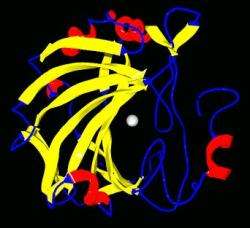
A ribbon diagram of carbonic anhydrase, which isolates carbon dioxide in the lungs for exhalation. Image credit: Wikimedia Commons.

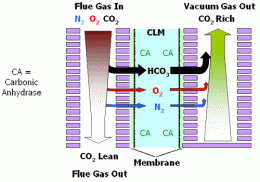
(PhysOrg.com) -- An enzyme in our blood that enables our lungs to exhale carbon dioxide could be the key to isolating carbon dioxide emissions from coal plants in order to store them safely underground. A company called Carbozyme, based in New Jersey, is developing a synthetic version of the blood enzyme that could capture carbon dioxide using one-third less energy than other methods.

The blood enzyme, called carbonic anhydrase, is constantly converting and reconverting as part of our respiration process. At first, cells pump carbon dioxide into the blood, where carbonic anhydrase converts the into bicarbonate to make it easier to transport to the lungs. Then, in the lungs, the same enzyme converts the bicarbonate back into carbon dioxide to be exhaled. Carbonic anhydrase works very efficiently, capturing about two pounds of carbon dioxide per day.

By mimicking the way this blood enzyme separates carbon dioxide from other gases in the body, researchers at Carbozyme have demonstrated how to capture and separate carbon dioxide from a wide variety of gas emissions, such as those from coal stacks. Isolating carbon dioxide is essential for sequestering the underground, where it can be stored in layers of basalt rock. In addition to using less energy, the synthetic enzyme method also avoids using hazardous chemicals that some other gas separation methods use.

Carbozyme plans to test the technology on coal burners at the University of North Dakota next year, and eventually license the method to coal plants. The company says that the design can also be tailored for different applications, such as in the food and beverage industry and .

Blood Enzyme Could Help Realize Clean Coal
Enlarge

Image credit: Carbozyme, Inc.

More information: www.carbozyme.us
via: Popular Science

© 2009 PhysOrg.com

4.2 /5 (6 votes)  

Rank 4.2 /5 (6 votes)
Relevant PhysicsForums posts
  • Stoichiometry
    created18 hours ago
  • Boiling and melting point of impure substances
    created19 hours ago
  • Safe nitrogen compound to decompose a 500 deg C in a furnace?
    createdFeb 09, 2012
  • [ask]electron inside drinking water
    createdFeb 08, 2012
  • How to avoid formation of Lithium Chromate ???
    createdFeb 08, 2012
  • how to choose a reduced or oxidated form in a redox
    createdFeb 08, 2012
  • More from Physics Forums - Chemistry

More news stories

Fool's gold may prove an unlikely alternative to overexploited catalytic materials

Catalytic materials, which lower the energy barriers for chemical reactions, are used in everything from the commercial production of chemicals to catalytic converters in car engines. However, with current catalytic materials ...

Chemistry / Materials Science

created 9 hours ago | popularity 4.6 / 5 (5) | comments 2 | with audio podcast

Unpicking HIV’s invisibility cloak

Drug researchers hunting for alternative ways to treat human immunodeficiency virus (HIV) infections may soon have a novel target—its camouflage coat. HIV hides inside a cloak unusually rich in a sugar ...

Chemistry / Biochemistry

created 9 hours ago | popularity 5 / 5 (4) | comments 0

No entry without protein recycling: Researchers discover new coherence in enzyme transport

The group of Prof. Dr. Ralf Erdmann at the Ruhr-Universität Bochum, Germany, discovered a connection of peroxisomal protein import and receptor export. In the Journal of Biological Chemistry, they disclo ...

Chemistry / Biochemistry

created 9 hours ago | popularity not rated yet | comments 0

Under the microscope #7

In this video Dr Ingrid Graz shows us a thin layer of gold on top of rubber. Cracks in the gold allow it to stretch and we can use this for stretchable electronics.

Chemistry / Other

created 11 hours ago | popularity not rated yet | comments 0

Hydrogen from acidic water: Researchers develop potential low cost alternative to platinum for splitting water

A technique for creating a new molecule that structurally and chemically replicates the active part of the widely used industrial catalyst molybdenite has been developed by researchers with the Lawrence Berkeley ...

Chemistry / Materials Science

created Feb 09, 2012 | popularity 5 / 5 (12) | comments 13 | with audio podcast


Google users warned of threat to smartphone wallets

Users of Google smartphone wallets were being warned on Friday that there is a way to crack pass codes intended to thwart thieves from going on illicit shopping sprees.

Anonymous knocks CIA website offline (Update)

The website of the Central Intelligence Agency was inaccessible on Friday after the hacker group Anonymous claimed to have knocked it offline.

Complex wiring of the nervous system may rely on a just a handful of genes and proteins

Researchers at the Salk Institute have discovered a startling feature of early brain development that helps to explain how complex neuron wiring patterns are programmed using just a handful of critical genes. ...

NASA sees wide-eyed cyclone Jasmine

Cyclone Jasmine's eye has opened wider on NASA satellite imagery, as it moves through the Southern Pacific Ocean.

NASA sees Giovanna reach cyclone strength, threaten Madagascar

Tropical Storm 12S built up steam and became a cyclone on February 10, 2012 as NASA's Terra satellite passed overhead. Residents of east-central Madagascar should prepare for this cyclone to make landfall ...

Putting the squeeze on planets outside our solar system

(PhysOrg.com) -- Using high-powered lasers, scientists at Lawrence Livermore National Laboratory and collaborators discovered that molten magnesium silicate undergoes a phase change in the liquid state, abruptly ...