Stellar family portrait takes imaging technique to new extremes
December 3, 2009
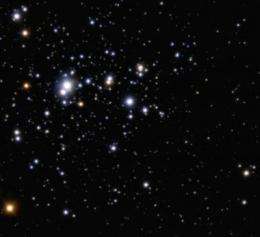
This impressive image of the open cluster known as Trumpler 14 was obtained with the Multi-conjugate Adaptive optics Demonstrator mounted on ESO’s Very Large Telescope. The cluster, which is found to be only 500 000 years old -- a blink of an eye in the Universe’s history -- resides at the outskirts of the central region of the Carina Nebula, located some 8000 light-years away towards the constellation of Carina (the Keel). Trumpler 14 is not only the youngest, but also one of the most populous clusters within the nebula. Astronomers counted about 2000 stars in the very central parts of this cluster. The MAD instrument allows astronomers to obtain very sharp images over a wide area and this image is the adaptive optics image that so far covers the widest area on the sky. The field of view is about 2 arcminutes across and the image is based on data obtained through two different filters (K and H). Credit: ESO/H. Sana
Noted for harbouring Eta Carinae -- one of the wildest and most massive stars in our galaxy -- the impressive Carina Nebula also houses a handful of massive clusters of young stars. The youngest of these stellar families is the Trumpler 14 star cluster, which is less than one million years old -- a blink of an eye in the Universe's history. This large open cluster is located some 8000 light-years away towards the constellation of Carina (the Keel).
A team of astronomers, led by Hugues Sana, acquired astounding images of the central part of Trumpler 14 using the Multi-conjugate Adaptive optics Demonstrator (MAD) mounted on ESO's Very Large Telescope (VLT). Thanks to MAD, astronomers were able to remove most of the blurring effects of the atmosphere and thus obtain very sharp images. MAD performs this correction over a much larger patch of the sky than any other current adaptive optics instrument, allowing astronomers to make wider, crystal-clear images.
Thanks to the high quality of the MAD images, the team of astronomers could obtain a very nice family portrait. They found that Trumpler 14 is not only the youngest — with a refined, newly estimated age of just 500 000 years — but also one of the most populous star clusters within the nebula. The astronomers counted about 2000 stars in their image, spanning the whole range from less than one tenth up to a factor of several tens of times the mass of our own Sun. And this in a region which is only about six light-years across, that is, less than twice the distance between the Sun and its closest stellar neighbour!
The most prominent star is the supergiant HD 93129A, one of the most luminous stars in the Galaxy. This titan has an estimated mass of about 80 times that of the Sun and is approximately two and a half million times brighter! It makes a stellar couple — a binary star — with another bright, massive star. The astronomers found that massive stars tend to pair up more often than less massive stars, and preferably with other more massive stars.
The Trumpler 14 cluster is undoubtedly a remarkable sight to observe: this dazzling patch of sky contains several white-blue, hot, massive stars, whose fierce ultraviolet light and stellar winds are blazing and heating up the surrounding dust and gas. Such massive stars rapidly burn their vast hydrogen supplies — the more massive the star, the shorter its lifespan. These giants will end their brief lives dramatically in convulsive explosions called supernovae, just a few million years from now.
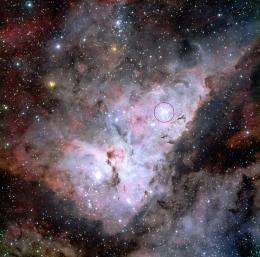
This image of the Carina Nebula shows the position of the Trumpler 14 cluster of stars.
A few orange stars are apparently scattered through Trumpler 14, in charming contrast to their bluish neighbours. These orange stars are in fact stars located behind Trumpler 14. Their reddened colour is due to absorption of blue light in the vast veils of dust and gas in the cloud.The technology used in MAD to correct for the effect of the Earth's atmosphere over large areas of sky will play a crucial role in the success of the next generation European Extremely Large Telescope (E-ELT).
More information: This research has been presented in a paper submitted to Astronomy and Astrophysics ("A MAD view of Trumpler 14", by H. Sana et al.). Research paper — http://staff.scien … ch_tr14.html
-
Trumpler 14: Bright young stars mix it up in new image
Aug 31, 2005 |
not rated yet |
0
-
Strong winds over the keel
Feb 12, 2009 |
not rated yet |
0
-
The little man and the cosmic cauldron
May 27, 2008 |
not rated yet |
0
-
Hubble captures outstanding views of mammoth stars
Nov 25, 2008 |
not rated yet |
0
-
Stellar family in crowded, violent neighborhood proves to be surprisingly normal
Jun 04, 2009 |
not rated yet |
0
-
Engineers build first sub-10-nm carbon nanotube transistor
Feb 01, 2012 |
4.9 / 5 (33) |
30
-
Something old, something new: Evolution and the structural divergence of duplicate genes
Jan 31, 2012 |
4.6 / 5 (7) |
1
-
The hidden nanoworld of ice crystals: Revealing the dynamic behavior of quasi-liquid layers
Jan 30, 2012 |
5 / 5 (4) |
1
-
Stock market network reveals investor clustering
Jan 27, 2012 |
3.9 / 5 (23) |
8
-
Of microchemistry and molecules: Electronic microfluidic device synthesizes biocompatible probes
Jan 26, 2012 |
5 / 5 (2) |
0
-
Never ending outer space.....
Feb 11, 2012
-
Neutron Star fragments?
Feb 11, 2012
-
stationary or not?
Feb 11, 2012
-
Scale of the Universe
Feb 10, 2012
-
Titan's lack of impact craters
Feb 09, 2012
-
Real pictures of black hole eating a star?
Feb 08, 2012
- More from Physics Forums - General Astronomy
More news stories
Latin America mining boom clashes with conservation
Latin America is experiencing a mining boom as prices rise fuelled by a hike in global demand, but the region is also being hit by a wave of violent protests, strikes and rallies by environmentalists.
20 hours ago |
5 / 5 (1) |
1
Salvage workers begin pumping fuel from Italian shipwreck
Salvage workers Sunday began pumping fuel from the shipwrecked Italian cruise liner Costa Concordia, a day ahead of schedule, officials said.
12 hours ago |
5 / 5 (2) |
0
Political leaders play key role in how worried Americans are by climate change: study
More than extreme weather events and the work of scientists, it is national political leaders who influence how much Americans worry about the threat of climate change, new research finds.
Feb 06, 2012 |
5 / 5 (8) |
75
NASA budget will axe Mars deal with Europe: scientists
US President Barack Obama's budget proposal to be submitted next week for 2013 will cut NASA's budget by 20 percent and eliminate a major partnership with Europe on Mars exploration, scientists said Thursday.
Space & Earth / Space Exploration
Feb 10, 2012 |
5 / 5 (4) |
58
Humans may have helped the decline of African rainforests 3000 years ago
(PhysOrg.com) -- Large areas of rainforests in Central Africa mysteriously disappeared over three thousand years ago, to be replaced by savannas. The prevailing theory has been that the cause was a change ...
Scientists discover molecular secrets of 2,000-year-old Chinese herbal remedy
For roughly two thousand years, Chinese herbalists have treated Malaria using a root extract, commonly known as Chang Shan, from a type of hydrangea that grows in Tibet and Nepal. More recent studies suggest that halofuginone, ...
New method to examine batteries -- MRI from the inside
There is an ever-increasing need for advanced batteries for portable electronics, such as phones, cameras, and music players, but also to power electric vehicles and to facilitate the distribution and storage of energy derived ...
A mitosis mystery solved: How chromosomes align perfectly in a dividing cell
Although the process of mitotic cell division has been studied intensely for more than 50 years, Whitehead Institute researchers have only now solved the mystery of how cells correctly align their chromosomes during symmetric ...
Google might launch Drive for cloud storage soon
(PhysOrg.com) -- Google's next big move, according to the Wall Street Journal, is a cloud storage service called Drive. Hardly first to the plate, Google is simply catching up to introducing its cloud reposi ...
Lab study raises questions over nano-particle impact
Tests involving chickens have raised questions about the impact on health from engineered nano-particles, the ultra-fine grains commonly used in drugs and processed foods, scientists said on Sunday.
Starve a virus, feed a cure? Findings show how some cells protect themselves against HIV
A protein that protects some of our immune cells from the most common and virulent form of HIV works by starving the virus of the molecular building blocks that it needs to replicate, according to research published online ...

Dec 03, 2009
Rank: 3 / 5 (1)
With kind regards,
Oliver K. Manuel