Astronauts to taste 'space sushi'
December 3, 2009
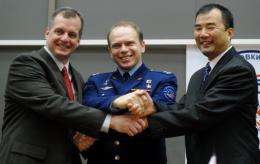
US astronaut Timothy Creamer (L), Russian cosmonaut Oleg Kotov (C), and Japanese astronaut Soichi Noguchi (R) clasp hands during a press conference outside Moscow in Star City. Creamer said on Thursday he was impatient to taste "space sushi" courtesy of his Japanese crewmate after they arrive on the International Space Station (ISS) later this month.
US astronaut Timothy Creamer said on Thursday he was impatient to taste "space sushi" courtesy of his Japanese crewmate after they arrive on the International Space Station (ISS) later this month.
"We can't wait for when Soichi makes us sushi!" Creamer said, referring to Japanese astronaut Soichi Noguchi, at a press conference at the Star City cosmonaut training centre outside Moscow, the Interfax news agency reported.
Noguchi and Creamer -- a US Army colonel making his first flight to space -- as well as Russian cosmonaut Oleg Kotov will blast off on December 21 from the Baikonur space base in Kazakhstan for a two-day voyage to the ISS in a cramped Soyuz capsule.
Separately, recent ISS resident Robert Thirsk said the re-entry ride in the Soyuz had been his favourite part of his entire six-month space voyage.
"The landing was the most interesting and dynamic part of my expedition," said Thirsk, a Canadian astronaut who returned to Earth on Tuesday along with Belgian Frank De Winne and Russian Roman Romanenko.
"In the last 20 minutes before landing the shuttle shook violently and plasma fire could be seen out the window. The feeling was 10 times stronger than all of my expectations!"
Despite the fiery visuals described by Thirsk, Japan's Noguchi expressed full faith in the safety of Russia's Soyuz capsule, whose Soviet-era design has not changed since the 1960s.
"The Soyuz is a very reliable and time-tested space shuttle. I really like its design and I am sure that our flight on it will be without incident," Noguchi said, quoted by RIA-Novosti news agency.
The ISS will be manned by just two people, US astronaut Jeff Williams and Russian cosmonaut Maxim Surayev, until the three new crew members arrive on December 23.
(c) 2009 AFP
-
ISS astronauts land safely in Kazakhstan
Dec 01, 2009 |
not rated yet |
0
-
Brazilian astronaut OK'd for ISS mission
Dec 07, 2005 |
not rated yet |
0
-
Space station crew finally at full staff of six (w/Video)
May 29, 2009 |
not rated yet |
0
-
Astronauts to blast off to expanded space station
May 26, 2009 |
not rated yet |
0
-
New dinner table top priority as ISS expands
May 07, 2009 |
not rated yet |
0
-
Engineers build first sub-10-nm carbon nanotube transistor
Feb 01, 2012 |
4.9 / 5 (31) |
30
-
Something old, something new: Evolution and the structural divergence of duplicate genes
Jan 31, 2012 |
4.6 / 5 (7) |
1
-
The hidden nanoworld of ice crystals: Revealing the dynamic behavior of quasi-liquid layers
Jan 30, 2012 |
5 / 5 (3) |
1
-
Stock market network reveals investor clustering
Jan 27, 2012 |
3.9 / 5 (23) |
8
-
Of microchemistry and molecules: Electronic microfluidic device synthesizes biocompatible probes
Jan 26, 2012 |
5 / 5 (1) |
0
-
Scale of the Universe
8 hours ago
-
Titan's lack of impact craters
Feb 09, 2012
-
Real pictures of black hole eating a star?
Feb 08, 2012
-
Hypothetical way to travel faster than light, but not technically exceed lightspeed
Feb 06, 2012
-
How do scientists monitor the Sun's activity?
Feb 05, 2012
-
Search patterns in observational studies
Feb 05, 2012
- More from Physics Forums - General Astronomy
More news stories
Humans may have helped the decline of African rainforests 3000 years ago
(PhysOrg.com) -- Large areas of rainforests in Central Africa mysteriously disappeared over three thousand years ago, to be replaced by savannas. The prevailing theory has been that the cause was a change ...
Could Venus be shifting gear?
(PhysOrg.com) -- ESAs Venus Express spacecraft has discovered that our cloud-covered neighbour spins a little slower than previously measured. Peering through the dense atmosphere in the infrared, the ...
Space & Earth / Space Exploration
15 hours ago |
5 / 5 (7) |
7
|
NASA budget will axe Mars deal with Europe: scientists
US President Barack Obama's budget proposal to be submitted next week for 2013 will cut NASA's budget by 20 percent and eliminate a major partnership with Europe on Mars exploration, scientists said Thursday.
Space & Earth / Space Exploration
18 hours ago |
5 / 5 (2) |
18
Mars Science Laboratory computer issue resolved
(PhysOrg.com) -- Engineers have found the root cause of a computer reset that occurred two months ago on NASA's Mars Science Laboratory and have determined how to correct it.
Space & Earth / Space Exploration
16 hours ago |
4.7 / 5 (6) |
3
|
Two new moons for Jupiter
Advances in technology have lead to the discovery of new planets outside of our Solar System, and now even new moons in our own backyard.
Space & Earth / Space Exploration
15 hours ago |
4 / 5 (1) |
7
Google users warned of threat to smartphone wallets
Users of Google smartphone wallets were being warned on Friday that there is a way to crack pass codes intended to thwart thieves from going on illicit shopping sprees.
Anonymous knocks CIA website offline (Update)
The website of the Central Intelligence Agency was inaccessible on Friday after the hacker group Anonymous claimed to have knocked it offline.
New error-correcting codes guarantee the fastest possible rate of data transmission
Error-correcting codes are one of the triumphs of the digital age. Theyre a way of encoding information so that it can be transmitted across a communication channel such as an optical fiber o ...
New power source discovered
(PhysOrg.com) -- Researchers at the Massachusetts Institute of Technology (MIT) and RMIT University have made a breakthrough in energy storage and power generation.
Complex wiring of the nervous system may rely on a just a handful of genes and proteins
Researchers at the Salk Institute have discovered a startling feature of early brain development that helps to explain how complex neuron wiring patterns are programmed using just a handful of critical genes. ...
The power of estrogen -- male snakes attract other males
A new study has shown that boosting the estrogen levels of male garter snakes causes them to secrete the same pheromones that females use to attract suitors, and turned the males into just about the sexiest ...