Sandtrapped Rover Makes a Big Discovery
December 3, 2009
Sandtrapped Rover Makes a Big Discovery

Enlarge

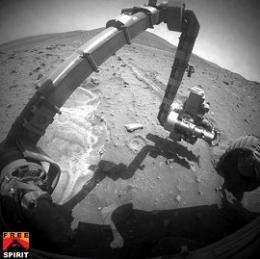
Spirit surveys its own predicament. The bright soil pictured left is loose, fluffy material churned by the rover's left-front wheel as Spirit, driving backwards, broke through a darker, crusty surface. At right is the least-embedded of the rover's six wheels.

Homer's Iliad tells the story of Troy, a city besieged by the Greeks in the Trojan War. Today, a lone robot sits besieged in the sands of Troy while engineers and scientists plot its escape.

Welcome to "Troy" - style. NASA's robotic rover Spirit is bogged down on the Red Planet in a place the rover team named after the ancient city.

So why aren't scientists lamenting?

"The rover's spinning wheels have broken through a crust, and we've found something supremely interesting in the disturbed soil," says Ray Arvidson of the Washington University in St. Louis.

Spirit, like its twin rover Opportunity, has roamed the for nearly 6 years. During that time, the rover has had some close calls and come out fighting from each. In fact, it's been driving backwards since one of its wheels jammed in 2006.

From the beginning, the rovers' motto has been "follow the water." Both rovers have been searching Mars for minerals formed in the presence of H2O. Mars appears dry today, but minerals can provide clues that water was once there.

"It's been easy for Opportunity to find such minerals," explains Arvidson. "Opportunity landed in an ancient lake bed. Spirit has had to work much harder. Spirit landed in basaltic plains formed by chewed up by repeated meteoroid impacts. There's been little evidence of anything that was ever very wet."

But when Spirit reached an area of Mars called the "Columbia Hills," the whole complexion of the mission changed. "Spirit came across iron hydroxide, a mineral that forms in the presence of water. That alerted us to the change. We started coming across more and more rocks formed in the presence of water."

Then Spirit got stuck in a patch of loose soil on the edge of a small crater. Heavy sigh. Stuck again.
Sandtrapped Rover Makes a Big Discovery
Enlarge

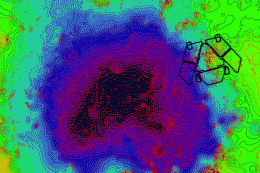
A topographic map of Spirit's surroundings at Troy. Spirit is straddling the edge of a small crater. Sulfate materials are located in the crater (from the middle of the rover and extending to the left). The topo map was generated from stereo images taken by Spirit's navigation camera when it was approaching the area in April 7, 2009.

But wait!

"Spirit had to get stuck to make its next discovery," says Arvidson.

As the rover tried to break free, its wheels began to churn up the soil, uncovering sulfates underneath.

"Sulfates are minerals just beneath the surface that shout to us that they were formed in steam vents, since steam has sulfur in it. Steam is associated with hydrothermal activity - evidence of water-charged explosive volcanism. Such areas could have once supported life."

"And most amazingly, the boundary between the sulfate-rich soil and the soil with just the generic concentration of sulfates runs right down the middle of the stranded rover. Spirit is lodged on the edge of a crater -- sitting astride the boundary!"

"Also, the robot found that the top of the sulfate material is crusty. Ancient sulfates probably formed this crust as they were processed by variations in climate associated with changes in Mars' orbit over millions of years."

Here's what the scientists think: When a Martian pole faces the sun in Martian summer, it gets warmer at that pole and the water ice shifts to the equator. It even snows there! Warm dark soil under the snow causes the bottom layer of snow to melt. The water trickles into the sulfates, dissolving the water-soluble iron sulfates and forming a crust with the calcium sulfates remaining.

"By being stuck at Troy, Spirit has been able to teach us about the modern water cycle on Mars." Indeed, Spirit's saga at Troy has given scientists material evidence of past water on Mars on two time scales: ancient volcanic times, and cycles ongoing to the present day.

"We've sat here for more than 6 months. That's a long time to take measurements. We've learned a lot. Troy is a good place to be under siege, but we’re ready to leave."

Will Spirit break free to continue its incredible journey? Tune in to Science@NASA to find out if the escape plan works.

Source: Science@, by Dauna Coulter

4.8 /5 (56 votes)  

Filter


Move the slider to adjust rank threshold, so that you can hide some of the comments.


Display comments: newest first

Digi
Dec 03, 2009

Rank: 5 / 5 (13)
It is incredible that after six years the rovers are still surprising us, stuck or not. What a success they have been.
tpb
Dec 03, 2009

Rank: 1.3 / 5 (6)
quote
"Sulfates are minerals just beneath the surface that shout to us that they were formed in steam vents, since steam has sulfur in it.

Steam has sulfur in it????
Leannemo
Dec 03, 2009

Rank: 5 / 5 (5)
@tpb: The next sentence explains that it is volcanic steam - which contains sulfur. "Steam is associated with hydrothermal activity - evidence of water-charged explosive volcanism." The writer could have clarified it better. Google or Bing it for more details.
teledyn
Dec 03, 2009

Rank: 4.8 / 5 (5)
if the martian soil deals you fluffy lemons, I guess you might as well make some sulfate lemonaid!
tpb
Dec 03, 2009

Rank: 1 / 5 (4)
@Leannemo
Just because some steam vents on earth have sulfur doesn't mean they did on Mars.
The point is that the sulfates found on mars may have nothing to do with steam vents.
Sonhouse
Dec 04, 2009

Rank: 5 / 5 (1)
@Leannemo
Just because some steam vents on earth have sulfur doesn't mean they did on Mars.
The point is that the sulfates found on mars may have nothing to do with steam vents.

Well lets hear your alternative explanation then.
deatopmg
Dec 04, 2009

Rank: not rated yet
Probably a stupid question but, is the arm strong enough to lift and rotate the rover until it is off the rock that it is supposedly hung up on or until it is at least pointed backwards downhill?

Also, since all of the minerals found so far on Mars are in an oxidized form (where did the oxygen come from?) it is likely that the "sulfur" in the volcanic "steam" vents was also oxidized and in the form of sulfur dioxide. Further oxidation of the SO2 to sulfur trioxide by reaction with oxygen in the atmosphere then neutralization by the iron hydroxide generated the sulfate ion.

"From the beginning, the rovers' motto has been "follow the water."" HMMMM, then why is there no direct water measurement device like a conductivity probe or IR spectrometer? Many of the photos show one or the other rover's tracks passing from dry sandy soil into a lower area of wet cohesive sand and then out again. Is it water or some unknown process making the sand sticky? Must be the latter.
googleplex
Dec 04, 2009

Rank: not rated yet
Good point deatopmg.
Can't he claw his way out by using its arm like an ice axe in the sand. Probably hard to get a purchase on the sand. But worth a try. They could test it on earth using a copy of the rover...I assume that they have one.
PieRSquare
Dec 04, 2009

Rank: 4.7 / 5 (3)
I don't know the specs but I suspect the motors in the arm were only designed to move the arm itself and not for doing push-ups, crater-climbing or pole-vaulting.
Velanarris
Dec 04, 2009

Rank: 2 / 5 (1)
@Leannemo
Just because some steam vents on earth have sulfur doesn't mean they did on Mars.
The point is that the sulfates found on mars may have nothing to do with steam vents.

Well lets hear your alternative explanation then.


An easy explanation would be Ammonia vents. Perhaps perchlorate vents, any number of other NON water devices can result in sulphurous steam like deposits.
redmoon
Dec 04, 2009

Rank: 5 / 5 (3)
@deatopmg: The robotic arm (technical name is "Instrument Deployment Device" = IDD) is not strong enough to lift or to move the rover. The arm exerts only 14 lbs (6,35 kg) of force while the rover weighs 150 lbs (68 kg) on Mars. Also this action could damage the scientific instruments at the end of the IDD.
Rank 4.8 /5 (56 votes)
Related Stories
Relevant PhysicsForums posts
  • Titan's lack of impact craters
    created12 hours ago
  • Real pictures of black hole eating a star?
    createdFeb 08, 2012
  • Hypothetical way to travel faster than light, but not technically exceed lightspeed
    createdFeb 06, 2012
  • How do scientists monitor the Sun's activity?
    createdFeb 05, 2012
  • Search patterns in observational studies
    createdFeb 05, 2012
  • Derivation of Pogson's law
    createdFeb 03, 2012
  • More from Physics Forums - General Astronomy

More news stories

Deconstructing a mystery: What caused Snowmaggedon?

In the quiet after the storms, streets and cars had all but disappeared under piles of snow. The U.S. Postal Service suspended service for the first time in 30 years. Snow plows struggled to push the evidence ...

Space & Earth / Earth Sciences

created 8 hours ago | popularity 4.7 / 5 (3) | comments 1 | with audio podcast

Researchers create 3-D laser maps that show how earthquake changes landscape

Geologists have a new tool to study how earthquakes change the landscape down to a few inches, and it's giving them insight into how earthquake faults behave. In the Feb. 10 issue of the journal Science, a team ...

Space & Earth / Earth Sciences

created 10 hours ago | popularity 5 / 5 (4) | comments 0 | with audio podcast

Ocean microbe communities changing, but long-term environmental impact is unclear

As oceans warm due to climate change, water layers will mix less and affect the microbes and plankton that pump carbon out of the atmosphere – but researchers say it's still unclear whether these processes ...

Space & Earth / Earth Sciences

created 10 hours ago | popularity 5 / 5 (2) | comments 2 | with audio podcast

New views show old NASA Mars landers

(PhysOrg.com) -- The High Resolution Imaging Science Experiment (HiRISE) camera on NASA's Mars Reconnaissance Orbiter recorded a scene on Jan. 29, 2012, that includes the first color image from orbit showing ...

Space & Earth / Space Exploration

created 16 hours ago | popularity 4.9 / 5 (7) | comments 5 | with audio podcast

Black holes and star formation

(PhysOrg.com) -- It has long been recognized that galaxy mergers or even close interactions can play a vital role in shaping the morphology of galaxies. One way they can do so, it is thought, is by triggering ...

Space & Earth / Astronomy

created 15 hours ago | popularity 4 / 5 (6) | comments 3 | with audio podcast


'Dark plasmons' transmit energy

Microscopic channels of gold nanoparticles have the ability to transmit electromagnetic energy that starts as light and propagates via "dark plasmons," according to researchers at Rice University.

FDA-approved drug rapidly clears amyloid from the brain, reverses Alzheimer's symptoms in mice

Neuroscientists at Case Western Reserve University School of Medicine have made a dramatic breakthrough in their efforts to find a cure for Alzheimer's disease. The researchers' findings, published in the journal Science, show t ...

Hydrogen from acidic water: Researchers develop potential low cost alternative to platinum for splitting water

A technique for creating a new molecule that structurally and chemically replicates the active part of the widely used industrial catalyst molybdenite has been developed by researchers with the Lawrence Berkeley ...

Ultraviolet protection molecule in plants yields its secrets

Lying around in the sun all day is hazardous not just for humans but also for plants, which have no means of escape. Ultraviolet (UV) radiation from the sun can damage proteins and DNA inside cells, leading ...

Anyone can learn to be more inventive, cognitive researcher says

There will always be a wild and unpredictable quality to creativity and invention, says Anthony McCaffrey, a cognitive psychology researcher at the University of Massachusetts Amherst, because an "Aha moment" is rare and ...

New method makes culture of complex tissue possible in any lab

Scientists at the University of California, San Diego have developed a new method for making scaffolds for culturing tissue in three-dimensional arrangements that mimic those in the body. This advance, published online in ...