Chicken of the sea? Tuna farming getting a boost
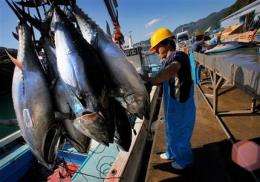
(AP) -- Thousands of tuna, their silver bellies bloated with fat, swim frantically around in netted areas of a small bay, stuffing themselves until they grow twice as heavy as in the wild. Is this sushi's future? Tuna raised like chickens or cows?
As the world's love affair with raw fish depletes wild tuna populations, long-running efforts to breed the deep-sea fish from egg to adulthood may finally be bearing fruit. Though the challenges are daunting, the potential profits are huge.
By the end of this year, an Australian company says it will begin selling small amounts of southern bluefin tuna hatched in its fishery. A Japanese firm breeding the more prized Pacific bluefin tuna hopes to start sales in 2013 and ship 10,000 fish by 2015.
Whether tuna farming will become viable on a large scale remains an unanswered question. Tuna are much harder to rear than the widely farmed salmon and shrimp. They are large and need room to swim. They only spawn under certain circumstances. In some experiments, fewer than 1 percent of the babies survive. And those that do eat so much that they could wipe out other fish species.
The bulk of the tuna farmed today isn't bred from eggs; it is caught in the sea and fattened on farms, which does nothing to save nature's dwindling stock.
Atlantic bluefin, found in the Atlantic Ocean and the Mediterranean, is disappearing so rapidly that Monaco is pushing to list it as an endangered species at an international meeting in Qatar in March. The U.S. says it will back the proposal.
Separately, the International Commission for the Conservation of Atlantic Tunas recently slashed the quota for next year's catch by about a third to 13,500 tons, a move criticized by environmentalists as not going far enough.
No wonder Japan's biggest seafood company, Maruha Nichiro Holdings Inc., is bullish on tuna. Maruha operates several tuna farms, including the one here in Kumano, a small coastal city in western Japan. Here, in a small bay, the fish live in netted sections mostly 50 meters by 80 meters (160 feet by 260 feet), smaller than a football field.
"For years, everyone assumed it was impossible to breed tuna on farms," says Takashi Kusano, a general manager who has worked for 20 years on cultivating tuna. "Tuna remains forever a mystery."
Japanese consume 80 percent of the world's Atlantic and Pacific bluefin tuna, the two species most sought after by sushi lovers. In Japan, they are called "hon-maguro," which translates roughly as "true tuna."
The survival rate for hatched Pacific bluefin is about 0.4 percent of the 28 million eggs collected for tests at Maruha's farms. Another effort, at Japan's Kinki University, has achieved a 6 percent survival rate.
Those numbers sound low, but one tuna lays tens of millions of eggs and the survival rates are improving.
"I had to solve the puzzle of why our fish kept dying," recalls Kusano.
Unlike other fish, which can pump oxygen better through their mouths, tuna must swim continuously at up to 80 kph (50 mph) to absorb oxygen through their gills.
Baby fish, which aren't developed enough to brake or steer, often die ramming into the nets that cordon off tuna farms in coastal waters.
Learning about tuna diseases and dietary habits took years of trial and error, and tuna are surprisingly vulnerable to stress, Kusano said.
A handful of tuna that Maruha has produced are set to lay eggs next year, a sign that the full life cycle may be finally completed.
Kinki University has already done that, producing 40,000 Pacific bluefin babies this year from eggs laid by tuna on its farms, up from 10,000 last year.
Even if the hurdles to a full life cycle are cleared, other concerns remain, such as the tuna's voracious appetite.
"Bluefin tuna are like lions and tigers. They are at the very, very top of the food chain. And they eat other fish. What you are doing is catching wild fish to create bluefin tuna," said Mike Hirshfield, chief scientist at Oceana, an advocacy group for the world's oceans. "The anchovies, the sardines and the herrings are already fished to the max."
That raises ethical questions about feeding tuna with relatively cheap fish that are needed by people in developing countries, Hirshfield said.
Maruha's answer is a tuna feed, which it patented in 2006, made of fishmeal mixed with oils and nutrients and looking like brown sausages.
The company says its feed is less polluting, fattens tuna three times faster than feeding them small fish, uses fish that aren't eaten by people, and can be stored at room temperature, slashing energy needs.
Eventually, Maruha hopes to develop a vegetarian tuna feed.
Hirshfield calls vegetarian feed the last hope, noting it has had some success with salmon and trout.
Wild tuna still commands a premium over farmed tuna. In January, a 200-kilogram (440-pound) Pacific bluefin tuna fetched a record 20.2 million yen ($220,000) at a Japanese fish market. 40-kilogram (90-pound) tuna raised at Maruha fetch about 100,000 yen ($1,100) each.
Farmed tuna's disadvantage is that "it doesn't have a fish taste, and its color is almost white," said Kazuo Sato, 56, who has run a sushi shop outside of Tokyo for 31 years. But, he added, "we can't be relying just on natural tuna these days, and there are bound to be improvements in farmed tuna."
Maruha harvests its fish the old-fashioned way, with baited lines from small boats - the method believed best to preserve a sought-after buttery taste.
The company aims to be marketing 10,000 tuna bred from eggs in 2015, worth 1.5 billion yen ($17 million) at today's prices. That would be 10 percent of Japan's current annual farmed tuna production of 5,000 tons, only a tiny fraction of the 44,000 tons still caught in the wild.
At Kinki University, Osamu Murata, head of research, says, "It's our mission to spread to the world our knowledge about producing man-raised tuna that doesn't rely on nature's resources."
In Australia, Clean Seas Tuna worked with Kinki to overcome such problems as cannibalism and young tuna crashing into tank walls, the company said. And Hawaiian regulators have approved the world's first commercial farm for "ahi," bigeye tuna.
In Japan, tuna is such a staple that it recently merited an editorial in Yomiuri, the country's largest newspaper, urging readers to curb their appetites for the sake of the fish's long-term survival.
That would include eating less "toro," the prized fatty cut. "To keep enjoying 'toro,' we must exercise self-control," it said.
©2009 The Associated Press. All rights reserved. This material may not be published, broadcast, rewritten or redistributed.


