Virgin Galactic readies maiden suborbital flight
December 6, 2009 by Paula Bustamante
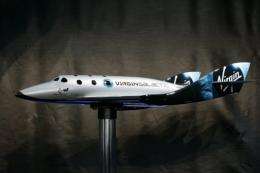
A scale model of the Virgin Galactic SpaceShipTwo

Enlarge

A scale model of the Virgin Galactic SpaceShipTwo in 2008 at the America Museum of Natural History in New York. British billionaire Sir Richard Branson will unveil a craft on Monday that could soon carry tourists on an out-of-this-world trip into space -- for a mere 200,000 dollars.

British billionaire Sir Richard Branson will unveil a craft on Monday that could soon carry tourists on an out-of-this-world trip into space -- for a mere 200,000 dollars. (Update: Virgin Galactic unveils commercial spaceship)

The lunar-like landscape of the Mojave desert between Los Angeles and Las Vegas will stage the roll-out of Virgin Galactic's SpaceShipTwo (SS2), the brain child of aerospace engineer Burt Rutan.

SS2, which can carry six passengers and two pilots, plans to begin test flights next year and start commercial flights between 2011 and 2012.

Virgin Galactic, owned by Branson's Virgin Group and Abu Dhabi's Aabar Investments, says about 300 adventurers from around the world have paid a total of 40 million dollars in deposits to guarantee spots on the carbon composite wonder machine.

Aerospace experts are already bidding on suborbital flights as the next generation of business travel.

Pamela Hurley-Moser, owner of Hurley Travel Experts in Portland, Oregon, is among 50 travel consultants chosen as accredited space agents for Virgin Galactic.

The company now boasts specials to Iceland, Thailand and, yes, space.

But space tourism, for now, remains an exclusive experience reserved for those willing to pay the hefty fee for a seat on the two-and-a-half-hour flights 100 kilometers (62 miles) above Earth.

"Just as aviation, and before that rail and automobile transportation, first a few will go to space, but ultimately, over the next hundred years or so, spaceflight will become commonplace," said Charles Chafer, chief executive of Space Services, which specializes in space funerals.

In 2007, the Houston, Texas company released into space the ashes of "Star Trek" star James Doohan.

But Hong Kong to London in three hours?

"This is possible," Chafer told AFP. "And the history of human transportation suggests that when it is possible to shorten travel times, markets grow to enable that activity."

Space Services spokeswoman Susan Schonfeld noted that the company now takes the ashes of hundreds of people at a time into space, up from about 27 people in 2007.

"Through the years, I have had the opportunity to speak to hundreds and hundreds of people from all over the world," she noted. "We have launched very famous people... but 99 percent of the people are everyday people like myself that have a very deep sense of exploration I do believe is in all of us."

For Chafer, what today seems like an indulgence for adventurous millionaires will spur the construction of facilities for a solar power satellite system, asteroid exploration, mineral extraction and research of compounds cheaper to produce in microgravity.

"Transportation is an enabling tool," the aerospace executive insisted.

"Once we have routine transportation into suborbital and orbital space we will see business travel and package delivery times reduced and we will begin to see construction of large facilities in Earth orbit."

For Monday's launch, the WhiteKnightTwo mothership, which boasts a wingspan of 140 feet (42.7 meters), will carry the smaller SS2 rocket ship 50,000 feet (15.2 kilometers) into the sky before it detaches and blasts up to the brink of space.

There, the tourists can experience five minutes of weightlessness in a cabin with circular windows on the sides and the ceiling.

"As humanity eventually moves to other planets and bodies throughout the solar system, we will of course fly into -- and eventually live in -- space," predicted Chafer.

(c) 2009 AFP

Filter


Move the slider to adjust rank threshold, so that you can hide some of the comments.


Display comments: newest first

plasticpower
Dec 06, 2009

Rank: 4 / 5 (3)
Awesome news! Maybe by the time I am retired we will have affordable tickets for suborbital and orbital flights, and maybe even hotels in space.
DocM
Dec 06, 2009

Rank: 4.3 / 5 (3)
Besides the suborbital adventures by Virgin Galactic (SS2) and XCOR (Lynx) there are the orbital efforts by SpaceX (Dragon) and Bigelow Aerospace (Orion Lite - same pressure hull as NASA's Orion in a lighter structure.)

Bigelow Aerospace is also slated to launch the 175 cu/m Sundancer module for their space station in 2012 on a SpaceX Falcon 9 booster, followed by 2 larger 330 cu/m modules on Atlas V's. Theoretically their station could attach up to 4 of the 330 cu/m modules and 1 Sundancer.

Just 2+Sundancer would give Bigelow's station more internal volume than the ISS.

Looks to be an exciting few years....
KBK
Dec 06, 2009

Rank: 3.2 / 5 (5)
This is not going to mature or go much further until some other basic method of propulsion is found or brought forth. It is really that simple. This ignorance of nearly 100 years of Brute force, ie, rockets and similar propulsive systems is going to have to go the way of the Dodo bird - before things really get moving.
rjm1percent
Dec 06, 2009

Rank: 2.3 / 5 (3)
@kiyle, There are many alternatives to rocket propulsion that have been field tested and could well be in use in the near future. Try, solar sails, par example.
Arikin
Dec 06, 2009

Rank: 3 / 5 (3)
rjm1percent. Solar sails are used once you get into space... Not to escape earth's gravity.

I think KBK is thinking of a more eloquent way of 'slipping' past :-) gravity. You know like "slipping, falling, and missing the earth" to use a quote.
rjm1percent
Dec 06, 2009

Rank: 1.3 / 5 (3)
@Arikin, how about combining the use of light propulsion to escape earth's gravity, with the use of solar sails. Obviously both technologies still require tweaking, but it's just a thought.
Buyck
Dec 07, 2009

Rank: 4 / 5 (2)
Ach... the Spanish company "Galactic Suite" will have in 2012 a spacehotel operational in low orbit around the earth. "Bigelow Areospace" also announced that they will have a spacehotel to in 2012. So "Virgin Galactic" is just only the beginning of space colonization.
TheBigYin
Dec 07, 2009

Rank: 3.8 / 5 (4)
Until anti-gravity is discovered (!joke!) or we have a space-elevator (c.f A.C.Clarke) then we are going to have to use an ejectile propulsion system for the forseeable future.

KBK, I would hardly call Newtons Laws 'ignorance' - just the only method we have of giving sufficient momentum to our spaceships for now! We don't have the physics (yet) to do it any other way.

As for solar sails, the pressure exerted by the solar wind and/or photon evergy is only sufficient for space-travel once in interpanetary space - it will never be a part of getting from the surface into orbit (unless you count balloons!)
vit
Dec 07, 2009

Rank: 2 / 5 (3)
Give me just 100K and I'll mix you up a weed, booze and vicodin cocktail that'll make feel weightless for much longer than five minutes. I'll even punch you in the guts to make you puke and complete the experience.
yyz
Dec 08, 2009

Rank: not rated yet
I can't help but notice the similarity in appearance between the SS2 and the old X-20 Dyna-Soar from the '60s ( http://en.wikiped...Dynasoar ). Sorta like a Dyna-Soar with windows! Of course the flight characteristics of the two are completely different, but the similarity is uncanny.
Rank 5 /5 (23 votes)
Related Stories
Relevant PhysicsForums posts

More news stories

Scientists chart high-precision map of Milky Way's magnetic fields

(PhysOrg.com) -- Scientists at the Naval Research Laboratory (NRL) are part of an international team that has pooled their radio observations into a database, producing the highest precision map to date of ...

Space & Earth / Astronomy

created 10 hours ago | popularity 5 / 5 (4) | comments 9 | with audio podcast

Coral growth in Western Australia found to be thriving in warmer water

(PhysOrg.com) -- As most people are well aware, global warming isn’t just about the atmosphere, it’s about rising ocean temperatures as well. And like increases in the atmosphere, scientists aren’t ...

Space & Earth / Environment

created 12 hours ago | popularity 5 / 5 (1) | comments 7 | with audio podcast report

Surface of Mars an unlikely place for life after 600 million year drought, say scientists

Mars may have been arid for more than 600 million years, making it too hostile for any life to survive on the planet's surface, according to researchers who have been carrying out the painstaking task of analysing ...

Space & Earth / Space Exploration

created 10 hours ago | popularity 4.1 / 5 (8) | comments 1 | with audio podcast

Global extinction: Gradual doom is just as bad as abrupt

A painstakingly detailed investigation shows that mass extinctions need not be sudden events. The deadliest mass extinction of all took a long time to kill 90 percent of Earth's marine life, and it killed ...

Space & Earth / Earth Sciences

created 10 hours ago | popularity 3.9 / 5 (15) | comments 0 | with audio podcast

Mission to land on a comet

Europe’s Rosetta spacecraft is en route to intercept a comet– and to make history. In 2014, Rosetta will enter orbit around comet 67P/Churyumov-Gerasimenkoand land a probe on it, two firsts.

Space & Earth / Space Exploration

created 12 hours ago | popularity 5 / 5 (2) | comments 1 | with audio podcast


Amazon fungi found that eat polyurethane, even without oxygen

(PhysOrg.com) -- Until now polyurethane has been considered non-biodegradable, but a group of students from Yale University in the US has found fungi that will not only eat and digest it, they will do so even in the absence ...

Whole exome sequencing identifies cause of metabolic disease

Sequencing a patient's entire genome to discover the source of his or her disease is not routine – yet. But geneticists are getting close.

Hearing metaphors activates brain regions involved in sensory experience

When a friend tells you she had a rough day, do you feel sandpaper under your fingers? The brain may be replaying sensory experiences to help understand common metaphors, new research suggests.

Renowned physicist invents microscope that can peer at living brain cells

(PhysOrg.com) -- Ever since scientists began studying the brain, they’ve wanted to get a better look at what was going on. Researchers have poked and prodded and looked at dead cells under electron microscopes, ...

New kind of high-temperature photonic crystal could someday power everything from smartphones to spacecraft

A team of MIT researchers has developed a way of making a high-temperature version of a kind of materials called photonic crystals, using metals such as tungsten or tantalum. The new materials — which ...

Discovery of extremely long-lived proteins may provide insight into cell aging

One of the big mysteries in biology is why cells age. Now scientists at the Salk Institute for Biological Studies report that they have discovered a weakness in a component of brain cells that may explain ...