Scientists build 'single-atom transistor'
December 6, 2009
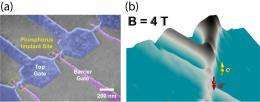
(a) Colored scanning electron microscope image of the measured device. Aluminum top gate is used to induce a two-dimensional electron layer at the silicon-silicon oxide interface below the metallization. The barrier gate is partially below the top gate and depletes the electron layer in the vicinity of the phosphorus donors (the red spheres added to the original image). The barrier gate can also be used to control the conductivity of the device. All the barrier gates in the figure form their own individual transistors. (b) Measured differential conductance through the device at 4 Tesla magnetic field. The red and the yellow spheres illustrate the spin-down and -up states of a donor electron which induce the lines of high conductivity clearly visible in the figure.
(PhysOrg.com) -- Researchers from Helsinki University of Technology (Finland), University of New South Wales (Australia), and University of Melbourne (Australia) have succeeded in building a working transistor, whose active region composes only of a single phosphorus atom in silicon. The results have just been published in Nano Letters.
The working principles of the device are based on sequential tunneling of single electrons between the phosphorus atom and the source and drain leads of the transistor. The tunneling can be suppressed or allowed by controlling the voltage on a nearby metal electrode with a width of a few tens of nanometers.
The rapid development of computers, which created the present information society, has been mainly based on the reduction of the size of transistors. We have known for a long time that this development has to slow down critically during the future decades when the even tighter inexpensive packing of transistors would require them to shrink down to the atomic length scales. In the recently developed transistor, all the electric current passes through the same single atom. This allows us to study the effects arising in the extreme limit of the transistor size.
“About half a year ago, I and one of the leaders of this research, Prof. Andrew Dzurak, were asked when we expect a single-atom transistor to be fabricated. We looked at each other, smiled, and said that we have already done that”, tells Dr. Mikko Möttönen. “In fact, our purpose was not to build the tiniest transistor for a classical computer, but a quantum bit which would be the heart of a quantum computer that is being developed worldwide”, he continues.
Problems arising when the size of a transistor is shrunk towards the ultimate limit are due to the emergence of so-called quantum mechanical effects. On one hand, these phenomena are expected to challenge the usual transistor operation. On the other hand, they allow classically irrational behavior which can, in principle, be harnessed for conceptually more efficient computing, quantum computing.
The driving force behind the measurements reported now is the idea to utilize the spin degree of freedom of an electron of the phosphorus donor as a quantum bit, a qubit. The researchers were able to observe in their experiments spin up and down states for a single phosphorus donor for the first time. This is a crucial step towards the control of these states, that is, the realization of a qubit.
More information: Original research article has been published in Nano Letters on Dec. 1st, 2009: Transport Spectroscopy of Single Phosphorus Donors in a Silicon Nanoscale Transistor, Kuan Yen Tan, Kok Wai Chan, Mikko Möttönen, Andrea Morello, Changyi Yang, Jessica van Donkelaar, Andrew Alves, Juha-Matti Pirkkalainen, David N. Jamieson, Robert G. Clark, and Andrew S. Dzurak, Nano Lett., Article ASAP, DOI:10.1021/nl901635j
Provided by Helsinki University of Technology
-
Searching for a single-electron source of standard quantized current
Aug 14, 2008 |
not rated yet |
0
-
Researchers shine light on atomic transistor
Nov 22, 2006 |
not rated yet |
0
-
Unknown molecule opens the door to quantum computing
Jun 27, 2008 |
not rated yet |
0
-
Detecting the spin of a single electron in a standard silicon transistor
Aug 10, 2004 |
not rated yet |
0
-
Theorist helps develop first single molecule transistor
Jun 07, 2005 |
not rated yet |
0
-
Engineers build first sub-10-nm carbon nanotube transistor
Feb 01, 2012 |
4.9 / 5 (29) |
30
-
Something old, something new: Evolution and the structural divergence of duplicate genes
Jan 31, 2012 |
4.6 / 5 (7) |
1
-
The hidden nanoworld of ice crystals: Revealing the dynamic behavior of quasi-liquid layers
Jan 30, 2012 |
5 / 5 (3) |
1
-
Stock market network reveals investor clustering
Jan 27, 2012 |
4 / 5 (22) |
8
-
Of microchemistry and molecules: Electronic microfluidic device synthesizes biocompatible probes
Jan 26, 2012 |
5 / 5 (1) |
0
-
vision at speed?
1 hour ago
-
Modelling The Transition Between Membrane and Beam Regime's
3 hours ago
-
Evidence that light is electromagnetic wave
4 hours ago
-
What kind of charges is within the smoke from cigarette?
4 hours ago
-
wave-particle duality and special relativity
5 hours ago
-
What happen to a metal bar near a Van de Graaff?
5 hours ago
- More from Physics Forums - General Physics
More news stories
New kind of solar cell could capture significantly more energy than current cells
New solar cells could increase the maximum efficiency of solar panels by over 25%, according to scientists from the University of Cambridge.
5 hours ago |
4.8 / 5 (5) |
9
|
Revealing how a battery material works
Since its discovery 15 years ago, lithium iron phosphate (LiFePO4) has become one of the most promising materials for rechargeable batteries because of its stability, durability, safety and ability to deliver ...
Nanotechnology / Nanomaterials
10 hours ago |
5 / 5 (4) |
0
|
Will bubble-powered microrockets zoom through the human stomach?
Scientists have developed a new kind of tiny motor which they term a "microrocket" that can propel itself through acidic environments, such as the human stomach, without any external energy source, ...
Nanotechnology / Nanomaterials
4 hours ago |
not rated yet |
0
'Shish kebab' structure provides improved form of 'buckypaper'
Scientists are reporting development of a new form of buckypaper, which eliminates a major drawback of these sheets of carbon nanotubes -- 50,000 times thinner than a human hair, 10 times lighter than steel, ...
Nanotechnology / Nanomaterials
3 hours ago |
not rated yet |
0
|
Nanoshell whispering galleries improve thin solar panels
Visitors to Statuary Hall in the U.S. Capitol Building may have experienced a curious acoustic feature that allows a person to whisper softly at one side of the cavernous, half-domed room and for another on ...
Nanotechnology / Nanomaterials
Feb 07, 2012 |
4.2 / 5 (5) |
6
|
New images capture 'stealth merger' of dwarf galaxies
New images of a nearby dwarf galaxy have revealed a dense stream of stars in its outer regions, the remains of an even smaller companion galaxy in the process of merging with its host. The host galaxy, known ...
Chandra finds Milky Way's black hole grazing on asteroids
(PhysOrg.com) -- The giant black hole at the center of the Milky Way may be vaporizing and devouring asteroids, which could explain the frequent flares observed, according to astronomers using data from NASA's ...
Windows 8 preview set for February 29
Microsoft on Wednesday revealed plans to unveil a test version of its latest Windows computer operating software later this month.
In scientific coup, Russians reach Antarctic lake
After more than two decades of drilling in Antarctica, Russian scientists have reached a gigantic freshwater lake hidden under miles of ice for some 20 million years - a pristine body of water that may hold ...
European Internet campaigners battle ACTA
A controversial international accord billed as a way to beat online piracy has sparked a fightback led by Internet users in ex-communist countries who say the region's past underlines the need to defend freedom.
Phelps using hyperbaric chamber to aid recovery
(AP) -- Michael Phelps is the latest athlete to use a hyperbaric chamber to aid his recovery from training.
Dec 06, 2009
Rank: 4 / 5 (1)
Or will it?
Dec 07, 2009
Rank: 5 / 5 (1)
Dec 10, 2009
Rank: not rated yet