NRL's MISSE7 launched aboard STS-129
December 7, 2009
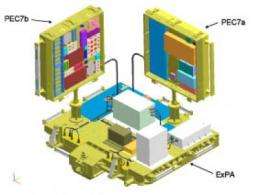
This is an illustration of the MISSE7 experiment showing the two Passive Experiment containers (labeled PECa and PECb) and the Express Payload Adapter. Credit: Naval Research Laboratory
The Materials on the International Space Station Experiment (MISSE) 7, designed and built by the Naval Research Laboratory (NRL), launched aboard STS-129 on November, 16, for transport to the International Space Station.
MISSE7 consists of two Passive Experiment Carriers (PEC7a and PEC7b) and three experiments mounted to the Express Pallet Assembly (ExPA). The individual experiments on MISSE7 include in situ monitoring of materials exposure, environmental monitoring including temperature, atomic oxygen exposure, and ionizing radiation. "The results will provide a better understanding of the durability of advanced materials and electronics when they are exposed to vacuum, solar radiation, atomic oxygen, and extremes of heat and cold," explains Mr. Phillip Jenkins, principal investigator. These materials and electronics, including solar cells, coatings, thermal protection, optics, sensors, and computing elements, have the potential to increase the performance and useful life of the next generation of satellites and launch systems.
NRL is responsible for the overall hardware integration and operation of MISSE7, including the power and data interfaces between the ISS and over 20 experiments included on MISSE7. NRL designed and built the power supply and thermal control system. The Communications Interface Board (CIB), which serves as the communication link between the ISS and the MISSE7 experiments, was designed, built, programmed and delivered to NRL by the Mobile And Remote Sensing (MARS) Lab at NASA GRC. Individual experiments that make up MISSE7 include investigators from NASA, DoD, DOE and university derived experiments. MISSE7 was integrated and flown under the direction of DoD's Space Test Program. NRL researchers from the Spacecraft Engineering Department and Electronics Science & Technology Division worked in conjunction on the MISSE7 project.
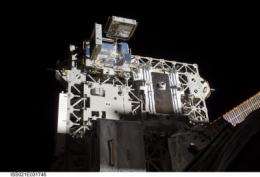
The MISSE 7 experiment on the Express Logistics Carrier 2 of the International Space Station was photographed by a space-walking STS-129 astronaut during the mission's third and final session of extravehicular activity (EVA). This is the latest in a series of experiments that expose materials and composite samples to space for several months before they are returned for experts to analyze. This MISSE experiment actually is plugged into the space station’s power supply. Credit: National Aeronautics and Space Administration, ISS021-E-031746, 23 Nov. 2009
After the PECs and ExPA were transported to the ISS on STS-129 the ExPA, fully integrated on the Express Logistics Carrier-2 (ELC2), was installed onto the ISS. On flight day eight, astronauts performed an "Extra Vehicular Activity" (EVA) and installed the PECs onto the ExPA and opened the PECs to expose the experiments to the space environment. The PECs will remain on the International Space Station for approximately eight months when they will be returned to Earth during the STS-134 mission. The ExPA will be left behind to support the next mission, MISSE 8.
Below is a summary list of the experiments flying on MISSE7.
- Xilinx Vertex 4 and Vertex 5 single event upset (SEU) testing - Sandia National Laboratory (SNL)
- Solar cell testing - NRL; Air Force Research Laboratory (Space Vehicles
Directorate), Lockheed Martin
- Atomic oxygen erosion and fluence monitoring - NASA GRC
- Mirror component testing - Aerospace Corp. and NRL
- Space Cube, advanced processor design SEU testing - NASA GSFC
- Multi-core processor single event upset testing - NRL
- SiC electronics testing - NASA GRC
- Raytheon's "Victory Chip" CMOS imager array - Assurance Technology
- HyperX, a high-performance, ultra-low power processor, SEU testing - NASA GSFC
- Materials exposure and environmental sensor suite - Air Force Research Laboratory, NASA GRC, MSFC, ARC, JSC, SNL and Boeing Phantom Works
- Tribology measurements - Air Force Research Laboratory and U of Florida
- Miniaturized electrostatic analyzer - US Air Force Academy
-
ORMatE returns to NRL after nearly 2 years in Earth orbit
Sep 30, 2009 |
not rated yet |
0
-
HICO-RAIDS experiments ready for payload integration
Sep 26, 2008 |
not rated yet |
0
-
Return to Sender: MISSE-6 Comes Home After More Than a Year in Space
Sep 03, 2009 |
not rated yet |
0
-
Opening The Door To New Materials For Exploration
Oct 07, 2005 |
not rated yet |
0
-
Sandia piezoelectric films to be part of NASA space station experiment
Aug 08, 2006 |
not rated yet |
0
-
Engineers build first sub-10-nm carbon nanotube transistor
Feb 01, 2012 |
4.9 / 5 (31) |
30
-
Something old, something new: Evolution and the structural divergence of duplicate genes
Jan 31, 2012 |
4.6 / 5 (7) |
1
-
The hidden nanoworld of ice crystals: Revealing the dynamic behavior of quasi-liquid layers
Jan 30, 2012 |
5 / 5 (3) |
1
-
Stock market network reveals investor clustering
Jan 27, 2012 |
3.9 / 5 (23) |
8
-
Of microchemistry and molecules: Electronic microfluidic device synthesizes biocompatible probes
Jan 26, 2012 |
5 / 5 (1) |
0
-
Scale of the Universe
5 hours ago
-
Titan's lack of impact craters
Feb 09, 2012
-
Real pictures of black hole eating a star?
Feb 08, 2012
-
Hypothetical way to travel faster than light, but not technically exceed lightspeed
Feb 06, 2012
-
How do scientists monitor the Sun's activity?
Feb 05, 2012
-
Search patterns in observational studies
Feb 05, 2012
- More from Physics Forums - General Astronomy
More news stories
Humans may have helped the decline of African rainforests 3000 years ago
(PhysOrg.com) -- Large areas of rainforests in Central Africa mysteriously disappeared over three thousand years ago, to be replaced by savannas. The prevailing theory has been that the cause was a change ...
NASA sees wide-eyed cyclone Jasmine
Cyclone Jasmine's eye has opened wider on NASA satellite imagery, as it moves through the Southern Pacific Ocean.
Space & Earth / Earth Sciences
4 hours ago |
2 / 5 (1) |
1
Could Venus be shifting gear?
(PhysOrg.com) -- ESAs Venus Express spacecraft has discovered that our cloud-covered neighbour spins a little slower than previously measured. Peering through the dense atmosphere in the infrared, the ...
Space & Earth / Space Exploration
12 hours ago |
5 / 5 (7) |
7
|
NASA sees Giovanna reach cyclone strength, threaten Madagascar
Tropical Storm 12S built up steam and became a cyclone on February 10, 2012 as NASA's Terra satellite passed overhead. Residents of east-central Madagascar should prepare for this cyclone to make landfall ...
Space & Earth / Earth Sciences
4 hours ago |
not rated yet |
0
Mars Science Laboratory computer issue resolved
(PhysOrg.com) -- Engineers have found the root cause of a computer reset that occurred two months ago on NASA's Mars Science Laboratory and have determined how to correct it.
Space & Earth / Space Exploration
13 hours ago |
4.7 / 5 (6) |
3
|
Google users warned of threat to smartphone wallets
Users of Google smartphone wallets were being warned on Friday that there is a way to crack pass codes intended to thwart thieves from going on illicit shopping sprees.
Anonymous knocks CIA website offline (Update)
The website of the Central Intelligence Agency was inaccessible on Friday after the hacker group Anonymous claimed to have knocked it offline.
Complex wiring of the nervous system may rely on a just a handful of genes and proteins
Researchers at the Salk Institute have discovered a startling feature of early brain development that helps to explain how complex neuron wiring patterns are programmed using just a handful of critical genes. ...
New error-correcting codes guarantee the fastest possible rate of data transmission
Error-correcting codes are one of the triumphs of the digital age. Theyre a way of encoding information so that it can be transmitted across a communication channel such as an optical fiber o ...
The power of estrogen -- male snakes attract other males
A new study has shown that boosting the estrogen levels of male garter snakes causes them to secrete the same pheromones that females use to attract suitors, and turned the males into just about the sexiest ...
Putting the squeeze on planets outside our solar system
(PhysOrg.com) -- Using high-powered lasers, scientists at Lawrence Livermore National Laboratory and collaborators discovered that molten magnesium silicate undergoes a phase change in the liquid state, abruptly ...
