At Stanford, nanotubes + ink + paper = equal instant battery (w/ Video)
December 7, 2009 By Janelle Weaver
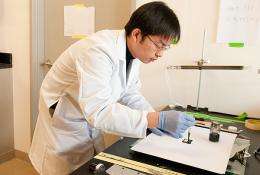
Bing Hu, a post-doctoral fellow, prepares a small square of ordinary paper to with an ink that will deposit nanotubes on the surface that can then be charged with energy to create a battery.
(PhysOrg.com) -- Stanford scientists are harnessing nanotechnology to quickly produce ultra-lightweight, bendable batteries and supercapacitors in the form of everyday paper.
Simply coating a sheet of paper with ink made of carbon nanotubes and silver nanowires makes a highly conductive storage device, said Yi Cui, assistant professor of materials science and engineering.
"Society really needs a low-cost, high-performance energy storage device, such as batteries and simple supercapacitors," he said.
Like batteries, capacitors hold an electric charge, but for a shorter period of time. However, capacitors can store and discharge electricity much more rapidly than a battery.
Cui's work is reported in the paper "Highly Conductive Paper for Energy Storage Devices," published online this week in the Proceedings of the National Academy of Sciences.
This video is not supported by your browser at this time.
Dip an ordinary piece of paper into ink infused with carbon nanotubes and silver nanowires, and it turns into a battery or supercapacitor. Crumple the piece of paper, and it still works. Stanford researcher Yi Cui sees many uses for this new way of storing electricity. Credit: Jack Hubbard, Stanford News Service
"These nanomaterials are special," Cui said. "They're a one-dimensional structure with very small diameters." The small diameter helps the nanomaterial ink stick strongly to the fibrous paper, making the battery and supercapacitor very durable. The paper supercapacitor may last through 40,000 charge-discharge cycles - at least an order of magnitude more than lithium batteries. The nanomaterials also make ideal conductors because they move electricity along much more efficiently than ordinary conductors, Cui said.Cui had previously created nanomaterial energy storage devices using plastics. His new research shows that a paper battery is more durable because the ink adheres more strongly to paper (answering the question, "Paper or plastic?"). What's more, you can crumple or fold the paper battery, or even soak it in acidic or basic solutions, and the performance does not degrade. "We just haven't tested what happens when you burn it," he said.
The flexibility of paper allows for many clever applications. "If I want to paint my wall with a conducting energy storage device," Cui said, "I can use a brush." In his lab, he demonstrated the battery to a visitor by connecting it to an LED (light-emitting diode), which glowed brightly.
A paper supercapacitor may be especially useful for applications like electric or hybrid cars, which depend on the quick transfer of electricity. The paper supercapacitor's high surface-to-volume ratio gives it an advantage.
"This technology has potential to be commercialized within a short time," said Peidong Yang, professor of chemistry at the University of California-Berkeley. "I don't think it will be limited to just energy storage devices," he said. "This is potentially a very nice, low-cost, flexible electrode for any electrical device."
Cui predicts the biggest impact may be in large-scale storage of electricity on the distribution grid. Excess electricity generated at night, for example, could be saved for peak-use periods during the day. Wind farms and solar energy systems also may require storage.
"The most important part of this paper is how a simple thing in daily life - paper - can be used as a substrate to make functional conductive electrodes by a simple process," Yang said. "It's nanotechnology related to daily life, essentially."
Cui's research team includes postdoctoral scholars Liangbing Hu and JangWook Choi, and graduate student Yuan Yang.
-
Li-Air: Argonne opens new chapter in battery research (w/ Video)
Sep 23, 2009 |
not rated yet |
0
-
Nanowire battery holds 10 times the charge of existing ones
Dec 18, 2007 |
not rated yet |
0
-
BlackBerry Storm 2 coming soon (w/ Video)
Oct 20, 2009 |
not rated yet |
0
-
Stable Opera 10.10 browser with Unite now available
Nov 24, 2009 |
not rated yet |
0
-
Ericsson developing a 'spider' computer (w/ Video)
Oct 30, 2009 |
not rated yet |
0
-
Engineers build first sub-10-nm carbon nanotube transistor
Feb 01, 2012 |
4.9 / 5 (30) |
30
-
Something old, something new: Evolution and the structural divergence of duplicate genes
Jan 31, 2012 |
4.6 / 5 (7) |
1
-
The hidden nanoworld of ice crystals: Revealing the dynamic behavior of quasi-liquid layers
Jan 30, 2012 |
5 / 5 (3) |
1
-
Stock market network reveals investor clustering
Jan 27, 2012 |
3.9 / 5 (23) |
8
-
Of microchemistry and molecules: Electronic microfluidic device synthesizes biocompatible probes
Jan 26, 2012 |
5 / 5 (1) |
0
-
polymer nanocomposites
10 hours ago
-
Corrosion Tests on Magnesium
23 hours ago
-
polyethylene copper nanocomposite
Feb 09, 2012
-
Output of xrd analysis
Feb 08, 2012
-
Transport phenomena problem based on problems 18.B11 and 19B.6 from Bird, stewart, lw
Feb 06, 2012
-
Help with material selection - Car Piston
Feb 05, 2012
- More from Physics Forums - Materials & Chemical Engineering
More news stories
What lies beneath: Mapping hidden nanostructures
The ability to diagnose and predict the properties of materials is vital, particularly in the expanding field of nanotechnology. Electron and atom-probe microscopy can categorize atoms in thin sheets of material, ...
2 hours ago |
5 / 5 (1) |
0
'Dark plasmons' transmit energy
Microscopic channels of gold nanoparticles have the ability to transmit electromagnetic energy that starts as light and propagates via "dark plasmons," according to researchers at Rice University.
18 hours ago |
5 / 5 (6) |
0
|
Nanotube therapy takes aim at breast cancer stem cells
Wake Forest Baptist Medical Center researchers have again proven that injecting multiwalled carbon nanotubes (MWCNTs) into tumors and heating them with a quick, 30-second laser treatment can kill them.
Nanotechnology / Bio & Medicine
23 hours ago |
5 / 5 (1) |
0
|
New kind of solar cell could capture significantly more energy than current cells
New solar cells could increase the maximum efficiency of solar panels by over 25%, according to scientists from the University of Cambridge.
Feb 08, 2012 |
4.5 / 5 (11) |
14
|
Nanoshell whispering galleries improve thin solar panels
Visitors to Statuary Hall in the U.S. Capitol Building may have experienced a curious acoustic feature that allows a person to whisper softly at one side of the cavernous, half-domed room and for another on ...
Nanotechnology / Nanomaterials
Feb 07, 2012 |
4.3 / 5 (6) |
6
|
New understanding of DNA repair could eventually lead to cancer therapy
A research group in the Faculty of Medicine & Dentistry at the University of Alberta is hoping its latest discovery could one day be used to develop new therapies that target certain types of cancers.
Zuckerberg's focus drives Facebook's ascent
When Mark Zuckerberg showed up to rent Judy Fusco's Los Altos, Calif., house in the fall of 2004, soon after he'd arrived in Silicon Valley, the landlord was immediately struck by his confidence.
Antidepressants and pregnancy: Women must consider the impact of drugs on baby, and of depression on baby, themselves
Upon learning they are pregnant, most women dutifully nix the alcohol, sushi and caffeine. But what about antidepressants?
Both maternal and paternal age linked to autism
Older maternal and paternal age are jointly associated with having a child with autism, according to a recently published study led by researchers at The University of Texas Health Science Center at Houston (UTHealth).
Night, weekend delivery OK for babies with birth defects
Weekday delivery is no better than night or weekend delivery for infants with birth defects, according to a new study presented today at The Pregnancy Meeting, the Society for Maternal-Fetal Medicine's annual conference. ...
From virginity to Viagra
Americans will spend more than $17 billion on Valentine's Day, but far less on programs like sex education for adolescents. The editors of the new book, Sex for Life, From Virginity to Viagra, How Sexuality Changes Throughout ...
Dec 07, 2009
Rank: 5 / 5 (1)
Dec 08, 2009
Rank: not rated yet
Nanotube based capacitive storage is undoubtedly the future. Next I want to see this paper battery pasted on to a laptop cover (even though the storage density is not mentioned in the article).
Dec 10, 2009
Rank: not rated yet