Absence of evidence for a meteorite impact event 13,000 years ago
December 8, 2009
Absence of evidence for a meteorite impact event 13,000 years ago

Enlarge

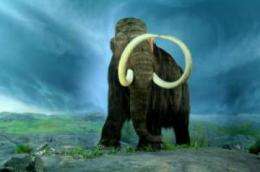
The woolly mammoth was one of the large mammals that became extinct in North America at the onset of the Younger Dryas approx. 13,000 years ago. Credit: Image of Woolly Mammoth at the Royal BC Museum, Victoria, British Columbia courtesy Wikipedia Commons

An international team of scientists led by researchers at the University of Hawaii at Manoa have found no evidence supporting an extraterrestrial impact event at the onset of the Younger Dryas ~13000 years ago.

The Younger Dryas is an abrupt cooling event in Earth's history. It coincided with the extinction of many large mammals including the woolly mammoth, the saber toothed jaguar and many sloths. This cooling period is generally considered to be the result of the complex global climate system, possibly spurred on by a reduction or slowdown of the thermohaline circulation in North America. This paradigm was challenged two years ago by a group of researchers that reported finding high iridium concentrations in terrestrial sediments dated during this time period, which led them to theorise that an impact event was instead the instigator of this climate shift.

A team led by François Paquay, a Doctoral graduate student in the Department of Geology and Geophysics at the University of Hawaii at Manoa (UHM) decided to also investigate this theory, to add more evidence to what they considered a conceptually appealing theory. However, not only were they unable to replicate the results found by the other researchers, but additional lines of evidence failed to support an impact theory for the onset of the Younger Dryas. Their results will be published in the December 7th early online edition of the prestigious journal the .

The idea that an impact event may have been the instigator for this cooling period was appealing because of several alleged impact markers, especially the high iridium concentrations that the previous team reported. However, it is difficult for proponents of this theory to explain why no impact crater of this age is known. "There is a black mat layer across North America which is correlated to the Younger Dryas climatic shift seen in Greenland ice cores dated at 13 thousand years ago by ," explains Paquay. "Initially I thought this type of layer could be associated with an impact event because concentration in the proxies of widespread wildfires are sky high. That plus very high levels of iridium (which is one indicator used to indicate extraterrestrial impact events). So the theory was conceptually appealing, but because of the missing impact site, the idea of one or multiple airburst arose."

To corroborate the theory, Paquay and his colleagues decided to take a three-pronged approach. The first was to replicate the original researchers data, the second step was to look for other tracers, specifically osmium isotopes, of extraterrestrial matter in those rocks, and the third step was to look for these concentrations in other settings. "Because there are so many aspects to the impact theory, we decided to just focus on geochemical evidence that was associated with it, like the concentration of iridium and other platinum group elements, and the osmium isotopes," says Paquay. "We also decided to look in very high resolution sediment cores across North America, and yet we could find nothing in our data to support their theory."

The team includes American, Belgian and Canadian researchers. Analysis of the sediments was done both at UHM and in Belgium, using the same sediments from the same interval and indepedently did the analysis work and got similar results. Both the marine and terrestrial sediment records do not indicate that an impact event was the trigger for the transition into the Younger Dryas cold period. "The marine and terrestrial record both complement each other to support this finding," concludes Paquay. "That's what makes the beauty of this study."

More information: This research will be presented at the American Geophysical Union Fall 2009 Meeting in San Francisco.

PNAS Early Edition, December 7, 2009 www.pnas.org_cgi_doi_10.1073_pnas.0908874106

Source: University of Hawaii at Manoa

4.1 /5 (17 votes)  

Filter


Move the slider to adjust rank threshold, so that you can hide some of the comments.


Display comments: newest first

deatopmg
Dec 08, 2009

Rank: not rated yet
Clearly something catastrophic happened to the large animals and Clovis culture. Maybe a nearby gamma ray burst really does fit. But what about all the smaller animals - how did they survive? Was there a contraction in numbers at that time?
Archivis
Dec 08, 2009

Rank: 1.6 / 5 (7)
Now see boys and girls, the wooly mammoth and various other large mammals produced a vast amount of methane gas, leading to an Al Gore calibur greenhouse effect which is where your climate shift came from.

"If you read it online, it MUST be true..."
AMMBD
Dec 08, 2009

Rank: not rated yet
Perhaps the airburst, perhaps something else. The question remains WHAT? There's scads of evidence something serious went down 13K ago. Be nice to know what.
andre_chaisson
Dec 08, 2009

Rank: not rated yet
Balderdash!! I have found the elusive Clovis Comet craters (yes theres 2 of them!). http://www.youtub...Gy8TIinI
Hernan
Dec 08, 2009

Rank: 4.5 / 5 (2)
If the a comet hit a 1 mile thick ice sheet, wouldn't the catastrophic melting also take most of the evidence away? I would search for evidence of catastrophic meltdowns (floods, as in many of the old cultures myths).
rebellionkid
Dec 08, 2009

Rank: not rated yet
Not relevant to a very interesting article, but:

"Ads by Google
Darwin's errors unearthed - Serious doubts about evolution are evolving. Flawed theory exposed... - www.ucg.org.uk/ad/ev/"

appeared at the top of the page, google doesn't appear to be screening these appropriately.
marjon
Dec 08, 2009

Rank: 3.3 / 5 (3)
"Scientists have long blamed climate change for the mass extinction of animals that took place in North America almost 13,000 years ago. Now some researchers say a comet broke apart and burned the landscape and many of the creatures living on it. The proof is "nanodiamonds," microscopic diamonds they've found in the soil across the continent."
http://www.npr.or...98958270
DragonHunter
Dec 08, 2009

Rank: 4.7 / 5 (3)
The thing to keep in mind is that impact science is very poorly understood. There are many clearly obvious impact structures on this continent that aren't normal craters. And do not fit the standard model in any way.

I've cataloged more than 500 of them. This 8.5 meg PDF has a sampling of 50: http://dl.dropbox...ters.pdf
po6ert
Dec 08, 2009

Rank: 1 / 5 (1)
has anybody considered the impact of excessive carbon sequestion by plants leading to a fall in co2 levels? here to for a warmer planet! :-)) I can do without a return to the ice age in which we are currently living
vidyunmaya
Dec 08, 2009

Rank: 1 / 5 (2)
Sub:Earth Planet-Magnetic Fields-Reversal
Earth Planet Magnetic reversal is around 26,000 Years. Dwapara Tuga must be dated back to 12,000-13,000 Years. The subject is relevant for Cosmological Index-Cosmology Vedas Interlinks
See: Earth Glow Index -Cosmic Signatures and Cosmic Alignment-2012
http://www.scribd...ORMATION
Vidyardhi Nanduri
R_R
Dec 09, 2009

Rank: not rated yet
Perhaps the obvious answers are hidden the best. When you start to take logic out of the equation everything becomes complicated. Perhaps these people searching for clues should get in a boat and row themselves 250 miles out to the center of the perfect giant arc at lower right Hudson Bay and take a dive and observe the lava basin from rim to rim. This precision arc certainly could represent an impact crater. So perhaps all these searchers should join forces and grab an orr and hopefully their boat will stay afloat and not take their archaic forms of deduction to the bottem.
Shootist
Dec 13, 2009

Rank: not rated yet
The thing to keep in mind is that impact science is very poorly understood. There are many clearly obvious impact structures on this continent that aren't normal craters. And do not fit the standard model in any way.

I've cataloged more than 500 of them. This 8.5 meg PDF has a sampling of 50: http://dl.dropbox...ters.pdf


cinder cones.
Shootist
Dec 13, 2009

Rank: not rated yet
Perhaps the obvious answers are hidden the best. When you start to take logic out of the equation everything becomes complicated. Perhaps these people searching for clues should get in a boat and row themselves 250 miles out to the center of the perfect giant arc at lower right Hudson Bay and take a dive and observe the lava basin from rim to rim. This precision arc certainly could represent an impact crater. So perhaps all these searchers should join forces and grab an orr and hopefully their boat will stay afloat and not take their archaic forms of deduction to the bottem.


Hudson Bay is not an astrobleme. Astroblemes that size look more like Sudbury or Vredefort.

http://impacts.rajmon.cz/
Rank 4.1 /5 (17 votes)
Relevant PhysicsForums posts
  • Discrepancy between oxygen and carbon-dioxide levels
    created6 hours ago
  • where gems are found in the world
    created9 hours ago
  • Wind Waves in Reservoir ~ Wind run-up and Wind set-up
    createdFeb 08, 2012
  • Balance of oxygen in the atmosphere
    createdFeb 01, 2012
  • The case for a methanol-based economy
    createdJan 30, 2012
  • Weather in a rotating cylinder
    createdJan 25, 2012
  • More from Physics Forums - Earth

More news stories

New views show old NASA Mars landers

(PhysOrg.com) -- The High Resolution Imaging Science Experiment (HiRISE) camera on NASA's Mars Reconnaissance Orbiter recorded a scene on Jan. 29, 2012, that includes the first color image from orbit showing ...

Space & Earth / Space Exploration

created 20 hours ago | popularity 4.9 / 5 (7) | comments 8 | with audio podcast

Deconstructing a mystery: What caused Snowmaggedon?

In the quiet after the storms, streets and cars had all but disappeared under piles of snow. The U.S. Postal Service suspended service for the first time in 30 years. Snow plows struggled to push the evidence ...

Space & Earth / Earth Sciences

created 12 hours ago | popularity 4.7 / 5 (3) | comments 1 | with audio podcast

Black holes and star formation

(PhysOrg.com) -- It has long been recognized that galaxy mergers or even close interactions can play a vital role in shaping the morphology of galaxies. One way they can do so, it is thought, is by triggering ...

Space & Earth / Astronomy

created 19 hours ago | popularity 4.1 / 5 (7) | comments 5 | with audio podcast

Ocean microbe communities changing, but long-term environmental impact is unclear

As oceans warm due to climate change, water layers will mix less and affect the microbes and plankton that pump carbon out of the atmosphere – but researchers say it's still unclear whether these processes ...

Space & Earth / Earth Sciences

created 14 hours ago | popularity 5 / 5 (2) | comments 2 | with audio podcast

Researchers create 3-D laser maps that show how earthquake changes landscape

Geologists have a new tool to study how earthquakes change the landscape down to a few inches, and it's giving them insight into how earthquake faults behave. In the Feb. 10 issue of the journal Science, a team ...

Space & Earth / Earth Sciences

created 14 hours ago | popularity 5 / 5 (4) | comments 0 | with audio podcast


'Dark plasmons' transmit energy

Microscopic channels of gold nanoparticles have the ability to transmit electromagnetic energy that starts as light and propagates via "dark plasmons," according to researchers at Rice University.

FDA-approved drug rapidly clears amyloid from the brain, reverses Alzheimer's symptoms in mice

Neuroscientists at Case Western Reserve University School of Medicine have made a dramatic breakthrough in their efforts to find a cure for Alzheimer's disease. The researchers' findings, published in the journal Science, show t ...

Hydrogen from acidic water: Researchers develop potential low cost alternative to platinum for splitting water

A technique for creating a new molecule that structurally and chemically replicates the active part of the widely used industrial catalyst molybdenite has been developed by researchers with the Lawrence Berkeley ...

Ultraviolet protection molecule in plants yields its secrets

Lying around in the sun all day is hazardous not just for humans but also for plants, which have no means of escape. Ultraviolet (UV) radiation from the sun can damage proteins and DNA inside cells, leading ...

Soraa LED light may dim 50-watt halogen rivals

(PhysOrg.com) -- Soraa, a Fremont, California company founded in 2008, this week launched its first product, a light that uses LEDS (light emitting diodes). The "Soraa LED MR16 lamp" is the "perfect" replacement ...

Anyone can learn to be more inventive, cognitive researcher says

There will always be a wild and unpredictable quality to creativity and invention, says Anthony McCaffrey, a cognitive psychology researcher at the University of Massachusetts Amherst, because an "Aha moment" is rare and ...