Hubble's Deepest View of Universe Unveils Never-Before-Seen Galaxies (w/ Video)
December 8, 2009
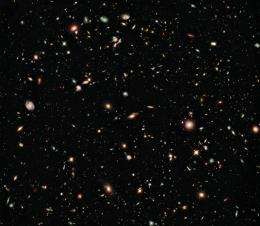
This image is a composite of separate exposures made by the WFC3 instrument on the Hubble Space Telescope. Three filters were used to sample broad wavelength ranges in the near-infrared. The color results from assigning different colors to each monochromatic image. In this case, the assigned colors are: F105W (Y) blue, F125W (J) green and F160 (H) red. The image is roughly 2.4 arcminutes wide. Credit: NASA, ESA, G. Illingworth (UCO/Lick Observatory and the University of California, Santa Cruz), R. Bouwens (UCO/Lick Observatory and Leiden University) and the HUDF09 Team
(PhysOrg.com) -- In 2004, Hubble created the Hubble Ultra Deep Field (HUDF), the deepest visible-light image of the Universe, and now, with its brand-new camera, Hubble is seeing even farther. This image was taken in the same region as the visible HUDF, but is taken at longer wavelengths.
Hubble's newly installed Wide Field Camera 3 (WFC3) collects light from near-infrared wavelengths and therefore looks even farther back towards the Big Bang, because the light from hot young stars in these very distant galaxies is stretched out of the ultraviolet and visible regions of the spectrum into near-infrared wavelengths by the expansion of the Universe. This new deep view also provides insights into how galaxies grew in their formative years early in the Universe's history.
This video is not supported by your browser at this time.
How far is far? And how do you know when you get there? NASA's Hubble Space Telescope has taken the deepest photograph of the universe ever made in near-infrared light. The picture reveals several thousands of far-flung galaxies. The farthest, merely dim points of light in this view offer a peek at the universe as it looked just 600 million years after the Big Bang. No galaxies have ever been seen before at such early times. This image reveals the emergence of stars and galaxies in the infant universe's formative years. This new Hubble view clearly demonstrates that the James Webb Space Telescope will have a lot to go hunting for at the horizon of the universe. Credit: NASA, ESA, and G. Bacon and M. Estacion (STScI)
A boon to astronomers worldwide, the new WFC3 data — taken by the HUDF09 team — have set a multitude of teams to work, furiously searching for the most distant galaxies yet discovered. In just three months, twelve scientific papers on these new data have been submitted.This image was taken by the HUDF09 team, which has made it available for research by astronomers worldwide. The photo was taken with the new WFC3/infrared camera on Hubble in late August 2009, during a total of four days of pointing for 173 000 seconds of total exposure time. Infrared light is invisible to the human eye and therefore does not have colours that can be perceived. The representation is "natural" in that shorter infrared wavelengths are represented as blue and the longer wavelengths as red. The faintest objects are about one billion times fainter than the dimmest visible objects seen with the naked eye.
These Hubble observations are blazing a trail for Hubble's successor, the NASA/ESA James Webb Space Telescope (JWST), which will look even farther into the Universe than Hubble, at infrared wavelengths. The launch of JWST is planned for 2014.
-
'Big baby' galaxy found in newborn Universe
Sep 28, 2005 |
not rated yet |
0
-
Hubble finds hundreds of young galaxies in the early universe
Sep 21, 2006 |
not rated yet |
0
-
Lenses galore -- Hubble finds large sample of very distant galaxies
Jul 24, 2008 |
not rated yet |
0
-
Hubble finds strong contender for galaxy distance record
Feb 12, 2008 |
not rated yet |
0
-
Hubble, Spitzer find 'Lego-block' galaxies in early universe
Sep 06, 2007 |
not rated yet |
0
-
Engineers build first sub-10-nm carbon nanotube transistor
Feb 01, 2012 |
4.9 / 5 (30) |
30
-
Something old, something new: Evolution and the structural divergence of duplicate genes
Jan 31, 2012 |
4.6 / 5 (7) |
1
-
The hidden nanoworld of ice crystals: Revealing the dynamic behavior of quasi-liquid layers
Jan 30, 2012 |
5 / 5 (3) |
1
-
Stock market network reveals investor clustering
Jan 27, 2012 |
3.9 / 5 (23) |
8
-
Of microchemistry and molecules: Electronic microfluidic device synthesizes biocompatible probes
Jan 26, 2012 |
5 / 5 (1) |
0
-
Titan's lack of impact craters
Feb 09, 2012
-
Real pictures of black hole eating a star?
Feb 08, 2012
-
Hypothetical way to travel faster than light, but not technically exceed lightspeed
Feb 06, 2012
-
How do scientists monitor the Sun's activity?
Feb 05, 2012
-
Search patterns in observational studies
Feb 05, 2012
-
Derivation of Pogson's law
Feb 03, 2012
- More from Physics Forums - General Astronomy
More news stories
Could Venus be shifting gear?
(PhysOrg.com) -- ESAs Venus Express spacecraft has discovered that our cloud-covered neighbour spins a little slower than previously measured. Peering through the dense atmosphere in the infrared, the ...
Space & Earth / Space Exploration
3 hours ago |
5 / 5 (4) |
4
|
Humans may have helped the decline of African rainforests 3000 years ago
(PhysOrg.com) -- Large areas of rainforests in Central Africa mysteriously disappeared over three thousand years ago, to be replaced by savannas. The prevailing theory has been that the cause was a change ...
Clam fields found at deep, low-temperature Mariana vents
(PhysOrg.com) -- Scientists have marveled at the unusual life forms thriving at high temperature hydrothermal vents of the deep ocean.
Space & Earth / Earth Sciences
3 hours ago |
not rated yet |
0
|
Mars Science Laboratory computer issue resolved
(PhysOrg.com) -- Engineers have found the root cause of a computer reset that occurred two months ago on NASA's Mars Science Laboratory and have determined how to correct it.
Space & Earth / Space Exploration
4 hours ago |
5 / 5 (5) |
2
|
Two new moons for Jupiter
Advances in technology have lead to the discovery of new planets outside of our Solar System, and now even new moons in our own backyard.
Space & Earth / Space Exploration
3 hours ago |
not rated yet |
2
New understanding of DNA repair could eventually lead to cancer therapy
A research group in the Faculty of Medicine & Dentistry at the University of Alberta is hoping its latest discovery could one day be used to develop new therapies that target certain types of cancers.
Zuckerberg's focus drives Facebook's ascent
When Mark Zuckerberg showed up to rent Judy Fusco's Los Altos, Calif., house in the fall of 2004, soon after he'd arrived in Silicon Valley, the landlord was immediately struck by his confidence.
Both maternal and paternal age linked to autism
Older maternal and paternal age are jointly associated with having a child with autism, according to a recently published study led by researchers at The University of Texas Health Science Center at Houston (UTHealth).
Night, weekend delivery OK for babies with birth defects
Weekday delivery is no better than night or weekend delivery for infants with birth defects, according to a new study presented today at The Pregnancy Meeting, the Society for Maternal-Fetal Medicine's annual conference. ...
Sonic Cradle lands spot in TED exhibition
A Simon Fraser University graduate student project that melds music, meditation and modern technology has landed a rare spot as an exhibit at TEDActive 2012 in Palm Springs, California this month.
From virginity to Viagra
Americans will spend more than $17 billion on Valentine's Day, but far less on programs like sex education for adolescents. The editors of the new book, Sex for Life, From Virginity to Viagra, How Sexuality Changes Throughout ...
Dec 08, 2009
Rank: 4 / 5 (2)
Huh? What's this mean? The news release says we can & you are saying we can't?
Dec 08, 2009
Rank: 4.5 / 5 (8)
The matter in galaxies is not infinitely old and the dark ages are real based on many types of evidence. Not least is that the early universe was made up mostly of hydrogen with some helium, before stars had the chance to burn those elements into higher elements. If stars went back in time indefinitely the universe would have burned out long ago.
Aether theory isn't generally accepted, and simplistic/weak/nonsensical arguments like yours don't add any credibility to it.
I understand the curiosity that drives people to want to know more about the universe than we know today. But I don't understand why many people latch onto poorly supported theories like aether and try to use random facts in isolation from other facts to support such speculative/discredited theories. Its like some people want to believe they have special knowledge, the experts don't have, so badly they will accept or manufacture any mirage that supports something different from the current consensus.
Dec 08, 2009
Rank: 5 / 5 (3)
Dec 08, 2009
Rank: 4.5 / 5 (2)
Yeah, and there's no evidence of evolution either. Yeesh.
Dec 08, 2009
Rank: not rated yet
Dec 08, 2009
Rank: 5 / 5 (2)
Do you have any actual evidence, or math, or *anything* to back this up? I certainly support your right to have an opinion, but phrasing it as a self-evident fact without any backup doesn't make it so, and won't make people believe you just because.
Dec 08, 2009
Rank: 3 / 5 (2)
Any object can be cut in half, forever, because there will always be 2 remains from a cut, so those remains can be cut again, indefinitely.
The reverse is the same. It can always get bigger, there are no space walls to stop the growth.
Indefinitely, Infinity, that's all the evidence we need.
There are no ends. It keeps on going and going, forever and ever.
Dec 08, 2009
Rank: 1 / 5 (4)
Lets see, that little grain of sand on one of Florida beach is a small part of Space, made of smaller particles, called molecules (galaxies?) and in turn made of even smaller particles. Well, if that grain of sand exploded, will it create all the beaches on earth, or for that matter, all the beaches on all the planets in the entire universe? Absolutely ridiculous.
Dec 08, 2009
Rank: 5 / 5 (5)
And I don't see infinity when I look out, nor when I look in. The Infinite is neither perceivable nor comprehensible by finite human beings. Infinity is always merely inferred from a finite series of finite occurrences.
Dec 08, 2009
Rank: 5 / 5 (3)
nevermark should've mentioned a little factoid that your "Aether theory" might have trouble with: more distant galaxies are spectroscopically proven to contain fewer heavy elements (i.e. elements heavier than hydrogen and helium.) Thus, empirical data tells us undeniably that matter all across the observable universe started out very simple and only got more complicated in the course of churning by generations of stars (i.e. over time.) As time goes on, more heavy elements are produced and galaxies become enriched in "metals" -- what astronomers call any element with more than two protons in its nucleus.
Dec 08, 2009
Rank: 1.7 / 5 (6)
Dec 08, 2009
Rank: 1.7 / 5 (6)
http://map.gsfc.n...age.html
Dec 08, 2009
Rank: 5 / 5 (3)
And you know this.. how exactly?
What I want to know is why don't people wait for the small individual pieces (advancements in science and observation) to come together, and try to come up with all sort of half-assed theories and stories based on mostly diddly squat, that they try to adapt to reality as they go along.
I think the universe is made of tiny bursting soap bubbles.... of infinite density of course.
Bleh.
Dec 09, 2009
Rank: 1 / 5 (3)
http://www.newsci...ies.html
the concept, Universe is infinite random stuff isn't very extravagant at all - it just tries to minimize postulates by Occam's razor principle. So I don't understand, why all people are avoiding it so much. Frankly speaking, scientists have no better models anyway.
Dec 09, 2009
Rank: 5 / 5 (4)
Think about it this way. In about 10 billion years the night sky will be all but vacant of galaxies to visible light devices. That is aside from our very own Milky Way, or rather the mix of the Milky way and Andromeda. Think if we were having this discussion then? We'd be talking about whether other galaxies could possibly exist, and whoever was the proponent of that theory would have no physical or observable evidence for it.
Now think about what this discussion would be like if the Universe was only 1 billion years old?
Our frame of reference limits the accuracy with which we can discuss this topic. Right now we're still very similar to those who thought the Earth was flat, since all we can see is an unending horizon in the Universe.
Much like the flat earth proponents, we may be wrong. The question is, by how much?
Dec 09, 2009
Rank: 5 / 5 (1)
Dec 09, 2009
Rank: 2 / 5 (2)
And if we'll be that advanced then we'll certainly have a Grand Unified Theory without all the uncertainties and controversies of contemporary theories.
Dec 09, 2009
Rank: 1 / 5 (1)
Dec 09, 2009
Rank: 5 / 5 (2)
Because on a finite planet, for example our planet Earth, you can pick any direction and walk in an infinitely long line and never come to an end, yet you would have never left the finite earth.
Everything is dependent on frame of reference.
That's kind of why I laugh when people say the flat earth theory was wrong. It's technically not "wrong", it's just that their measurements weren't precise enough to determine the change in the Earth's surface. Now the people who say the Earth is spehrical are "wrong" because the southern hemisphere bulges more. It's actually pear shaped.
Perhaps we'll find out something equally as interesting about our Universe as time goes by.
Dec 09, 2009
Rank: 1 / 5 (3)
I do not need to know anything about physics. The simple reason is, physical exists, always was, and always will. Time always was and always will. Without time, there can not be anything, and without anything, there can not be time.
Space is a physical entity that exists in time. Time, is the existence of a physical entity. There are no space/time warp. Every physical object lives in time. I'm not talking about our time, but an event that happens over and over, and the existence of any object is an event, even if nothing happens. Just the fact that it exist is time, because it takes time to just exist, waiting.
You can not travel to another world in a split seconds. You can only do that with time perception. But in "real" time, it took many years for that travel to happen. It takes me time to write this, so time exists.
Dec 09, 2009
Rank: 5 / 5 (1)
Yeah, he's right, you have no understanding of modern physics.
Dec 09, 2009
Rank: 5 / 5 (3)
The spectroscopy I was talking about involves absorption spectra. No amount of "preferential dispersion" is going to erase absorption elemental fingerprints from light. Try again.
Reference?
Why are all quasars found exclusively at ultra-high redshifts and very far away? Why aren't there any nearby quasars?
That would be an Earth-shattering revelation, if it were true. It is not, unfortunately. I'll just stop here; don't want to spam the thread...
Dec 10, 2009
Rank: 5 / 5 (1)
Actually, all of the night sky is the same age.
Big bang theory doesn't postulate that the singularity expanded over the space we exist in, the singularity was the origin of ALL space within our Universe, meaning every point is exactly as old as every other point. The only "age" in the night sky is the age of the emitted energy we're viewing in relation to its emission point. That's why the CMB comes from everywhere, because it originated everywhere.
That's also why the Universe has no center, and why we can't point to a spot in the sky and say "the big bang came from there." because it came from everywhere we can see. The universe is its own center.
Dec 10, 2009
Rank: 2.5 / 5 (2)
Perhaps you would like to take a stab at the questions asked, rather than paraphrase your textbooks.
The CMB is the oldest energy we can observe, in terms of the age of the energy when it arrives here, today. The new observations of old energy come from a source that has been estimated to be no more than 600,000,000 years after the CMB emission, meaning that energy was very close to the boundary of our universe at the time of emission. It is not noted specifically in this article, but most observations of such ancient energy sources are through 'cosmic lensing' of intermediary large gravitational fields - without which the energy would have become too divergent for us to detect.
Hence my questions, based on the those popular ideas that the CMB represents the outer limits, and the universe has no (known) center, either these observations are from near the origin (center?), or the cosmic lensing should provide multiple perspectives
Dec 10, 2009
Rank: 3 / 5 (2)
What you're not understanding is that there is NO CENTER to the universe. The CMB wasn't radiated, it is being radiated RIGHT NOW from everywhere. Space doesn't have a fixed volume, but energy has a fixed intensity over volume. So if the volume of space is expanding then the intensity of the energy is decreasing. The CMB weakens but the amount of energy being emitted by the origin of the CMB does not.
What you're confusing is the fact that the CMB is not a blast wave. The CMB is continuous energy release over an ever expanding volume.
Your question in regards to Hubble's expanding Universe isn't valid as this would have no implications on Hubble's expanding universe, this would be part of the associated framework contained within Hubble's Expanding Universe hypothesis.
I figured you had a background in the topic, but it appears the standard answer wasn't clear enough for you.
Dec 10, 2009
Rank: 1 / 5 (1)
I meant, The CMB is the sum total of all energy within the universe. As the universe expands the CMB "cools" due to volume but the total energy content never changes.
Basically, what you're talking about is a snapshot of what the Universe contained 600 BYA.
Dec 11, 2009
Rank: 5 / 5 (1)
Dec 12, 2009
Rank: 5 / 5 (1)
Dec 13, 2009
Rank: 1 / 5 (1)
next generation of telescopes will cause us to revise the age and size of the universe, then again and again.
eventually the narrow minded anal types will have to give up and realise that time and space are endless, even if we can not comprehend how.
Dec 13, 2009
Rank: 5 / 5 (1)
Dec 14, 2009
Rank: 1 / 5 (1)
Dec 14, 2009
Rank: not rated yet
Yes but not from where we're sitting. You wouldn't be able to catch light originating from Earth/Sol long ago without a rebound of some sort off of a foreign object or not being on Earth/Sol.
Dec 15, 2009
Rank: 5 / 5 (2)
The CMB is a different situation. Actually, its really not true that the temperature of the universe was completely uniform when the CMB was generated, because we can see tiny temperature variations in it today. This implies that different parts of the universe became transparent from stable atom combination sooner than others.
However I find very strange the assertion that the CMB is the sum total of the energy of the universe.