New research may lead to new ways to control honeybee parasite
December 8, 2009
MSU research may lead to new ways to control honeybee parasite

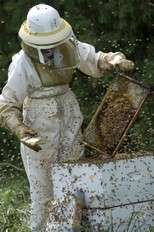
A graduate student tends bees at the MSU apiary. Photo by Kurt Stepnitz

(PhysOrg.com) -- Ground-breaking discoveries by Michigan State University researchers could help protect honeybees from deadly parasites that have devastated commercial colonies.

The MSU researchers for the first time were able to produce in the laboratory proteins that help channel through cell membranes of parasites known as Varroa mites. The research, using cellular frog eggs, also found that these proteins react to chemicals differently than the sodium channel proteins in honeybees, a finding that could be a key to controlling the mites.

"The insecticide used to control Varroa mites, fluvalinate, targets the mite sodium channel," said Ke Dong, MSU professor of entomology. "But the mites are becoming resistant to fluvalinate. Successfully producing the mite sodium channel in the lab now allows scientists to develop new chemicals that target the mite sodium channel but don't affect the ’s."

Fluvalinate paralyzes the mite and eventually kills it. But in addition to the problem of growing mite resistance, the pesticide can harm bees and contaminate honey if not used extremely carefully.

The MSU scientists also found two in the mite sodium channel that make the mite resistant to tetrodotoxin, or TTX, a deadly poison found in pufferfish not currently used as an insecticide

"Chemicals such as fluvalinate and TTX target sodium channels in insects and mites, so this basic research opens the door for more applied research on chemicals to control mites and other pest insects," Dong said.

Other members of the MSU team are Yuzhe Du, senior research associate; Yoshiko Nomura, visiting scholar; Zhiqi Liu, former research associate; and Zachary Huang, associate professor, all in the Department of Entomology.

Varroa mites invaded the United States from the eastern hemisphere in 1987 and can kill an entire honeybee colony within a year, feeding on bee blood and transmitting viruses. The mites wiped out nearly 50 percent of the U.S. commercial honeybee population in 2004.

Varroa mites also may possibly contribute to colony collapse disorder, or CCD, according to the U.S. Department of Agriculture. First described in 2006, CCD is the official name for the disappearance of hundreds of thousands of bees from hives around the world. Scientists have not been able to find a cause.

"These mites are a big, big problem for agriculture," Huang said. "Nearly 80 percent of food crops depend on pollination."

In Michigan, fruit and vegetable crops valued at $400 million depend on honeybee pollination and honey and beeswax add another $5 million to the state's economy each year. Nationwide, bee pollination is responsible for $15 billion in added crop value, particularly for specialty crops such as almonds and other nuts, berries, fruits and vegetables, according to the USDA. It's estimated that one out of every three bites of food people eat is made possible by pollination.

The research is published in the Dec. 4 issue of The Journal of Biological Chemistry.

Provided by Michigan State University (news : web)

4.5 /5 (4 votes)  

Rank 4.5 /5 (4 votes)
Related Stories
Relevant PhysicsForums posts
  • [ask]electron inside drinking water
    created10 hours ago
  • How to avoid formation of Lithium Chromate ???
    created15 hours ago
  • how to choose a reduced or oxidated form in a redox
    created21 hours ago
  • Mesomeric effect in acids.
    created21 hours ago
  • Looking for a safe endothermic chemical reaction
    createdFeb 07, 2012
  • Anomalies of H20
    createdFeb 07, 2012
  • More from Physics Forums - Chemistry

More news stories

Chemists harvest light to create 'green' tool for pharmaceuticals

(PhysOrg.com) -- A team of University of Arkansas researchers, including an Honors College undergraduate student, has created a new, "green" method for developing medicines. The researchers used energy from ...

Chemistry / Biochemistry

created 1 hour ago | popularity not rated yet | comments 0 | with audio podcast

Engineers find inspiration for new materials in Piranha-proof armor

(PhysOrg.com) -- It’s a matchup worthy of a late-night cable movie: put a school of starving piranha and a 300-pound fish together, and who comes out the winner?

Chemistry / Materials Science

created 1 hour ago | popularity 5 / 5 (1) | comments 1 | with audio podcast

Why staying warm in winter is a bit more complicated if you're a lizard

Recent studies at the ISIS neutron source, the Science and Technology Facilities Council’s (STFC) world leading research centre, have given a new insight into the mysterious ‘anti-freeze’ capabilities ...

Chemistry / Materials Science

created 1 hour ago | popularity not rated yet | comments 0

Research provides octagonal window of opportunity for carbon capture

(PhysOrg.com) -- Filtering carbon dioxide, a greenhouse gas, from factory smokestacks is a necessary, but expensive part of many manufacturing processes. However, a collaborative research team from the National ...

Chemistry / Materials Science

created Feb 08, 2012 | popularity 5 / 5 (1) | comments 5 | with audio podcast

Scientists develop biological computer to encrypt and decipher images

Scientists at The Scripps Research Institute in California and the Technion–Israel Institute of Technology have developed a "biological computer" made entirely from biomolecules that is capable of deciphering ...

Chemistry / Biochemistry

created Feb 07, 2012 | popularity 4.5 / 5 (11) | comments 3 | with audio podcast


New Zealand team finds early plant arrivers dominated landscape

(PhysOrg.com) -- It seems intuitive that not all plant species could have taken a foothold on land at the same time all those millions of years ago as conditions on Earth evolved to the point where they could survive; some ...

Black holes and star formation

(PhysOrg.com) -- It has long been recognized that galaxy mergers or even close interactions can play a vital role in shaping the morphology of galaxies. One way they can do so, it is thought, is by triggering ...

Deciding to go left or right: Researchers use device to determine that lower animals can navigate too

For decades, scientists have associated binary decision making — opting to go left or right — with higher-ranking animals, including humans. A team of Harvard researchers, however, is rewriting that ...

Tidal forces could squeeze out planetary water

Alien planets might experience tidal forces powerful enough to remove all their water, leaving behind hot, dry worlds like Venus, researchers said.

Researchers develop gene therapy to boost brain repair for demyelinating diseases

(Medical Xpress) -- Our bodies are full of tiny superheroes—antibodies that fight foreign invaders, cells that regenerate, and structures that ensure our systems run smoothly. One such structure is myelin—a ...

Google launches Chrome browser for Android smartphones

With more and more people connecting to the Internet through a phone or a tablet instead of a PC, Google Inc. is bringing its fast-growing browser, Chrome, to the newest Android-powered mobile devices.