A special kind of flight training
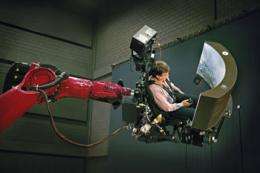
(PhysOrg.com) -- A new generation of flight simulators will attempt to make air traffic safer.
Whether for a business trip to a neighbouring country or a holiday in the Caribbean: What most people take for granted, actually poses a great challenge not only for the transport business, but also particularly for pilots. The goal of the European Union project SUPRA, funded with 3.7 million Euro, is to train pilots in the best manner possible and prepare them for hazardous scenarios.
Scientists from nine institutions and industrial enterprises aim to investigate motion perception in extreme situations as well as to improve flight simulators, thereby making an important contribution to enhanced aviation safety. Researchers from the Max Planck Institute for Biological Cybernetics in Tübingen, Germany, will contribute to the biological foundations of understanding how pilots become disoriented in extreme flight conditions, and how balance and visual information combine in the brain.
Student pilots receive ever increasing amounts of training in simulators, combined with flight training in real aircraft. This saves money, helps protect the environment and above all, is a safer form of training. Standard flight manoeuvres, such as take-off and landing, can already be properly trained with current flight simulator technology. Extreme manoeuvres, such as recovery from loss of control are much more complex and difficult to simulate. One of the problems the interdisciplinary research team seeks to resolve is the lack of an appropriate algorithm to optimize the motion within the limited workspace of any simulator for such extreme conditions. Within the framework of the three-year SUPRA project (Simulation of Upset Recovery in Aviation), their goal is to improve the simulation of such complex flight manoeuvres and to develop a new generation of flight simulators.
At first, relevant training scenarios must be chosen for the experiments. This will be done in close cooperation with professional test pilots, who have already acquired much experience with such extreme conditions. The scientists, under the direction of Heinrich H. Bülthoff at the Max Planck Institute for Biological Cybernetics, hope to discover how pilots perceive aircraft motion during the extreme situations and why they can become spatially disoriented. They are particularly interested in the interaction of vision and signals the brain receives from the balance organs in the inner ear. With the help of a robotic arm, test persons will be exposed to a variety of accelerations, while simultaneously viewing a computer-generated virtual environment. By using the appropriate stimulation of both the visual and balance systems, it is possible to "trick" the brain in such a way that the pilot perceives an actual flight manoeuvre, rather than the laboratory. For example, the scientists are able to give an impression of acceleration with purely visual stimulation, although not actually providing real motion. This perception can be enhanced by providing a suitable actual motion. This type of illusion of motion is used in flight simulators to produce a perception of motion that would not otherwise be possible due to the limited workspace.
The international consortium makes use of two completely new types of simulators that exist in the Dutch research institute, TNO, and in the Max Planck Institute for Biological Cybernetics in Tübingen, Germany. "In these times of ever increasing mobility, thorough training of new pilots is an important theme. We are pleased that the European Union has provided us with the opportunity to work with an international team to make an important contribution to flight safety by improving pilot training", stated Heinrich H. Bülthoff at the start of the project.
More information: Video: motion simulator: www.cyberneum.de/RoboLab_Film_en.html
Provided by Max-Planck-Gesellschaft (news : web)


