Bacteria offer insights into human decision making
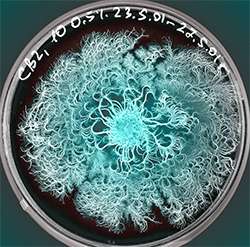
(PhysOrg.com) -- Scientists studying how bacteria under stress collectively weigh and initiate different survival strategies say they have gained new insights into how humans make strategic decisions that affect their health, wealth and the fate of others in society.
Their study, published this week in the early online edition of the journal Proceedings of the National Academy of Sciences, was accomplished when the scientists applied the mathematical techniques used in physics to describe the complex interplay of genes and proteins that colonies of bacteria rely upon to initiate different survival strategies during times of environmental stress. Using the mathematical tools of theoretical physics and chemistry to describe complex biological systems is becoming more commonplace in the emerging field of theoretical biological physics.
The authors of the new study are theoretical physicists and chemists at the University of California, San Diego's Center for Theoretical Biological Physics, the nation's center for this activity funded by the National Science Foundation, and Tel Aviv University in Israel. They say that how genes are turned on and off in bacteria living under conditions of stress not only shed light on how complex biological systems interact, but provide insights for economists and political scientists applying mathematical models to describe complex human decision making.
"Everyone knows the need to try to postpone important decisions until the last moment but apparently there are simple creatures that do it well and therefore can really teach us — the bacteria," said Eshel Ben Jacob, a physics professor at Tel Aviv University and a fellow of the Center for Theoretical Biological Physics. He co-authored the study with three other scientists at the center: José Onuchic, a professor of physics at UC San Diego and a co-director of the center, Peter Wolynes, a professor of physics and chemistry at UC San Diego and Daniel Schultz, a postdoctoral researcher at UC San Diego.
In nature, bacteria live in large colonies whose numbers may reach up to 100 times the number of people on earth. Many bacteria respond to extreme stress — such as starvation, poisoning and irradiation — by creating spores, dormant states that are highly resistant to the outside environment and that can germinate into fully functioning bacteria once the environment improves. The response involves more than 500 genes and takes about 10 hours in Bacillus subtilis, the bacterium used by the scientists in their study.
Each bacterium in the colony communicates via chemical messages and performs a sophisticated decision making process using a specialized network of genes and proteins. Modeling this complex interplay of genes and proteins by the bacteria enabled the scientists to assess the pros and cons of different choices in game theory, a branch of mathematics that attempts to model decision making by humans, in which an individual's success in making choices depends on the choices of others.
When bacteria form spores, the mother cell dies, but not before it stores a copy of its DNA in a special capsule called the spore. The mother cell then breaks open and its DNA and remaining proteins are released to the environment. The bacteria on the road to spore formation don’t always form spores. They can change their fate and escape into a different state called "competence."
In this state, the bacteria change their membranes to allow the easy absorption of material from the dying cells. This allows for the creation of a "competence intermediate state," in which the bacteria hope to survive even under these unfriendly conditions. When normal conditions are restored, bacteria return to normal life without having to make a spore. The advantage of this situation is the ability of quickly returning to normality, but there is also a disadvantage: likely death if the conditions get even worse. As a result, each bacterium has a dilemma.
"It pays for the individual cell to take the risk and escape into competence only if it notices that the majority of the cells decide to sporulate," explained Onuchic. "But if this is the case, it should not take this chance because most of the other cells might reach the same conclusion and escape from sporulation. Observations have shown that indeed only about 10 percent of the bacteria enter into competence. But how they make this decision and which cells take this chance have been a mystery."
The researchers discovered in their study that the bacteria’s game theory decision making process is far more advanced than the well-known game theory problem known as the Prisoner's Dilemma.
Classic Prisoner's Dilemma, when applied to two prisoners, gives them the following offer: If only one prisoner pleads guilty, the one that cooperates gets two years in jail while the other one gets six years. If both of them admit guilt, then they will be imprisoned for four years. However, if none of them pleads guilty, they go free with no punishment. The temptation is not to admit anything, but the prisoners never know whether or not the other prisoner cooperated and pled guilty.
Because the number of participants in a bacterial colony can be up to 100 times the number of people on earth, the bacteria need to construct a more complex form of game theory. The rapidly changing environmental conditions they face means also bacteria have limited time to decide.
"Prisoner's Dilemma for bacteria is more complex," said Ben Jacob. "Each bacterium must decide whether to become a spore; that is, to cooperate, or escape into competence, or take advantage of the others, while it has a limited time to decide while a clock is ticking. We discovered that each cell has an internal timer whose pace changes according to the stress it experiences — the pace goes up for higher stress decisions such as in humans. Our internal clock speeds up under danger because of the secretion of adrenaline and therefore we have the sensation of time slowing down. In addition to internal stress, each bacterium adjusts the pace of its timer accordingly to the stress of its peers and their intention to sporulate or to go into competence."
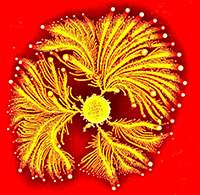
According to Onuchic, bacteria usually do not cheat their friends and inform them by sending chemical messages about their true intensions.
"We have developed for the first time a system level model of a large gene network to decipher the underlying principles of the bacteria game theory and how an internal network of genes and proteins is used to calculate risks in this complicated situation," he said.
This has applications to human society because many people encounter similar dilemmas during their own lives. For example, should people ignore side effects and vaccinate against a new potentially lethal virus or should they not vaccinate and take the risk of being infected with the possible consequences? If the majority of the population is going to get vaccinated, then it is better for each individual not to get vaccinated. However, if most people will not be vaccinated then it is better to be vaccinated.
"What each bacterium is doing is the equivalent if each individual on earth was able receive the exact information about the rate of spread of this new virus, the exact information about the intensions, to be vaccinated or not, by each person on the planet, and in addition the exact information about the health risks of side effects or being infected,” said Ben Jacob. “A decision is then made in the context of this vast amount of information."
"We have shown how the bacteria do this complex calculation according to well-defined principles," added Onuchic. "We learned a simple rule: Anyone who needs to make a decision under pressure in life, especially if it is a possible death decision, will take its time. She or he will review the trends of change, will render all possible chances and risks, and only then react."
"Another interesting fact is that the same cells in the same environment, in this case, bacteria in the colony, can actually in a statistical matter choose two different outcomes: sporulation or competence. This leads us to speculate whether similar ideas can be extrapolated to explain the decisions of cells to develop cancer: Can a similar cell in a tissue make the decision to duplicate normally or to modify into a cancer cell? How does this stochastic process affect life, biology, evolution and disease is an interesting challenge that will be at the center of questions answered at the interface of the physical and life sciences."
Provided by University of California - San Diego (news : web)


