Scientists discover first evidence of brain rewiring in children
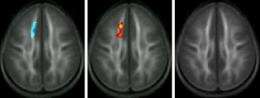
Carnegie Mellon University scientists Timothy Keller and Marcel Just have uncovered the first evidence that intensive instruction to improve reading skills in young children causes the brain to physically rewire itself, creating new white matter that improves communication within the brain.
As the researchers report today in the journal Neuron, brain imaging of children between the ages of 8 and 10 showed that the quality of white matter — the brain tissue that carries signals between areas of grey matter, where information is processed — improved substantially after the children received 100 hours of remedial training. After the training, imaging indicated that the capability of the white matter to transmit signals efficiently had increased, and testing showed the children could read better.
"Showing that it's possible to rewire a brain's white matter has important implications for treating reading disabilities and other developmental disorders, including autism," said Just, the D.O. Hebb Professor of Psychology and director of Carnegie Mellon's Center for Cognitive Brain Imaging (CCBI).
Dr. Thomas R. Insel, director of the National Institute of Mental Health, agreed. "We have known that behavioral training can enhance brain function. The exciting breakthrough here is detecting changes in brain connectivity with behavioral treatment. This finding with reading deficits suggests an exciting new approach to be tested in the treatment of mental disorders, which increasingly appear to be due to problems in specific brain circuits," Insel said.
Keller and Just's study was designed to discover what physically changes in the brains of poor readers who make the transition to good reading. They scanned the brains of 72 children before and after they went through a six-month remedial instruction program. Using diffusion tensor imaging (DTI), a new brain imaging technique that tracks water movement in order to reveal the microscopic structure of white matter, Keller and Just found a brain change involving the white matter cabling that wires different parts of the brain together.
"Water molecules that are inside nerve fibers tend to move or diffuse parallel to the nerve fibers," explained Keller, a CCBI research scientist and author of the first developmental study of compromised white matter in autism. "To track the nerve fibers, the scanner senses areas in which many water molecules are moving along in the same direction and produces a road-map of the brain's wiring."
Previous DTI studies had shown that both children and adults with reading difficulty displayed areas of compromised white matter. This new study shows that 100 hours of intensive reading instruction improved children's reading skills and also increased the quality of the compromised white matter to normal levels. More precisely, the DTI imaging illustrated that the consistency of water diffusion had increased in this region, indicating an improvement in the integrity of the white matter tracts.
"The improved integrity essentially increases communication bandwidth between the two brain areas that the white matter connects, by a factor of 10," Just said. "This opens a new era of being able to see the brain wiring change when an effective instructional treatment is applied. It lets us see educational interventions from a new perspective."
Out of the 72 children, 47 were poor readers and 25 were reading at a normal level. The good readers and a group of 12 poor readers did not receive the remedial instruction, and their brain scans did not show any changes. "The lack of change in the control groups demonstrates that the change in the treated group cannot be attributed to naturally occurring maturation during the study," Keller said.
Keller and Just also found that the amount of change in diffusion among the treated group was directly related to the amount of increase in phonological decoding ability. The children who showed the most white matter change also showed the most improvement in reading ability, confirming the link between the brain tissue alteration and reading progress.
Additional analyses indicated that the change resulted from a decrease in the movement of water perpendicular to the main axes of the underlying white matter fibers, a finding consistent with increased myelin content in the region. Although the authors caution that further research will be necessary to uncover the precise mechanism for the change in white matter, some previous findings indicate a role for electrical activity along axons in promoting the formation of myelin around them, providing a plausible physiological basis for intensive practice and instruction increasing the efficiency of communication among brain areas.
"We're excited about these results," Just said. "The indication that behavioral intervention can improve both cognitive performance and the microstructure of white matter tracts is a breakthrough for treating and understanding development problems."
Source: Carnegie Mellon University (news : web)


