Marseillevirus, new giant virus discovered
December 9, 2009
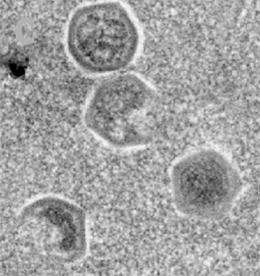
Marseillevirus at different stages of its formation in an amoeba. © Raoult / URMITE
Scientists in France have isolated a new giant virus that lurks inside amoeba and whose gene pool includes genetic material from other species.
After Mimivirus, Mamavirus and the virophage, the group of giant viruses now has a new member called Marseillevirus.
Discovered in an amoeba by the team led by Didier Raoult at the Unité de Recherche sur les Maladies Infectieuses et Tropicales Emergentes research group (CNRS, France), a description of this new virus was published this week on the website of the Proceedings of the National Academy of Sciences (PNAS). These findings suggest the exchange of genes in amoebae that may lead to the constitution of different gene repertoires that could be a source of new pathogens.
Amoebae are single-cell, eukaryote (possessing a nucleus) living organisms, some of which are human or animal parasites and may cause a variety of pathologies. Most amoebae live in water, damp soils or mosses. They are mobile and capable of ingesting a wide variety of different organisms (for example, viruses or bacteria with extraordinarily broadly ranging sizes and lifestyles). Thus amoebae provide a site for numerous exchanges of genetic material arising from the many organisms that "colonize" them.
The team led by Didier Raoult at URMITE has recently discovered, in an amoeba, a member of a new family of giant viruses, which it has called the Marseillevirus, smaller than Mimivirus, which is the largest giant virus known at present. With a chimeric genome (containing both DNA and RNA) of 368,000 base pairs, Marseillevirus is indeed the fifth largest viral genome to be sequenced. It has an icosahedral shape and a diameter of about 250 nanometers (or 250 millionths of a millimeter). In addition, the researchers discovered that it contained genes from markedly differing sources, i.e. of bacterial, viral or eukaryote origin, or arising from Archae.
The genome of Marseillevirus, a mosaic of genes from very different organisms, thus demonstrates the exchange of genes between the organisms that "colonize" amoebae. These studies have also revealed the role of amoebae, and more generally phagocytic protists (or single-cell eukaryotes) that feed on microbes in the environment, in the constitution of new gene "repertoires" which may be capable of generating new agents that will be pathogenic to multicellular organisms such as animals, plants or humans.
More information: Giant Marseillevirus highlights the role of amoebae as a melting pot in emergence of chimaeric microorganism: Boyer M., Raoult D. and al., PNAS, 2009
Provided by CNRS
-
Research on viral origins suggests new definition of virus may be needed
Feb 12, 2009 |
not rated yet |
0
-
H3N1 pig flu virus found in South Korea
Nov 20, 2006 |
not rated yet |
0
-
In Brief: Mobile viruses doubled since Nov. 05
Apr 28, 2006 |
not rated yet |
0
-
Researchers Engineer Self-Destructing Virus
Jul 10, 2008 |
not rated yet |
0
-
Findings uncover new details about mysterious virus
Apr 28, 2009 |
not rated yet |
0
-
Engineers build first sub-10-nm carbon nanotube transistor
Feb 01, 2012 |
4.9 / 5 (31) |
30
-
Something old, something new: Evolution and the structural divergence of duplicate genes
Jan 31, 2012 |
4.6 / 5 (7) |
1
-
The hidden nanoworld of ice crystals: Revealing the dynamic behavior of quasi-liquid layers
Jan 30, 2012 |
5 / 5 (3) |
1
-
Stock market network reveals investor clustering
Jan 27, 2012 |
3.9 / 5 (23) |
8
-
Of microchemistry and molecules: Electronic microfluidic device synthesizes biocompatible probes
Jan 26, 2012 |
5 / 5 (1) |
0
-
Protease cleavage
4 hours ago
-
Pertubance in a model
10 hours ago
-
Cancer drugs and Alzheimer's, Oh my!
19 hours ago
-
Squishing cells
19 hours ago
-
Any books/articles for evolutionary stable strategy models in humans?
Feb 09, 2012
-
Science behind the bore feeling?
Feb 09, 2012
- More from Physics Forums - Biology
More news stories
The power of estrogen -- male snakes attract other males
A new study has shown that boosting the estrogen levels of male garter snakes causes them to secrete the same pheromones that females use to attract suitors, and turned the males into just about the sexiest ...
9 hours ago |
5 / 5 (3) |
0
|
Grass to gas: Researchers' genome map speeds biofuel development
Researchers at the University of Georgia have taken a major step in the ongoing effort to find sources of cleaner, renewable energy by mapping the genomes of two originator cells of Miscanthus x giganteus, a large perenn ...
6 hours ago |
3.7 / 5 (3) |
0
|
Experts reveal how plants don't get sunburn
(PhysOrg.com) -- Experts at the University of Glasgow have discovered how plants survive the harmful rays of the sun.
9 hours ago |
5 / 5 (2) |
0
|
Protein libraries in a snap
(PhysOrg.com) -- A Rice University undergraduate will depart with not only a degree but also a possible patent for his invention of an efficient way to create protein libraries, an important component of biomolecular ...
12 hours ago |
5 / 5 (2) |
0
|
Miami battling invasion of giant African snails
No one knows how they got there. But an invasion of African giant snails has southern Florida in a panic over potential crop damage, disease and general yuckiness surrounding the slimy gastropods.
13 hours ago |
4 / 5 (1) |
4
Google users warned of threat to smartphone wallets
Users of Google smartphone wallets were being warned on Friday that there is a way to crack pass codes intended to thwart thieves from going on illicit shopping sprees.
Anonymous knocks CIA website offline (Update)
The website of the Central Intelligence Agency was inaccessible on Friday after the hacker group Anonymous claimed to have knocked it offline.
Complex wiring of the nervous system may rely on a just a handful of genes and proteins
Researchers at the Salk Institute have discovered a startling feature of early brain development that helps to explain how complex neuron wiring patterns are programmed using just a handful of critical genes. ...
NASA sees wide-eyed cyclone Jasmine
Cyclone Jasmine's eye has opened wider on NASA satellite imagery, as it moves through the Southern Pacific Ocean.
NASA sees Giovanna reach cyclone strength, threaten Madagascar
Tropical Storm 12S built up steam and became a cyclone on February 10, 2012 as NASA's Terra satellite passed overhead. Residents of east-central Madagascar should prepare for this cyclone to make landfall ...
Putting the squeeze on planets outside our solar system
(PhysOrg.com) -- Using high-powered lasers, scientists at Lawrence Livermore National Laboratory and collaborators discovered that molten magnesium silicate undergoes a phase change in the liquid state, abruptly ...
Dec 09, 2009
Rank: 3 / 5 (2)
This is me in my ignorance: is it common among biologists/DNA researchers to pretend that humans are a separate thing from animals? Is there a scientific and widely-accepted fundamental reason (pertaining to immune system perhaps) that human beings are classified outside of animals? Or is this simply a case of the author making a redundant statement? Last I checked, we do not fall under any of the other Kingdoms of life.
Dec 09, 2009
Rank: 2.3 / 5 (3)
"The idea of a common ancestor makes no sense in the light of viruses," he said.
"That was Darwin's idea, but he was clearly wrong."
---
Wow. This is one of the most retarded things I have EVER seen written in a biology article. Darwin's theory, and how it has been modified in the last century relate to life- virii are NOT life. The reproductive hijacking techniques of these things perfectly explain why it has code spanning multiple kingdoms.
Seriously, please get real biologists for this. I expect at least an elementary understanding of biology in articles.
Dec 09, 2009
Rank: 4.8 / 5 (4)
No. But when you publish in non-scientif circles you need to include these qualifiers since many people will think when you only write about 'parasites in animals' that this has nothing to do with humans.
I think what he's getting at is the notion that these viruses acquire DNA from a lot of sources - which gives them no distinct ancestor from which they can be said to have evolved.
(unless you count a DNA single base pair as 'a common ancestor' - but that would be stretching it)
Dec 09, 2009
Rank: 1 / 5 (3)
Dec 09, 2009
Rank: not rated yet
---
Remember though, biological evolution deals with life it's self. A virus is not alive, but is rather akin to a "Rogue protein," that has to conscript a fully living cells
Dec 09, 2009
Rank: 5 / 5 (2)
Viruses are a bit of a puzzle when it comes to the definition of life. The way I see it they show our definition of life for what it is: arbitrary and unusable except for in trivial cases.
Dec 09, 2009
Rank: 1 / 5 (1)
Dec 09, 2009
Rank: 5 / 5 (1)
I don't think even that is quite fair. They'd still have a common ancestor nonetheless, it'd just be harder to pinpoint with genetics. The new DNA the virus absorbs would simply be another method of genetic variation. Treat it the same way and I don't really see how it would be much different. Seems like the viruses pretty much remain the same, they're not really a true merging of two distinct species or anything.