Entropy alone creates complex crystals from simple shapes, study shows
December 9, 2009
Entropy alone creates complex crystals from simple shapes, study shows

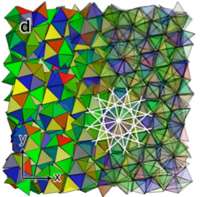
Researchers uncovered a way to pack tetrahedra more densely than ever before. Experiments and computer simulations, like the one shown here, helped the team to obtain the highest packing fraction of 85.03 and discover the formation of quasicrystals when the tetrahedra were compressed.

(PhysOrg.com) -- In a study that elevates the role of entropy in creating order, research led by the University of Michigan shows that certain pyramid shapes can spontaneously organize into complex quasicrystals.

A quasicrystal is a solid whose components exhibit long-range order, but without a single pattern or a unit cell that repeats.

A paper on the findings appears in the Dec. 10 issue of Nature. Researchers from Case Western Reserve University and Kent State University collaborated on the study.

Entropy is a measure of the number of ways the components of a system can be arranged. While often linked to disorder, entropy can also cause objects to order. The pyramid shape central to this research is the tetrahedron---a three-dimensional, four-faced, triangular polyhedron that turns up in and biology.

"Tetrahedrons are the simplest regular solids, while quasicrystals are among the most complex and beautiful structures in nature. It's astonishing and totally unexpected that entropy alone can produce this level of complexity," said Sharon Glotzer, a professor in the University of Michigan departments of Chemical Engineering and Materials Science and Engineering and principal investigator on the project.

The finding may lead to the development of a variety of that derive properties from their structure, said Rolfe Petschek, a physics professor at Case Western Reserve who helped with the mathematical characterization of the structure. "A quasicrystal will have different properties than a crystal or ordinary solid," Petschek said.

The scientists used computer simulation to find the arrangement of tetrahedrons that would yield the densest packing---that would fit the most tetrahedrons in a box.

The was for decades conjectured to be the only solid that packs less densely than spheres, until just last year when U-M mathematics graduate student Elizabeth Chen found an arrangement that proved that speculation wrong. This latest study bests Chen's organization and discovered what is believed to be the densest achievable packing of tetrahedrons.

But Glotzer says the more significant finding is that the tetrahedrons can unexpectedly organize into intricate quasicrystals at a point in the computer simulation when they take up roughly half the space in the theoretical box.

In this computer experiment, many thousands of tetrahedrons organized into dodecagonal, or 12-fold, quasicrystals made of parallel stacks of rings around pentagonal dipyramids. A pentagonal dipyramid contains five tetrahedrons arranged into a disk. The researchers discovered that this motif plays a key role in the overall packing.

This is the first result showing such a complicated self-arrangement of hard particles without help from attractive interactions such as chemical bonds, Glotzer said.

"Our results go to the very heart of phase transitions and to the question of how complex order arises in nature and in the materials we make," Glotzer said. "We knew that entropy on its own could produce order, but we didn't expect it to produce such intricate order. What else might be possible just due to entropy?"

Other approaches to solving the tetrahedron packing problem have not involved . Researchers instead tried out different arrangements to arrive at the densest structure. That was the approach taken by Chen, who achieved a packing fraction of more than 77 percent, which means the shapes took up more than 77 percent of the space in the box. (Cubes have a 100 percent packing fraction in a cubic box, while spheres pack at only 74 percent.)

Rather than "posit what they might do," this computer simulation allowed the tetrahedrons to figure out the best packing on their own according to the laws of statistical mechanics and thermodynamics, said Michael Engel, a postdoctoral researcher at U-M and co-first author of the paper with U-M chemical engineering graduate student Amir Haji-Akbari.

In the simulation, the tetrahedrons organized into a quasicrystal and settled on a packing that, when compressed further, used up 83 percent of the space. Engel then reorganized the shapes into a "quasicrystalline approximate," which is a periodic crystal closely resembling the quasicrystal. He found an arrangement that filled more than 85 percent of the space.

The researchers are excited about the possible applications of the new structure.

"Made of the right materials, this unexpected new tetrahedron quasicrystal may possess unique optical properties that could be very interesting and useful," said Peter Palffy-Muhoray, a professor in the Liquid Crystal Institute at Kent State University and a collaborator on the work. Possible uses include communication and stealth technologies.

More information: "Disordered, quasicrystalline and crystalline phases of densely packed tetrahedra." Nature.

Source: University of Michigan (news : web)

4.8 /5 (22 votes)  

Filter


Move the slider to adjust rank threshold, so that you can hide some of the comments.


Display comments: newest first

Ronan
Dec 10, 2009

Rank: not rated yet
Well, I understand that with delta H out of the way (not much heat released from different block packing arrangements, after all), entropy's all that can be blamed, but...Hm. I'm so used to thinking of entropy ALWAYS increasing disorder that it producing order, of a sort, is hard to wrap my head around. I suppose...is it that these crystal arrangements are the most likely configuration under the conditions tested? Normally, the most likely configuration of a system would be maximum disorder, I understand, but...I guess, given the right conditions, order could win out. Can anyone who knows more about this/is familiar with entropy in non-chemical contexts say whether what I'm saying sounds sensible?
phystic
Dec 10, 2009

Rank: not rated yet
very very interesting and relevant(IMO). A concept I've pondered in some hypothetical-merged-models, but very interesting to see manifestations in the laboratory.
Rank 4.8 /5 (22 votes)
Relevant PhysicsForums posts
  • How to avoid formation of Lithium Chromate ???
    created4 hours ago
  • how to choose a reduced or oxidated form in a redox
    created10 hours ago
  • Mesomeric effect in acids.
    created10 hours ago
  • Looking for a safe endothermic chemical reaction
    createdFeb 07, 2012
  • Anomalies of H20
    createdFeb 07, 2012
  • Orbital Hybridization - Real or Approximation
    createdFeb 07, 2012
  • More from Physics Forums - Chemistry

More news stories

Research provides octagonal window of opportunity for carbon capture

(PhysOrg.com) -- Filtering carbon dioxide, a greenhouse gas, from factory smokestacks is a necessary, but expensive part of many manufacturing processes. However, a collaborative research team from the National ...

Chemistry / Materials Science

created 13 hours ago | popularity 5 / 5 (1) | comments 3 | with audio podcast

Carbonized coffee grounds remove foul smells

For coffee lovers, the first cup of the morning is one of life's best aromas. But did you know that the leftover grounds could eliminate one of the worst smells around – sewer gas?

Chemistry / Materials Science

created 12 hours ago | popularity 5 / 5 (2) | comments 2 | with audio podcast

Study adds timing capability to living cell sensors

(PhysOrg.com) -- Individual cells modified to act as sensors using fluorescence are already useful tools in biochemistry, but now they can add good timing to their resumé, thanks in part to expertise ...

Chemistry / Biochemistry

created 13 hours ago | popularity not rated yet | comments 0 | with audio podcast

'Cell assay on a chip': solid results from simple means

(PhysOrg.com) -- The great artist and inventor Leonardo da Vinci once said that "simplicity is the ultimate sophistication." National Institute of Standards and Technology (NIST) research engineer Javier Atencia ...

Chemistry / Analytical Chemistry

created 13 hours ago | popularity 5 / 5 (1) | comments 1

New crime-fighting tools aim to deter and nab terrorists

Fingerprints, ballistics, DNA analysis and other mainstays of the forensic science toolkit may get a powerful new crime-solving companion as scientists strive to develop technology for "fingerprinting" and tracing the origins ...

Chemistry / Other

created 11 hours ago | popularity not rated yet | comments 0


Astronomy team discovers nearby dwarf galaxy

(PhysOrg.com) -- A team led by UCLA research astronomer Michael Rich has used a unique telescope to discover a previously unknown companion to the nearby galaxy NGC 4449, which is some 12.5 million light years ...

Amasia: As next supercontinent forms, Arctic Ocean, Caribbean will vanish first

(PhysOrg.com) -- Geologists at Yale University have proposed a new theory to describe the formation of supercontinents, the epic process by which Earth’s major continental blocks combine into a single ...

Why are there so few fish in the Earth's oceans?

(PhysOrg.com) -- A Stony Brook University researcher has found that, contrary to popular belief, there are not plenty of fish in the sea.

Transparent iron? For the first time, an experiment shows that atomic nuclei can become transparent

At the high-brilliance synchrotron light source PETRA III, a team of DESY scientists headed by Dr. Ralf Röhlsberger has succeeded in making atomic nuclei transparent with the help of X-ray light. At the ...

Physicists build highly efficient 'no-waste' laser

A team of University of California, San Diego researchers has built the smallest room-temperature nanolaser to date, as well as an even more startling device: a highly efficient, "thresholdless" laser that ...

Scientists strengthen memory by stimulating key site in brain

Ever gone to the movies and forgotten where you parked the car? New UCLA research may one day help you improve your memory.