Tropical birds waited for land crossing between North and South America: study
December 9, 2009
Tropical birds waited for land crossing between North and South America: study

Enlarge

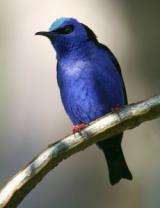
This red-legged honeycreeper dispersed from South America into North America over the completed land bridge - Photo by Noel Ureņa, copyright by Tropical Feathers www.costaricabirdingtours.com

Despite their ability to fly, tropical birds waited until the formation of the land bridge between North and South America to move northward, according to a University of British Columbia study published this week in the Proceedings of the National Academy of Sciences Early Edition.

"While many North American simply flew across the marine barriers that once separated the continents, tropical birds, especially those in Amazon forest regions, began colonization of North America almost entirely after the completion of the land bridge," says lead author Jason Weir, who conducted the study as part of his PhD at UBC.

"This study is the most extensive evidence to date that shows the land bridge playing a key role in the interchange of bird species between North and South America and the abundant biodiversity in the tropical regions," says Weir, now a post-doctoral fellow at the University of Chicago.

The Isthmus of Panama land bridge was completed between three and four million years ago, and today consists of the country of Panama. It is believed to have initiated the Great American Biotic Interchange, bringing mammals that evolved uniquely in South America during its "island isolation" - the armadillo, opossum and porcupine - to North America.

records have shown that also travelled across the land bridge from North to South America, increasing biodiversity in the tropical regions. "But a lack of bird fossils has made it difficult to determine if the land bridge was equally instrumental in the interchange of avian species," says Weir.

By analyzing the DNA of 457 bird species on either side of the land bridge, Weir and colleagues at UBC and the Smithsonian Tropical Research Institute in Panama were able to reconstruct a "family tree" of species closely related to one another and revealed a "hidden chapter" in the impact of the land bridge to biodiversity. They found a dramatic increase in the rates of interchange after the land bridge completion.

"This is a bit surprising," says co-author Dolph Schluter, UBC zoology professor and Canada Research Chair in Evolutionary Biology. "Couldn't the birds have flown across the gap? Some did, but most tropical birds waited for the land crossing."

The researchers believe the inability of many tropical birds to fly long distances across open water - some are reluctant even to cross rivers as narrow as 200 metres - may have contributed to the few north-bound movements prior to the land bridge completion.

More information: The paper is available online at http://www.pnas.or … ull.pdf+html

Source: University of British Columbia (news : web)

3.8 /5 (4 votes)  

Filter


Move the slider to adjust rank threshold, so that you can hide some of the comments.


Display comments: newest first

deatopmg
Dec 10, 2009

Rank: not rated yet
Until they could know, by seeing, why would they just fly north or fly south w/ (anthropomorphic) hope that they'd find a "new land"? In fact maybe some did (E & W too) and were never heard from again.
Rank 3.8 /5 (4 votes)
Relevant PhysicsForums posts
  • Mitosis
    created1 hour ago
  • Stem cell question.
    created3 hours ago
  • Protease cleavage
    created9 hours ago
  • Pertubance in a model
    created16 hours ago
  • Cancer drugs and Alzheimer's, Oh my!
    createdFeb 09, 2012
  • Squishing cells
    createdFeb 09, 2012
  • More from Physics Forums - Biology

More news stories

The power of estrogen -- male snakes attract other males

A new study has shown that boosting the estrogen levels of male garter snakes causes them to secrete the same pheromones that females use to attract suitors, and turned the males into just about the sexiest ...

Biology / Plants & Animals

created 14 hours ago | popularity 4.8 / 5 (6) | comments 1 | with audio podcast

Grass to gas: Researchers' genome map speeds biofuel development

Researchers at the University of Georgia have taken a major step in the ongoing effort to find sources of cleaner, renewable energy by mapping the genomes of two originator cells of Miscanthus x giganteus, a large perenn ...

Biology / Biotechnology

created 11 hours ago | popularity 3.8 / 5 (5) | comments 0 | with audio podcast

Experts reveal how plants don't get sunburn

(PhysOrg.com) -- Experts at the University of Glasgow have discovered how plants survive the harmful rays of the sun.

Biology / Cell & Microbiology

created 14 hours ago | popularity 4.8 / 5 (5) | comments 0 | with audio podcast

Miami battling invasion of giant African snails

No one knows how they got there. But an invasion of African giant snails has southern Florida in a panic over potential crop damage, disease and general yuckiness surrounding the slimy gastropods.

Biology / Ecology

created 18 hours ago | popularity 4 / 5 (1) | comments 4

Protein libraries in a snap

(PhysOrg.com) -- A Rice University undergraduate will depart with not only a degree but also a possible patent for his invention of an efficient way to create protein libraries, an important component of biomolecular ...

Biology / Cell & Microbiology

created 17 hours ago | popularity 4.8 / 5 (4) | comments 0 | with audio podcast


Google users warned of threat to smartphone wallets

Users of Google smartphone wallets were being warned on Friday that there is a way to crack pass codes intended to thwart thieves from going on illicit shopping sprees.

Anonymous knocks CIA website offline (Update)

The website of the Central Intelligence Agency was inaccessible on Friday after the hacker group Anonymous claimed to have knocked it offline.

New error-correcting codes guarantee the fastest possible rate of data transmission

Error-correcting codes are one of the triumphs of the digital age. They’re a way of encoding information so that it can be transmitted across a communication channel — such as an optical fiber o ...

Complex wiring of the nervous system may rely on a just a handful of genes and proteins

Researchers at the Salk Institute have discovered a startling feature of early brain development that helps to explain how complex neuron wiring patterns are programmed using just a handful of critical genes. ...

Humans may have helped the decline of African rainforests 3000 years ago

(PhysOrg.com) -- Large areas of rainforests in Central Africa mysteriously disappeared over three thousand years ago, to be replaced by savannas. The prevailing theory has been that the cause was a change ...

New power source discovered

(PhysOrg.com) -- Researchers at the Massachusetts Institute of Technology (MIT) and RMIT University have made a breakthrough in energy storage and power generation.