Saturn's Mysterious Hexagon Emerges from Winter Darkness
December 9, 2009
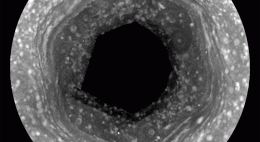
This movie from Cassini, made possible only as Saturn's north pole emerged from winter darkness, shows new details of a jet stream that follows a hexagon-shaped path and has long puzzled scientists.
(PhysOrg.com) -- After waiting years for the sun to illuminate Saturn's north pole again, cameras aboard NASA's Cassini spacecraft have captured the most detailed images yet of the intriguing hexagon shape crowning the planet.
The new images of the hexagon, whose shape is the path of a jet stream flowing around the north pole, reveal concentric circles, curlicues, walls and streamers not seen in previous images.
The last visible-light images of the entire hexagon were captured by NASA's Voyager spacecraft nearly 30 years ago, the last time spring began on Saturn. After the sunlight faded, darkness shrouded the north pole for 15 years. Much to the delight and bafflement of Cassini scientists, the location and shape of the hexagon in the latest images match up with what they saw in the Voyager pictures.
"The longevity of the hexagon makes this something special, given that weather on Earth lasts on the order of weeks," said Kunio Sayanagi, a Cassini imaging team associate at the California Institute of Technology. "It's a mystery on par with the strange weather conditions that give rise to the long-lived Great Red Spot of Jupiter."
This video is not supported by your browser at this time.
The hexagon was originally discovered in images taken by the Voyager spacecraft in the early 1980s. It encircles Saturn at about 77 degrees north latitude and has been estimated to have a diameter wider than two Earths. The jet stream is believed to whip along the hexagon at around 100 meters per second (220 miles per hour).Early hexagon images from Voyager and ground-based telescopes suffered from poor viewing perspectives. Cassini, which has been orbiting Saturn since 2004, has a better angle for viewing the north pole. But the long darkness of Saturnian winter hid the hexagon from Cassini's visible-light cameras for years. Infrared instruments, however, were able to obtain images by using heat patterns. Those images showed the hexagon is nearly stationary and extends deep into the atmosphere. They also discovered a hotspot and cyclone in the same region.
The visible-light cameras of Cassini's imaging science subsystem, which have higher resolution than the infrared instruments and the Voyager cameras, got their long-awaited glimpse of the hexagon in January, as the planet approached equinox. Imaging team scientists calibrated and stitched together 55 images to create a mosaic and three-frame movie. The mosaics do not show the region directly around the north pole because it had not yet fully emerged from winter night at that time.
Scientists are still trying to figure out what causes the hexagon, where it gets and expels its energy and how it has stayed so organized for so long. They plan to search the new images for clues, taking an especially close look at the newly identified waves that radiate from the corners of the hexagon -- where the jet takes its hardest turns -- and the multi-walled structure that extends to the top of Saturn's cloud layer in each of the hexagon's six sides. Scientists are also particularly intrigued by a large dark spot that appeared in a different position in a previous infrared image from Cassini. In the latest images, the spot appears in the 2 o'clock position.
Because Saturn does not have land masses or oceans on its surface to complicate weather the way Earth does, its conditions should give scientists a more elementary model to study the physics of circulation patterns and atmosphere, said Kevin Baines, an atmospheric scientist at NASA's Jet Propulsion Laboratory, Pasadena, Calif., who has studied the hexagon with Cassini's visual and infrared mapping spectrometer.
"Now that we can see undulations and circular features instead of blobs in the hexagon, we can start trying to solve some of the unanswered questions about one of the most bizarre things we've ever seen in the solar system," Baines said. "Solving these unanswered questions about the hexagon will help us answer basic questions about weather that we're still asking about our own planet."
-
Cassini Images Bizarre Hexagon on Saturn
Mar 27, 2007 |
not rated yet |
0
-
Giant Cyclones at Saturn's Poles Create a Swirl of Mystery
Oct 13, 2008 |
not rated yet |
0
-
Hot Cyclones Churn at Both Ends of Saturn
Jan 04, 2008 |
not rated yet |
0
-
Cassini Sees Into the Eye of a Monster Storm on Saturn
Nov 09, 2006 |
not rated yet |
0
-
Cassini cameras spot powerful new lightning storm on Saturn
Feb 14, 2006 |
not rated yet |
0
-
Engineers build first sub-10-nm carbon nanotube transistor
Feb 01, 2012 |
4.9 / 5 (30) |
30
-
Something old, something new: Evolution and the structural divergence of duplicate genes
Jan 31, 2012 |
4.6 / 5 (7) |
1
-
The hidden nanoworld of ice crystals: Revealing the dynamic behavior of quasi-liquid layers
Jan 30, 2012 |
5 / 5 (3) |
1
-
Stock market network reveals investor clustering
Jan 27, 2012 |
3.9 / 5 (23) |
8
-
Of microchemistry and molecules: Electronic microfluidic device synthesizes biocompatible probes
Jan 26, 2012 |
5 / 5 (1) |
0
-
Titan's lack of impact craters
22 hours ago
-
Real pictures of black hole eating a star?
Feb 08, 2012
-
Hypothetical way to travel faster than light, but not technically exceed lightspeed
Feb 06, 2012
-
How do scientists monitor the Sun's activity?
Feb 05, 2012
-
Search patterns in observational studies
Feb 05, 2012
-
Derivation of Pogson's law
Feb 03, 2012
- More from Physics Forums - General Astronomy
More news stories
Clam fields found at deep, low-temperature Mariana vents
(PhysOrg.com) -- Scientists have marveled at the unusual life forms thriving at high temperature hydrothermal vents of the deep ocean.
Space & Earth / Earth Sciences
48 minutes ago |
not rated yet |
0
|
Could Venus be shifting gear?
(PhysOrg.com) -- ESAs Venus Express spacecraft has discovered that our cloud-covered neighbour spins a little slower than previously measured. Peering through the dense atmosphere in the infrared, the ...
Space & Earth / Space Exploration
16 minutes ago |
5 / 5 (1) |
0
|
Streams need trees to withstand climate change
(PhysOrg.com) -- More than twenty years of biological monitoring have confirmed the importance of vegetation for protecting Australia's freshwater streams and rivers against the ravages of drought and climate ...
57 minutes ago |
not rated yet |
0
The turbulent birth of super star clusters in galaxy mergers
By combining two of the most advanced telescopes in the world -- the new Atacama Large Millimeter Array (ALMA) and the Very Large Telescope (VLT) of ESO -- a team of French astronomers from the Institut d'astrophysique ...
39 minutes ago |
not rated yet |
0
What does a nebula sound like?
What do things sound like out in the cosmos? Of course, sound waves cant travel through the vacuum of space; however, electromagnetic waves can. These electromagnetic waves can be recorded by devices called spectrographs ...
Space & Earth / Space Exploration
23 minutes ago |
5 / 5 (1) |
0
Seeing colors in music, tasting flavors in shapes may happen in life's early months
Famed violinist Itzhak Perlman sees a deep forest green whenever he plays a B-flat on his Stradivarius' G string. The A on the E string is red.
Is that sleepiness during pregnancy normal or a sign of sleep apnea?
(Medical Xpress) -- Most pregnant women complain of being tired. Some of them however, could be suffering more than normal fatigue associated with their pregnancy; they may have developed obstructive sleep apnea (OSA), a ...
Engineering images bring life to submerged city
(PhysOrg.com) -- Photo-realistic 3D mapping and digital reconstruction of an ancient underwater city in Greece have earned a team from the University of Sydney's Faculty of Engineering and Information Technologies ...
Numeracy: The educational gift that keeps on giving?
(Medical Xpress) -- Cancer risks. Investment alternatives. Calories. Numbers are everywhere in daily life, and they figure into all sorts of decisions. A new article published in Current Directions in Psychological Science, a journal of the Association for Psychological Science, examin ...
New power source discovered
(PhysOrg.com) -- Researchers at the Massachusetts Institute of Technology (MIT) and RMIT University have made a breakthrough in energy storage and power generation.
Measurements from high-energy collisions lead to better understanding of why meson particles disappear
For several years, physicists at the Relativistic Heavy Ion Collider (RHIC) at Brookhaven National Laboratory (BNL), USA, have studied an unusual state of matter called the quarkgluon plasma, which they ...
Dec 09, 2009
Rank: 1.3 / 5 (4)
Dec 09, 2009
Rank: 5 / 5 (2)
Dec 09, 2009
Rank: not rated yet
Dec 09, 2009
Rank: 1 / 5 (2)
Dec 09, 2009
Rank: not rated yet
Dec 09, 2009
Rank: 1 / 5 (2)
Wasn't aware of any hexagonal structure found in Lunar craters. Got any links? I saw a post from someone a day or two ago from a reader that had amassed a photo catalog of "square" impact craters in New Mexico, which were quite intriguing, but looked as if they might just as well have been reservoirs or pit mines or something. If they were, in fact, impact craters, they resembled something more like punctures made by some sort of four-sided object than some randomly-shaped object.
Hmmm...
Dec 09, 2009
Rank: 1 / 5 (3)
http://dl.dropbox...Craters.
Dec 09, 2009
Rank: not rated yet
http://en.wikiped...me_ratio
If we're talking only 2D shapes, I'm pretty sure a equilateral triangle or circle (respectively) would also win over a hexagon.
Dec 09, 2009
Rank: not rated yet
http://adsabs.har...36..410V
-google lists discussions of mars, mercury, Mimas and elsewhere-
Dec 09, 2009
Rank: 1 / 5 (2)
I'm surprised that I missed(or possibly forgot) this. Makes sense in terms of the characteristics of basaltic rocks.
Dec 10, 2009
Rank: not rated yet
Dec 10, 2009
Rank: 4.5 / 5 (2)
http://mediarelat...earo.php
Dec 10, 2009
Rank: not rated yet
You also get the same pattern if you put ice in the middle of a sheet of metal and heat the edges while swirling the sheet around.
Dec 10, 2009
Rank: 5 / 5 (1)
Actually, a really good example of this on earth, for which there's videos on youtube, is the eye of hurricanes. There's a good handful of media depicting their hexagon/pentagon shaped eyes. :D
Dec 10, 2009
Rank: not rated yet
It will be interesting to discover which wall of the hexagon is receiving the most external pressure and see how that is compensated for in the other walls, (imperfect geometry fluctuations), and also how the corners become more defined during peaks of external pressure one of more walls.
Further, does the shape rotate? Hurricane centers appear to rotate, but we don't understand the dynamics that cause it, or the circumstances that would cause the center to stop rotating - the shape on Saturn above a pole, it is not shifting across the surface of tropical ocean currents.
If the shape on Saturn is not altering its alignment at any time, what does it signify?
Dec 10, 2009
Rank: not rated yet
Dec 10, 2009
Rank: not rated yet
http://dx.doi.org...0.174503
http://dcwww.camd...gPolygon
http://ams.allenp...2.0.CO;2
Dec 10, 2009
Rank: not rated yet
Dec 13, 2009
Rank: 1 / 5 (1)
this would be the so called joke of the millenium
Dec 13, 2009
Rank: not rated yet
um are Geologists puzzled? or Chemists puzzled? or Physicists puzzled? or Biologists puzzled?
Do we have General Practioner type scientists that are qualified to be still figuring this out?
What type of scientist is an - imaging team associate?
Dec 14, 2009
Rank: not rated yet