NASA's WISE Set to Blast Off and Map the Skies
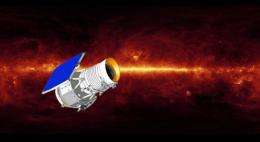
(PhysOrg.com) -- The countdown clock is ticking, with just days to go before the Wide-field Infrared Survey Explorer, or WISE, rockets into space on a mission to map the entire sky in infrared light.
NASA's newest spacecraft is currently perched atop a United Launch Alliance Delta II rocket at Vandenberg Air Force Base, north of Santa Barbara, Calif. It is scheduled to roar into space at dawn on Dec. 11, at 6:09:33 a.m. PST (9:09:33 a.m. EST), on a short journey to its final Earth-circling orbit 525 kilometers (326 miles) overhead.
After a one-month checkout, the mission will spend the next nine months mapping the cosmos in infrared light. It will cover the whole sky one-and-a-half times, snapping millions of pictures of everything from near-Earth asteroids to faraway galaxies bursting with new stars.
"The last time we mapped the whole sky at these particular infrared wavelengths was 26 years ago," said Edward (Ned) Wright of UCLA, who is the principal investigator of the mission. "Infrared technology has come a long way since then. The old all-sky infrared pictures were like impressionist paintings -- now, we'll have images that look like actual photographs."
At liftoff, the main Delta II engine and three solid-motor boosters will ignite, providing a total liftoff thrust of more than 1,812,000 newtons (407,000 pounds). The rocket will tilt toward the south, cross the California coastline and head out over the Pacific Ocean. At one minute and 39 seconds after launch, the three spent boosters will fall away from the rocket. Two minutes and 45 seconds later, the main engine will cut off, and 14 seconds later, the vehicle's second stage will ignite. At four minutes and 56 seconds after liftoff, the "fairing" covering the satellite will split open like a clamshell and fall away.
The second stage of the rocket will then cut off, reigniting again 52 minutes after launch. It will shut down a second time and then, at about 55 minutes after launch, the spacecraft will reach its final orbit and separate from the rocket. Engineers expect to pick up a signal from WISE anywhere from about one to 10 minutes after separation.
The next major event will occur about 20 minutes after separation -- the valves on the spacecraft's cryostat will automatically open. The cryostat houses and chills the telescope and infrared detectors with tanks of frozen hydrogen. Valves on the cryostat are opened after launch to allow boiled-off hydrogen to escape, thereby preventing the instrument from warming up.
"It is important to relieve the pressure due to the warming hydrogen as soon as possible," said William Irace, the mission’s project manager at NASA's Jet Propulsion Laboratory in Pasadena, Calif. "By venting the hydrogen to space, we cool our instrument down to extremely low temperatures so that the eyes of WISE won't be blinded by their own heat."
After the spacecraft is checked out and calibrated, it will begin the task of surveying the whole sky. This will take about six months, after which the spacecraft will begin to sweep the sky a second time, covering about one-half before the frozen coolant runs out. The mission's primary lifetime is expected to be about 10 months.
The closest of the mission’s finds will be asteroids and comets with orbits that come relatively close to Earth's path around the sun. These are called near-Earth objects. The infrared explorer will provide size and composition information about hundreds of these objects, giving us a better idea of their diversity. How many are dark like coal, and how many are shiny and bright? And how do their sizes differ? The mission will help answer these questions through its infrared observations, which provide information that can't be obtained using visible-light telescopes.
"We can help protect our Earth by learning more about the diversity of potentially hazardous asteroids and comets," said Amy Mainzer, deputy project scientist for the mission at JPL.
The farthest of the mission's targets are powerful galaxies that are either churning out loads of new stars or dominated by voracious black holes. These galaxies are shrouded in dust, and often can't be seen in visible light. WISE will expose millions, and may even find the most energetic, or luminous, galaxy in the universe.
"WISE can see these dusty objects so far away that we will be looking back in time 10 billion years, when galaxies were forming," said Peter Eisenhardt, the mission's project scientist at JPL. "By scanning the entire sky, we’ll learn just how extreme this galaxy formation process can get."
Provided by JPL/NASA (news : web)


