Suzaku catches retreat of a black hole's disk
December 10, 2009 by Francis Reddy
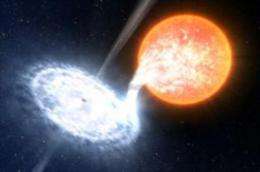
GX 339-4, illustrated here, is among the most dynamic binaries in the sky, with four major outbursts in the past seven years. In the system, an evolved star no more massive than the sun orbits a black hole estimated at 10 solar masses. Credit: ESO/L. Calçada
(PhysOrg.com) -- Studies of one of the galaxy's most active black-hole binaries reveal a dramatic change that will help scientists better understand how these systems expel fast-moving particle jets.
Binary systems where a normal star is paired with a black hole often produce large swings in X-ray emission and blast jets of gas at speeds exceeding one-third that of light. What fuels this activity is gas pulled from the normal star, which spirals toward the black hole and piles up in a dense accretion disk.
"When a lot of gas is flowing, the dense disk reaches nearly to the black hole," said John Tomsick at the University of California, Berkeley. "But when the flow is reduced, theory predicts that gas close to the black hole heats up, resulting in evaporation of the innermost part of the disk." Never before have astronomers shown an unambiguous signature of this transformation.
To look for this effect, Tomsick and an international group of astronomers targeted GX 339-4, a low-mass X-ray binary located about 26,000 light-years away in the constellation Ara. There, every 1.7 days, an evolved star no more massive than the sun orbits a black hole estimated at 10 solar masses. With four major outbursts in the past seven years, GX 339-4 is among the most dynamic binaries in the sky.
In September 2008, nineteen months after the system's most recent outburst, the team observed GX 339-4 using the orbiting Suzaku X-ray observatory, which is operated jointly by the Japan Aerospace Exploration Agency and NASA. At the same time, the team also observed the system with NASA's Rossi X-ray Timing Explorer satellite.
Instruments on both satellites indicated that the system was faint but in an active state, when black holes are known to produce steady jets. Radio data from the Australia Telescope Compact Array confirmed that GX 339-4's jets were indeed powered up when the satellites observed.
Despite the system's faintness, Suzaku was able to measure a critical X-ray spectral line produced by the fluorescence of iron atoms. "Suzaku's sensitivity to iron emission lines and its ability to measure the shapes of those lines let us see a change in the accretion disk that only happens at low luminosities," said team member Kazutaka Yamaoka at Japan's Aoyama Gakuin University.
X-ray photons emitted from disk regions closest to the black hole naturally experience stronger gravitational effects. The X-rays lose energy and produce a characteristic signal. At its brightest, GX 339-4's X-rays can be traced to within about 20 miles of the black hole. But the Suzaku observations indicate that, at low brightness, the inner edge of the accretion disk retreats as much as 600 miles.
"We see emission only from the densest gas, where lots of iron atoms are producing X-rays, but that emission stops close to the black hole -- the dense disk is gone," explained Philip Kaaret at the University of Iowa. "What's really happening is that, at low accretion rates, the dense inner disk thins into a tenuous but even hotter gas, rather like water turning to steam."
The dense inner disk has a temperature of about 20 million degrees Fahrenheit, but the thin evaporated disk may be more than a thousand times hotter.
The study, which appears in the Dec. 10 issue of the Astrophysical Journal Letters, confirms the presence of low-density accretion flow in these systems. It also shows that GX 339-4 can produce jets even when the densest part of the disk is far from the black hole.
"This doesn't tell us how jets form, but it does tell us that jets can be launched even when the high-density accretion flow is far from the black hole," Tomsick said. "This means that the low-density accretion flow is the most essential ingredient for the formation of a steady jet in a black hole system."
-
Astrophysicists Discover 'Compact Jets' From Neutron Star
May 22, 2006 |
not rated yet |
0
-
Spinning Black Hole Pushes the Limit
Nov 20, 2006 |
not rated yet |
0
-
An Intriguing, Glowing Galaxy
May 14, 2009 |
not rated yet |
0
-
Scientists Nudge Closer to the Edge of a Black Hole
Oct 06, 2006 |
not rated yet |
0
-
Why Are Galaxies without Black Holes Uncommon?
May 30, 2007 |
not rated yet |
0
-
Engineers build first sub-10-nm carbon nanotube transistor
Feb 01, 2012 |
4.9 / 5 (31) |
30
-
Something old, something new: Evolution and the structural divergence of duplicate genes
Jan 31, 2012 |
4.6 / 5 (7) |
1
-
The hidden nanoworld of ice crystals: Revealing the dynamic behavior of quasi-liquid layers
Jan 30, 2012 |
5 / 5 (3) |
1
-
Stock market network reveals investor clustering
Jan 27, 2012 |
3.9 / 5 (23) |
8
-
Of microchemistry and molecules: Electronic microfluidic device synthesizes biocompatible probes
Jan 26, 2012 |
5 / 5 (1) |
0
-
Scale of the Universe
12 hours ago
-
Titan's lack of impact craters
Feb 09, 2012
-
Real pictures of black hole eating a star?
Feb 08, 2012
-
Hypothetical way to travel faster than light, but not technically exceed lightspeed
Feb 06, 2012
-
How do scientists monitor the Sun's activity?
Feb 05, 2012
-
Search patterns in observational studies
Feb 05, 2012
- More from Physics Forums - General Astronomy
More news stories
Humans may have helped the decline of African rainforests 3000 years ago
(PhysOrg.com) -- Large areas of rainforests in Central Africa mysteriously disappeared over three thousand years ago, to be replaced by savannas. The prevailing theory has been that the cause was a change ...
Could Venus be shifting gear?
(PhysOrg.com) -- ESAs Venus Express spacecraft has discovered that our cloud-covered neighbour spins a little slower than previously measured. Peering through the dense atmosphere in the infrared, the ...
Space & Earth / Space Exploration
19 hours ago |
5 / 5 (7) |
8
|
NASA budget will axe Mars deal with Europe: scientists
US President Barack Obama's budget proposal to be submitted next week for 2013 will cut NASA's budget by 20 percent and eliminate a major partnership with Europe on Mars exploration, scientists said Thursday.
Space & Earth / Space Exploration
22 hours ago |
5 / 5 (2) |
19
Mars Science Laboratory computer issue resolved
(PhysOrg.com) -- Engineers have found the root cause of a computer reset that occurred two months ago on NASA's Mars Science Laboratory and have determined how to correct it.
Space & Earth / Space Exploration
20 hours ago |
4.7 / 5 (6) |
4
|
Two new moons for Jupiter
Advances in technology have lead to the discovery of new planets outside of our Solar System, and now even new moons in our own backyard.
Space & Earth / Space Exploration
19 hours ago |
4 / 5 (1) |
7
Anonymous knocks CIA website offline (Update)
The website of the Central Intelligence Agency was inaccessible on Friday after the hacker group Anonymous claimed to have knocked it offline.
New error-correcting codes guarantee the fastest possible rate of data transmission
Error-correcting codes are one of the triumphs of the digital age. Theyre a way of encoding information so that it can be transmitted across a communication channel such as an optical fiber o ...
Small modular reactor design could be a 'SUPERSTAR'
(PhysOrg.com) -- Though most of today's nuclear reactors are cooled by water, we've long known that there are alternatives; in fact, the world's first nuclear-powered electricity in 1951 came from a reactor ...
New power source discovered
(PhysOrg.com) -- Researchers at the Massachusetts Institute of Technology (MIT) and RMIT University have made a breakthrough in energy storage and power generation.
The power of estrogen -- male snakes attract other males
A new study has shown that boosting the estrogen levels of male garter snakes causes them to secrete the same pheromones that females use to attract suitors, and turned the males into just about the sexiest ...
Google users warned of threat to smartphone wallets
Users of Google smartphone wallets were being warned on Friday that there is a way to crack pass codes intended to thwart thieves from going on illicit shopping sprees.
Dec 10, 2009
Rank: not rated yet
That's a rather remarkable finding. Wonder if this relationship may also apply to supermassive black holes?
Dec 11, 2009
Rank: not rated yet