Study reveals H1N1 unexpected weakness
December 10, 2009
Study reveals H1N1 unexpected weakness

Enlarge

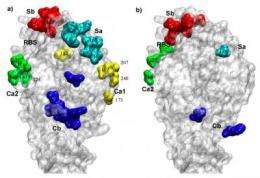
Researchers at Rice University and Baylor College of Medicine (BCM) have found what they believe is a weakness in H1N1's method for evading detection by the immune system. Credit: Rice University/Baylor College of Medicine

The H1N1 influenza virus has been keeping a secret that may be the key to defeating it and other flu viruses as well.

Researchers at Rice University and Baylor College of Medicine (BCM) have found what they believe is a weakness in H1N1's method for evading detection by the immune system.

Comparing its genetic sequences going all the way back to the virus's first known appearance in the deadly "" outbreak of 1918, they discovered a previously unrealized role of receptor-binding residues in host evasion, which effectively becomes a bottleneck that keeps the virus in check.

Rice's Jianpeng Ma and graduate student Jun Shen and BCM's Qinghua Wang compared the sequences of more than 300 strains of to track its evolution; they reported their results in a recent online edition of the scientific journal PLoS ONE.

The researchers were looking in particular at hemagglutinin (HA), the "hook" that allows the virus to attach itself to and infect host cells. It's long been known that five regions of H1N1's HA serve as antigenic sites, the protein fragments that trigger the body's immune system. These antigenic sites, first mapped in 1981, shuffle their amino-acid sequences in the endless cat-and-mouse game that viruses play to survive.

The researchers discovered several key residues involved in both antigenic sites and the receptor-binding site, the part of the protein that attaches to a cell and allows the virus to invade.

The common belief has been that the receptor binding could not change. "The site is known, but no one thought it was involved in the immune system. In order to recognize the receptor, that particular region has to be robust," Ma said. "But it turns out this region is not only variable, but also interacts with the ."

For a virus to evade antibodies, all five antigenic sites would have to disguise themselves by mutating. The new finding led the researchers to believe the receptor-binding residues would also have to mutate, but not so much that the binding no longer works. "If the binding is abolished, the virus dies," said Ma, a Rice professor in bioengineering with a joint appointment at BCM.

Such dual-function residues are a likely bottleneck for the virus, he said, because they're under the tightest restrictions. Thus, they could be easier to track over time and may chart a path to predict future mutations that will aid in vaccine design.

"It becomes a weak link and provides us with a window into the that we can monitor," Ma said. "The virus's bottleneck is our opportunity."

Wang, an assistant professor of biochemistry and molecular biology at BCM who has long studied the structure and function of HA, has been involved in the project since it began and is now working to verify the results in vitro. She hopes confirming the computations will lead to more efficiency in creating vaccines not only for H1N1 but also for other strains of the flu.

"An underlying implication is that this may not be restricted to H1N1," Wang said. "It may apply to other influenza viruses as well. If studying viral evolution can help predict what will cause a severe problem in humans, you can actually pre-stock vaccines, which will save time."

More information: View the paper at http://www.plosone … pone.0007789

Source: Rice University (news : web)

4.8 /5 (19 votes)  

Filter


Move the slider to adjust rank threshold, so that you can hide some of the comments.


Display comments: newest first

tkjtkj
Dec 10, 2009

Rank: 1 / 5 (2)
"If the binding is abolished, the virus dies," said Ma, a Rice professor in bioengineering with a joint appointment at BCM.


This yet another instance of an absolutely incorrect idea: that viruses are living things. They most certainly are NOT, and scientists who choose to perpetuate that absurd idea among non-scientists is doing a great disservice. One would think that a professor, especially one who deals with virology would not feed into this mistaken concept. Shame!

j.a., md
Bob_B
Dec 10, 2009

Rank: not rated yet
Please, explain all forms of life. Those known and not known.
Do rocks mutate?
Are trees alive?
Why can't a virus be defined as alive? Some old rules that say so?
barakn
Dec 10, 2009

Rank: 5 / 5 (1)
Ridiculous, tkjkj. There is no one standard definition of life that scientists have agreed upon.
ealex
Dec 10, 2009

Rank: 5 / 5 (3)
Does anyone ever comment on the subject of the article anymore instead of just nitpicking at the semantics?

I'm far from a biology major, but this seems like good scientific advance to me and it should be commended.

At least they're not researching the obvious like some other time wasters are.
paulthebassguy
Dec 10, 2009

Rank: 5 / 5 (1)
It's a shame that most comments in Physorg articles have now degenerated to ignorant people arguing.

I wish that only truly educated and informed people would comment and add to articles' integrity & interest.
Birger
Dec 11, 2009

Rank: 5 / 5 (1)
"It may apply to other influenza viruses as well. If studying viral evolution can help predict what will cause a severe problem in humans, you can actually pre-stock vaccines, which will save time."
...and if the time factor allows scaling up vaccine production, maybe even third-world countries could afford the vaccines, thus saving many lives since malnutrition makes people far more vulnerable to disease
NameIsNotNick
Dec 11, 2009

Rank: not rated yet
There is an old Irish saying: "Empty barrels make the most noise!".

It's a shame that most comments in Physorg articles have now degenerated to ignorant people arguing.

I wish that only truly educated and informed people would comment and add to articles' integrity & interest.

Rank 4.8 /5 (19 votes)
Relevant PhysicsForums posts
  • Is Everyday Technology Killing Us?
    createdFeb 08, 2012
  • Exercise and weight loss
    createdFeb 08, 2012
  • Why do we have head aches? Our brains can't feel anything.
    createdFeb 07, 2012
  • "The end of diseases" by David Agus, interview from Daily Show with Jon Stewart
    createdFeb 04, 2012
  • Oncolytic adenovirus
    createdFeb 04, 2012
  • Nutrition label stuffs and diets
    createdFeb 02, 2012
  • More from Physics Forums - Medical Sciences

More news stories

Complex wiring of the nervous system may rely on a just a handful of genes and proteins

Researchers at the Salk Institute have discovered a startling feature of early brain development that helps to explain how complex neuron wiring patterns are programmed using just a handful of critical genes. ...

Medicine & Health / Research

created 13 hours ago | popularity 4.9 / 5 (9) | comments 1 | with audio podcast

Team isolates nerve cells involved in storing long term memory and gene proteins associated with them

(Medical Xpress) -- A research team in Taiwan has succeeded in isolating two nerve cells in fruit fly brains that are believed to be the major players in allowing for the formation of long term memories. Furthermore, ...

Medicine & Health / Neuroscience

created 19 hours ago | popularity 5 / 5 (4) | comments 2 | with audio podcast report

Seeing colors in music, tasting flavors in shapes may happen in life's early months

Famed violinist Itzhak Perlman sees a deep forest green whenever he plays a B-flat on his Stradivarius' G string. The A on the E string is red.

Medicine & Health / Psychology & Psychiatry

created 20 hours ago | popularity 4.5 / 5 (2) | comments 2 | with audio podcast

Both maternal and paternal age linked to autism

Older maternal and paternal age are jointly associated with having a child with autism, according to a recently published study led by researchers at The University of Texas Health Science Center at Houston (UTHealth).

Medicine & Health / Psychology & Psychiatry

created 17 hours ago | popularity 4.3 / 5 (3) | comments 0 | with audio podcast

New understanding of DNA repair could eventually lead to cancer therapy

A research group in the Faculty of Medicine & Dentistry at the University of Alberta is hoping its latest discovery could one day be used to develop new therapies that target certain types of cancers.

Medicine & Health / Cancer

created 17 hours ago | popularity 4.8 / 5 (6) | comments 0 | with audio podcast


Anonymous knocks CIA website offline (Update)

The website of the Central Intelligence Agency was inaccessible on Friday after the hacker group Anonymous claimed to have knocked it offline.

New error-correcting codes guarantee the fastest possible rate of data transmission

Error-correcting codes are one of the triumphs of the digital age. They’re a way of encoding information so that it can be transmitted across a communication channel — such as an optical fiber o ...

Humans may have helped the decline of African rainforests 3000 years ago

(PhysOrg.com) -- Large areas of rainforests in Central Africa mysteriously disappeared over three thousand years ago, to be replaced by savannas. The prevailing theory has been that the cause was a change ...

Small modular reactor design could be a 'SUPERSTAR'

(PhysOrg.com) -- Though most of today's nuclear reactors are cooled by water, we've long known that there are alternatives; in fact, the world's first nuclear-powered electricity in 1951 came from a reactor ...

New power source discovered

(PhysOrg.com) -- Researchers at the Massachusetts Institute of Technology (MIT) and RMIT University have made a breakthrough in energy storage and power generation.

The power of estrogen -- male snakes attract other males

A new study has shown that boosting the estrogen levels of male garter snakes causes them to secrete the same pheromones that females use to attract suitors, and turned the males into just about the sexiest ...