'Fighting' IED attacks with SCARE technology
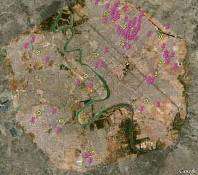
(PhysOrg.com) -- University of Maryland researchers have developed and successfully tested new computer software and computational techniques to analyze patterns of improvised explosive device (IED) attacks in Iraq, Afghanistan or other locations and predict the locations of weapons caches that are used by insurgents to support those attacks.
University of Maryland computer science Ph.D. student Paulo Shakarian and computer science Professor V.S. Subrahmanian, together with University of Torino (Italy) computer science Professor Maria-Luisa Sapino developed a new computational technique called geospatial abduction designed to help analysts locate caches of explosive weapons. Their resulting software, called SCARE (Spatio-Cultural Abductive Reasoning Engine) allows human analysts to combine available intelligence with this analytical computational technique to identify the most probable locations of IED weapons caches. The researchers say tests conducted with the SCARE software have been quite accurate.
"The SCARE software is not a stand-alone tool," said Subrahmanian, who also is director of the University of Maryland's Institute for Advanced Computer Studies "Military commanders and intelligence analysts would use SCARE in conjunction with their own experience and knowledge of a region, and together with available intelligence to pinpoint likely cache locations."
"SCARE is designed to address a very real tactical problem our soldiers encounter on a regular basis," said Shakarian, who is a U.S. Army Captain enrolled in the Army's Advanced Civil Schooling program "By helping concentrate the focus of both observations and searches, we think SCARE would allow field commanders to better deploy resources, and in many cases, catch insurgents in the process of resupplying such locations or actually carrying out IED attacks." Shakarian has spent over two years in Iraq.
To test their technique, Subrahmanian, Shakarian and Sapino ran through the SCARE program publically available data on the locations of IED attacks in Baghdad that occurred over a 21-month period. The locations of IED caches predicted by SCARE were then compared with actual locations of caches found in that region during that time. The predictions usually were within a half mile of actual locations. A paper on these findings was presented during the Third International Conference on Computational Cultural Dynamics, December 7- 8, 2009 (P. Shakarian, V.S. Subrahmanian, M.L. Sapino. SCARE: A Case Study with Baghdad - ICCCD, 2009)

Revealing NUMB3RS
The SCARE software with its logic-based, mathematical algorithms works like something out of the CBS TV show NUMB3RS, a "drama about an FBI agent who recruits his mathematical-genius brother to help the Bureau solve a wide range of challenging crimes in Los Angeles." Like the problems solved through application of logic-based mathematical formulas in the show, SCARE starts from known information to plot out underlying patterns and locations.
And like many of the NUMB3RS episodes, the SCARE mathematical formula is based on abductive logic. Classical deductive reasoning tries to state what follows from a set of facts, while abduction tries to find the best explanation for a set of observations. In this case, the observations are the locations of the IED attacks, together with the ethnic make-up of neighborhoods. The best explanations correspond to the most likely locations for the weapons caches supporting these attacks.
A different type of logic-based computational system and software called SOMA developed by at the University of Maryland actually was cited on a recent NUMB3RS show ("Hydra," Season 6, Episode 5), though the university was not credited. Developed for the Department of Defense, SOMA (Stochastic Opponent Modeling Agents) is a formal, logical-statistical reasoning language. It uses data about past behavior of terror groups to learn rules about the probability of an organization, community, or person taking certain actions in different situations in the future.
Building Real Security through Virtual Worlds
Subrahmanian and another Maryland colleague, John Dickerson, recently wrote in the journal Science about how computerized modeling and prediction of group behavior, together with improvements in video game graphics, are making possible virtual worlds in which defense analysts can explore and predict results of many different possible military and policy actions.
More information: www.umiacs.umd.edu/research/LC … D/projects/SCARE.jsp
Source: University of Maryland (news : web)


