The Meandering Channels of Mars
December 10, 2009 by Michael Schirber
The Meandering Channels of Mars

Enlarge

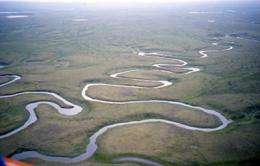
A meandering river in Siberia. Image Credit: Ólafur Ingólfsson, http://www3.hi.is/~oi/

Sinuous channels on the Martian surface may be evidence of relatively recent rainfall. Researchers plan to test this hypothesis by studying sinuous streams on Earth.

The surface of Mars is littered with channels that appear to be the work of ancient water flows. Indeed, some of these channels meander back and forth like slow-moving streams on our planet. Channels can be carved by lava, wind and , but these processes can't explain all the features on Mars.

"We've gotten over the hump and can now agree that water flowed on the in the past," says Alan Howard of the University of Virginia.

But how much and when is still unclear. Howard believes the meandering channels on Mars may tell us a lot about the wet history of our planetary neighbor.
The Meandering Channels of Mars
Enlarge

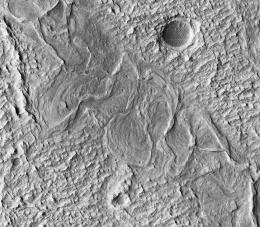
A sinuous channel in the Aeolis Planum region of Mars taken by the HiRISE camera on the Mars Reconnaissance Orbiter. Image Credit: NASA/JPL/University of Arizona

Howard and a group of researchers will be tromping into the desert and the arctic to find terrestrial "meanders" that might explain their counterparts on Mars.

On Earth, meandering streams occur where the floodplain is resistant to erosion. Often this is because the stream banks are held firm by grass and tree roots.

"Mars almost certainly didn't have vegetation like that," Howard says.

So what might have kept in place? Howard and his colleagues have a list of possible mechanisms: clay, ice, chemical processes. They will be studying how these mechanisms create sinuous channels on Earth to see if they can pinpoint the best representation for what created similar channels on Mars.

The work is funded by as part of its Mars Fundamental Research program.

Martian hydrology

Channels can be found all over the Martian landscape. Many are braided in a way that resembles river deltas on Earth.

But there are two areas on the red planet -- the Eberswalde Crater delta and the Aeolis/Zephyra Plana region -- where the channels snake their way through the now barren landscape. The channels were most likely carved by runoff from precipitation, Howard says. But that doesn't jive well with their age, which is estimated to be around 2 billion years old or even younger.

"The width and branching character of the channels is consistent with episodes of rain or snow, but it seems difficult to have precipitation that recently," Howard says.
The Meandering Channels of Mars
Enlarge

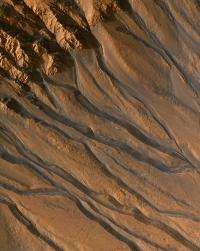
False color image of gully channels in a crater in the southern highlands of Mars, taken by the High Resolution Image Science Experiment (HiRISE) camera on the Mars Reconnaissance Orbiter. The gullies emanating from the rocky cliffs near the crater's rim (upper left) show meandering and braided patterns typical of water-carved channels. North is approximately up and illumination is from the left. The scale is 26 centimeters per pixel. Image credit: NASA/JPL/University of Arizona

Liquid water was thought to have disappeared from the surface of Mars more than 3 billion years ago. However, it's possible that water flowed after that - perhaps due to a large meteor impact or volcanic eruption that melted ice and created a wet micro-climate for a short period of time in the recent past.

But Howard and his colleagues wonder if such a brief wet spell could create meandering rivers in the martian landscape. Are there examples on Earth that could help solve the mystery?

Making hay over clay

Meandering rivers on Earth typically are found where vegetation traps fine sediment to eventually form a layer of cohesive material that is resistant to erosion.

But there are places where streams meander even though there’s not much vegetation around. Howard and his group have identified several such sites in the Nevada desert.

"We suspect clay sediment is providing the necessary cohesion," Howard says of these sites.

In the coming months, the team will visit these desert meanders to study their geology and test whether clay is indeed able to explain the meandering.

Clay has been detected on Mars in various locations, but it's mostly associated with earlier - supposedly wetter - epochs on Mars.

"Clay implies a considerable amount of weathering," Howard explains.

If the meandering channels on Mars formed because of clay in the soil, that would imply an appreciably wetter environment for a longer time and at a later epoch than scientists have imagined.
The Meandering Channels of Mars
Enlarge

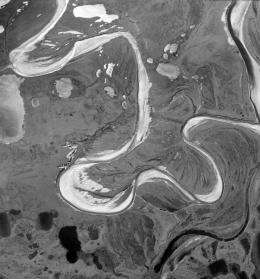
Aerial photo of a meandering stream near Barrow, Alaska. Image Credit: U.S. Geological Survey

Other possibilities

There may be other ways to make a waterway meander, besides clay.

Ice in the flow of water could hinder erosion of the banks. Howard's team plans to go to Alaska, near the town of Barrow, to see if ice is playing a part in the formation of meanders there.

Another possibility is chemical hardening of the stream bed. In arid environments, minerals deposited in the ground can cement together to form a hard thin layer. So-called "duricrusts" are common on Earth (and have been found on Mars), but the team has yet to find a meandering stream flowing through one. Howard says that the crusts take centuries to form, which is perhaps too long to develop the erosion boundaries needed for meandering.

The situation could, of course, be different on Mars. The climate is cooler, the surface is more iron-rich, and the gravity is just 38 percent that of Earth. This last difference is something that the researchers will be looking at closely to see what effect it has on channel formation.

Lastly, Howard has considered that microbial crusts - the closest that Mars could presumably have gotten to "vegetation" - may have provided soil cohesion.

"It would be obviously revolutionary if organisms were responsible for the meandering on , but we really have to eliminate all other possibilities first," Howard says.

Source: Astrobio.net

4.2 /5 (6 votes)  

Filter


Move the slider to adjust rank threshold, so that you can hide some of the comments.


Display comments: newest first

deatopmg
Dec 10, 2009

Rank: 2 / 5 (1)
"Mars almost certainly didn't have vegetation like that," Howard says. "

Based on what? Unreleased public paid for information or dogma.

If Scotland was tropical before the last ice age (and we know that CO2 couldn't have been the cause) then why couldn't Mars have been much warmer, and wetter, in the past w/ grass growing, like in the present day arctic?
deatopmg
Dec 10, 2009

Rank: 1 / 5 (1)
Scotland reference: http://www.physor...861.html

"It would be obviously revolutionary if organisms were responsible for the meandering on Mars, but we really have to eliminate all other possibilities first," Howard says."

Why, because the life issue could be too upsetting? Or because Life detection instrumentation hasn't been sent to Mars since the Viking experiment (early 70's) showed diurnal release of CO2? We have been told this was not by life but by some new, unknown mysterious chemical process. As a chemist, I know this is nonsense.
Birger
Dec 11, 2009

Rank: 4.5 / 5 (2)
As the late Carl Sagan said: "Extraordinary claims require extraordinary evidence". Remember how just about everybody used to believe that Venus was like a primitive, carbonaceous Earth, dripping with humidity because of the cloud cover which was all that could be observed. Then the soviet Venera probes showed the surface conditions were hellish, and bone dry.
The hopes of finding life on Mars might likewise turn out to be wishful thinking.
RayCherry
Dec 11, 2009

Rank: 4.5 / 5 (2)
Recent research of Venus has suggested that the 'totally dry' picture may be overstated, and that stable surface and/or sub-surface liquids (between the poles and the tropics) may provide conditions for 'extremophiles' which live in conditions that we could not survive.

It's not the picture of paradise that the Victorians imagined, but both Mars and Venus may support "life, Jim, but not as we know it"

I wish Carl were still with us, and that he had the lobbying power he has achieved since his death. He would not have us he discussing going to Mars, he would have us there by now, burying our first pioneers in Martian soil. Perhaps even being the first to go there, showing us the way.

No new territory has been conquered without cost, but we are going to have to pay to get out of the mess we are currently starting to understand.
pooky111
Dec 11, 2009

Rank: 5 / 5 (1)
Mars almost certainly didn't have vegetation like that," Howard says
Mr Howard how can you possibly exclude vegetation on mars at one time Have you been there before I think if you had been there it was most of the green house effect plunged Mars into a deep freeze But then 20 years ago you would have thought that mars had NO Water either !!!!!
Rank 4.2 /5 (6 votes)
Related Stories
Relevant PhysicsForums posts
  • Scale of the Universe
    created5 hours ago
  • Titan's lack of impact craters
    createdFeb 09, 2012
  • Real pictures of black hole eating a star?
    createdFeb 08, 2012
  • Hypothetical way to travel faster than light, but not technically exceed lightspeed
    createdFeb 06, 2012
  • How do scientists monitor the Sun's activity?
    createdFeb 05, 2012
  • Search patterns in observational studies
    createdFeb 05, 2012
  • More from Physics Forums - General Astronomy

More news stories

Humans may have helped the decline of African rainforests 3000 years ago

(PhysOrg.com) -- Large areas of rainforests in Central Africa mysteriously disappeared over three thousand years ago, to be replaced by savannas. The prevailing theory has been that the cause was a change ...

Space & Earth / Environment

created 16 hours ago | popularity 4.2 / 5 (9) | comments 10 | with audio podcast report

NASA sees wide-eyed cyclone Jasmine

Cyclone Jasmine's eye has opened wider on NASA satellite imagery, as it moves through the Southern Pacific Ocean.

Space & Earth / Earth Sciences

created 4 hours ago | popularity 2 / 5 (1) | comments 1

Could Venus be shifting gear?

(PhysOrg.com) -- ESA’s Venus Express spacecraft has discovered that our cloud-covered neighbour spins a little slower than previously measured. Peering through the dense atmosphere in the infrared, the ...

Space & Earth / Space Exploration

created 12 hours ago | popularity 5 / 5 (7) | comments 7 | with audio podcast

NASA sees Giovanna reach cyclone strength, threaten Madagascar

Tropical Storm 12S built up steam and became a cyclone on February 10, 2012 as NASA's Terra satellite passed overhead. Residents of east-central Madagascar should prepare for this cyclone to make landfall ...

Space & Earth / Earth Sciences

created 4 hours ago | popularity not rated yet | comments 0

Mars Science Laboratory computer issue resolved

(PhysOrg.com) -- Engineers have found the root cause of a computer reset that occurred two months ago on NASA's Mars Science Laboratory and have determined how to correct it.

Space & Earth / Space Exploration

created 13 hours ago | popularity 4.7 / 5 (6) | comments 3 | with audio podcast


Google users warned of threat to smartphone wallets

Users of Google smartphone wallets were being warned on Friday that there is a way to crack pass codes intended to thwart thieves from going on illicit shopping sprees.

Anonymous knocks CIA website offline (Update)

The website of the Central Intelligence Agency was inaccessible on Friday after the hacker group Anonymous claimed to have knocked it offline.

Complex wiring of the nervous system may rely on a just a handful of genes and proteins

Researchers at the Salk Institute have discovered a startling feature of early brain development that helps to explain how complex neuron wiring patterns are programmed using just a handful of critical genes. ...

New error-correcting codes guarantee the fastest possible rate of data transmission

Error-correcting codes are one of the triumphs of the digital age. They’re a way of encoding information so that it can be transmitted across a communication channel — such as an optical fiber o ...

The power of estrogen -- male snakes attract other males

A new study has shown that boosting the estrogen levels of male garter snakes causes them to secrete the same pheromones that females use to attract suitors, and turned the males into just about the sexiest ...

Putting the squeeze on planets outside our solar system

(PhysOrg.com) -- Using high-powered lasers, scientists at Lawrence Livermore National Laboratory and collaborators discovered that molten magnesium silicate undergoes a phase change in the liquid state, abruptly ...