Governments turn to cloud seeding to fight drought
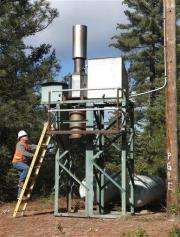
(AP) -- On a mountaintop clearing in the Sierra Nevada stands a tall metal platform holding a crude furnace and a box of silver iodide solution that some scientists believe could help offer relief from searing droughts.
This is a cloud-seeding machine designed to increase rainfall by spraying a chemical vapor into the clouds. Under the right conditions, it can help water droplets grow heavy, coalesce and fall to the ground.
Faced with water shortages, growing populations and the threat that climate change could make matters worse, governments around the globe have increasingly turned to cloud seeding in an attempt to wring more rain and snow from the sky.
But the efforts are threatened by budget cuts in states struggling to begin an economic recovery and by critics who insist the technique is unproven and might pose a threat to the environment.
"When there is a drought in a particular country, they start looking at alternative sources of freshwater, and cloudy air is one source," said Duncan Axisa, a scientist at the National Center for Atmospheric Research in Boulder, Colo., who supports expanding cloud-seeding research.
Government agencies and utilities from California to North Dakota spend an estimated $15 million a year on cloud seeding, and the number of projects has jumped by nearly a third in the last decade.
But spending in the United States is far lower than in many other countries. China spends an estimated $100 million a year on cloud-seeding efforts that include using anti-aircraft guns and rocket launchers to blast the sky with silver iodide.
"What's going on in the U.S. is tiny," said Arlen Huggins, an associate research scientist at the Desert Research Institute in Reno, Nev. "There's more being done outside the U.S. than here."
Other countries conducting cloud-seeding research include Australia, France, Greece, Saudi Arabia, Turkey and Venezuela.
In the U.S., utilities that run hydroelectric dams are among the most active cloud seeders. They say it is a cost-effective way to increase limited water supplies by 10 percent or more. Cloud seeding is also used in Texas and the Midwest to make hail smaller, reducing crop damage.
Lack of federal funding has not stopped dozens of other cloud-seeding projects run by public agencies and private enterprise. In 2008, 63 projects in nine states were reported to the National Oceanic and Atmospheric Association. That's up from 48 a decade ago.
California officials estimate that cloud seeding throughout the Sierra Nevada could produce another 300,000 to 400,000 acre-feet of water annually. An acre-foot is about enough water to supply a typical household for a year.
And proponents say cloud seeding is far cheaper than building a new dam or running ocean water through a desalination plant.
But finding money for the projects in a rough economy is a challenge. Oklahoma, Texas and Nevada have cut money for cloud-seeding projects, so many advocates of cloud seeding are now seeking federal funding, which was halted 14 years ago.
Legislation to restore federal funding has stalled several times in Congress. Republican Sen. Kay Bailey Hutchison of Texas introduced a $25 million bill that was passed by a Senate committee in May, but it is unclear when the measure might be taken up in the full Senate.
If the government funneled money to states conducting research, "we think we can pile up the evidence that the seeding we're doing is having a pronounced, profound effect," said Texas state meteorologist George Bomar.
The request for federal help has also renewed a debate about the effectiveness of cloud seeding.
The National Research Council in 2003 found there was no convincing evidence to prove the technique works, but the panel's scientists acknowledged the potential and encouraged more study.
"I think there's more science necessary to understand what conditions it will work in and what won't work," said Roelof Bruintjes, a weather-modification expert at the National Center for Atmospheric Research in Boulder, Colo. He was one of the authors of the 2003 report.
Cloud-seeding proponents cite data from several states:
- In the northern Sierra Nevada, where Pacific Gas & Electric has operated cloud seeders since 1953, the utility says data going back four decades show the area has received 5 percent more snow on average than before.
- In North Dakota, records indicate that between 4 and 14 percent more rain has fallen in areas subject to cloud seeding, according to the state's Atmospheric Resource Board.
Scientists say weather conditions must be right for cloud seeding to work. In the Sierra Nevada, if passing storm clouds are cold enough, a meteorologist in San Francisco uses a radio signal to turn on PG&E's mountaintop cloud seeder. The invisible silver iodide vapor is carried by the wind into the clouds, and it can begin to snow within 15 to 30 minutes.
Clouds can also be seeded by airplanes equipped to release the vapor.
Questions have been raised about the environmental effects, including whether the silver iodide solution used to stimulate snow harms water supplies. Silver iodide is a salt that does not dissolve in water.
It's a concern for some residents of a rural Northern California county where PG&E plans to install seven, 20-foot-tall generators for cloud seeding.
"We trust natural systems to regulate our atmosphere themselves," said Angelina Cook, who sits on the board of directors of the nonprofit McCloud Watershed Council in Siskiyou County. "We feel like tampering with meteorology results in more damaging consequences than the benefits derived."
The Weather Modification Association, which has a board comprised of federal researchers and program operators, published a study last summer concluding that years of research have shown no "environmentally harmful effects" from silver iodide.
Colorado has doubled its state and local spending on cloud seeding over the last 10 years to about $700,000 a year. In 2005, Wyoming lawmakers committed nearly $9 million to a five-year project to determine whether the technology works.
Cloud-seeding supporters say federal research funding would not only validate the system but lead to improvements in techniques.
"We want to chip away at changes in climate change now and do a good job at augmenting our precipitation now," said Joe Busto, who sits on the North American Interstate Weather Modification Council, a group of regulators from 10 states organized to promote cloud seeding.
©2009 The Associated Press. All rights reserved. This material may not be published, broadcast, rewritten or redistributed.


