UN talks: Rich nations must make big emission cuts
(AP) -- Wealthy nations would commit to drastically reduce greenhouse gas emissions in the next decade, and the world should strive to nearly eliminate them - or at least cut them in half - by 2050 under a draft agreement circulated Friday at the U.N. climate talks.
The draft pulled together the main elements of a global pact that 192 nations have been negotiating for two years, but left numbers on financing and cutting greenhouse gas emissions - perhaps the most contentious bargaining points of the agreement - for world leaders to hammer out next week.
The draft was meant to focus attention on the broad goals the world must achieve to avoid irreversible change in climate that scientists say could bring many species to extinction and cause upheavals in the human environment in many parts of the Earth.
"It's time to begin to focus on the big picture," said Yvo de Boer, the top U.N. climate official. "The serious discussion on finance and targets has begun."
In unusually blunt language, meanwhile, China's vice foreign minister said the chief U.S. negotiator at the talks either "lacks common sense" or was "extremely irresponsible" for saying that no U.S. climate funding should be going to China. The world's two biggest greenhouse gas polluters have been exchanging barbs this week about the sincerity of their pledges to fight climate change.
The draft accord said all countries together should reduce emissions by 50 percent to 95 percent by 2050, and rich countries should cut emissions by 25 percent to 40 percent by 2020, in both cases using 1990 as the baseline year.
So far, pledges from the industrial countries amounted to far less than the minimum. But the European Union, at a summit in Brussels, said it was raising its 2020 target to 30 percent, in a gambit intended to push other wealthy nations to deepen their emissions-reduction pledges during negotiations next week.
The six-page draft document distilled a much-disputed 180-page negotiating text, laying out the obligations of industrial and developing countries in curbing the growth of greenhouse gases responsible for global warming.
News of the document came as the European Union leaders agreed in Brussels to commit $3.6 billion (euro2.4 billion) a year until 2012 to a short-term fund to help poor countries cope with climate change. Most of the money came from Britain, France and Germany, with many cash-strapped former East bloc countries balking.
The EU also conditionally lifted its commitment to reduce carbon emissions by 30 percent below 1990 levels over the next decade, depending on better commitments by the United States and Canada. In the past the EU pledged a 20 percent cut with an option increase that to 30 percent as part of a global deal.
The draft agreement is less specific than other proposals and attempts to bridge the divide between rich and poor countries. It leaves much to be decided by more 110 heads of state, including President Barack Obama, Chinese Prime Minister Wen Jiabao and Russian President Dmitry Medvedev and most of Europe's top leadership, who are due to arrive in the Danish capital in one week for a landmark summit.
"This text will be the focus of the negotiations from now on," said Jake Schmidt, an analyst for the Natural Resources Defense Council.
The draft, drawn up by Michael Zammit Cutajar of Malta, said global emissions of greenhouse gases should peak "as soon as possible." But controlling carbon emissions should be subordinate to the effort to wipe out poverty and develop the economies of the world's poorest nations, it said.
It called for new funding in the next three years by wealthy countries to help poor countries adapt to a changing climate, but mentioned no figures.
And it made no specific proposals on long-term help for developing countries. "That's the gaping hole," said Antonio Hill, of Oxfam International.
Cutajar wrote that his text was meant to facilitate progress in the talks without prejudging whether they should result in a legally binding treaty or merely a political declaration.
In his blunt remarks, China's Vice Foreign Minister He Yafei said he was "shocked" by U.S. climate envoy Todd Stern's comments that Beijing shouldn't expect any American climate aid money.
"I don't want to say the gentleman is ignorant," He told reporters. "I think he lacks common sense where he made such a comment vis a vis funds for China. Either lack of common sense or extremely irresponsible."
In China's view, the U.S. and other rich countries have a heavy historical responsibility to cut emissions and any climate deal should take into account a country's development level.
China is grouped with the developing nations at the talks. But Stern said the U.S. doesn't consider China one of the neediest countries when it comes to giving those nations financial aid.
"I don't envision public funds - certainly not from the United States going to China," he said Wednesday. "China to its great credit has a dynamic economy, and sits on some $2 trillion in reserves. So we don't think China would be the first candidate for public funding."
The Chinese official said China wasn't asking for money, but suggested the U.S. and China had different responsibilities in dealing with global warming.
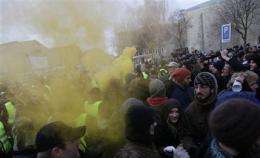
In downtown Copenhagen, police detained 40 people in the first street protests linked to the conference. About 200 people rallied in the area where corporate CEOs were meeting to discuss the role of business in global warming - one of many side events to the U.N. conference.
The protesters broke into small groups, banging drums and shouting, "Mind your business. This is our climate!" There were no reports of violence.
Police spokesman Henrik Moeller Nielsen said the detentions were preventative, to avoid disorder.
In Brussels, President Nicolas Sarkozy said the EU commitment of $3.6 billion a year until 2012 "puts Europe in a leadership role in Copenhagen."
The figure was reached after two days of tough talks during which eastern EU countries - still lagging in their own development and further battered by the global economic downturn, resisted pressure to chip in. In the end, all 27 EU nations agreed to donate, but about 20 percent is coming from Britain, France and Germany.
"There are few moments in history when nations are summoned to common decisions that will reshape the lives of men and women potentially for generations to come," said British Prime Minister Gordon Brown. "This world deal in Copenhagen must be ambitious, global, comprehensive legally binding within six months."
De Boer said the fact that Europe put a figure on the table - about 30 percent of what was needed - was "a huge encouragement to the process."
Critics said the EU was merely repacking aid promised earlier in different forms and sidestepping key climate change issues to produce a favorable headline.
Greenpeace said EU leaders were avoiding more important decisions on longer-term climate financing for poor nations and on greenhouse gas emissions cuts.
"Climate change will not end in three years ... so neither should the flow of cash," said Joris den Blanken, the environmental group's climate expert.
ActionAid, which focuses on development aid, said the EU was failing to pledge "real money" and that many EU states had "a track record of repackaging or re-announcing existing aid."
Swedish Prime Minister Fredrik Reinfeldt conceded the commitments announced Friday include new money as well as aid promised earlier.
©2009 The Associated Press. All rights reserved. This material may not be published, broadcast, rewritten or redistributed.


