Decades-old dioxins pollute river, divide US community
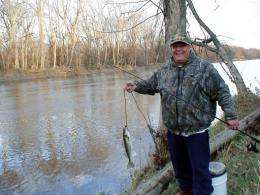
The signs posted along Michigan's Tittabawassee River warning of dangerous dioxin levels don't really worry fisherman David Mitchell.
If he catches a fish that swims here year round he tosses it back. But if he hooks a walleye -- only an occasional visitor to the river and has lower dioxin levels than the year-rounders -- then it's time for dinner.
"I don't think it's as big a concern as what people are saying it is," said Mitchell, 51, as he sat on a pail on the muddy bank and cast his line out into the water.
"I can remember when the rivers never froze in the winters and now they're freezing over, so the pollution in the rivers has got to be a lot less than it was."
The Tittabawassee may be clean enough to freeze now, but it remains one of the most contaminated waterways in the United States and a key example of the nation's struggle to deal with its industrial past.
President Barack Obama's administration has vowed to take tougher action against polluters and has invested nearly a billion dollars of stimulus funds to spur cleanup efforts.
But the decades-long conflict over this one watershed underscores the complexities of trying to force companies into environmental action.
It also foreshadows the bitter battle the White House will face when it comes to implementing the emissions cuts needed to address climate change -- the focus of talks in Copenhagen to thrash out a deal for the global warming summit there on Dec 17 and 18.
Dioxins are chemicals so toxic they get measured in trillionths of a gram. They linger for years in both the environment and the body and pose a host of health risks from cancer to birth defects.
For most of the last century, Dow Chemical Company dumped waste from the sprawling complex near its Midland, Michigan headquarters right into the Tittabawassee and burned it in unfiltered incinerators.
Among that waste were dioxins created during the production of herbicides like the Vietnam-era Agent Orange and other chemicals which were carried downstream into the Saginaw River and Lake Huron.
Such dumping was standard industrial practice until the environmental movement -- horrified by the sight of rivers and lakes so polluted they would catch on fire -- succeeded in pressing the federal government to start regulating air, water and ground pollution in 1970.
Since then, Dow -- one of the world's biggest chemical companies with 2008 sales of 57.4 billion dollars -- has invested millions in sophisticated pollution controls which carefully manage the toxic waste it produces.
Dow estimates its total accrued liability for the Midland-area cleanup is 312 million dollars and concluded in its 2008 annual report that "the possibility is remote" that the cleanup costs will have an "adverse impact" on its balance sheet.
Yet little has been done to clean up the dioxins which spread for more than 50 miles (80 kilometers) downstream and downwind of the Midland plant.
"Dow wrote the book, they wrote the book on how to delay things," said environmental activist Michelle Hurd Riddick of the Saginaw-based Lone Tree Council who has spent years fighting for a comprehensive cleanup.
"This is a 30 year-old-issue and no one has yet to have the political will to move that company."
There are a lot of different reasons why the cleanup has taken so long.
Much of the 1980's were spent on figuring out how to prevent further pollution from the chemical complex.
Much of the 1990's were spent trying to understand the extent of the contamination.
Dow has spent much of the past decade fighting with the state of Michigan about what needs to be done about it and insisting that the dioxins do not pose a significant health risk to residents.
A series of scandals have engendered a great deal of mistrust.
A 1983 congressional investigation found that the Environmental Protection Agency allowed Dow to cut critical passages from a report so it would not conclude that Dow was responsible for the bulk of the contamination in the Tittabawassee.
The head of the state regulatory agency was accused in 2002 of covering up evidence of contamination in the area and blocking further investigations.
And just last year the regional EPA administrator accused the Bush administration of forcing her out of her job by for being too tough on Dow.
Amid pressure from the Obama administration, Dow agreed in September to accept responsibility for the contamination and get to work on a comprehensive cleanup plan under the EPA's Superfund program.
"We think that we have a really solid tool in place with this proposed settlement to really move the process forward quickly," said Wendy Carney, the regional Superfund manager who is overseeing the project.
Dow has kept its public comments on the issue to the absolute minimum.
"We're focused right now on moving this agreement forward and focused on the implementation of that agreement so we can move towards resolution," Dow spokeswoman Mary Draves told AFP.
Critics say the deal is little different from one Dow reached with the state of Michigan in 2003 which has never been fully implemented.
Even if the EPA exerts more pressure than the state, it will be several years until the actual cleanup work begins and at least a decade for it to be completed.
The issue has divided the community, said Ralph Wirtz, managing editor of the Midland Daily News.
Many here are not sure if the benefit outweighs the cost. They worry about the impact on their property values or simply don't believe the dioxins are actually that dangerous.
Others call the river a chemical soup which threatens the health of thousands of people and hampers future economic development.
The real question, Wirtz said, is "how do you go about cleaning this up, setting this straight without bankrupting an entire community?"
At a public meeting held downriver at Saginaw Valley State University, the desire to just get this over with was palpable. So was the fear of what would happen next.
Ron Thurlow, who owns a riverfront house in nearby Freeland, was worried about the cottonwood trees after seeing how Dow had stripped the banks bare at a test site.
"Some of us have concerns that the river's going to end up looking like a ditch in Kansas, no trees for as far as you can see," he told EPA officials.
"Or it's the old Vietnam analogy we had to destroy the village to save it and I hope we're not going to end up destroying this river to save it."
(c) 2009 AFP


