Efforts to save endangered languages
December 14, 2009 by Lin Edwards
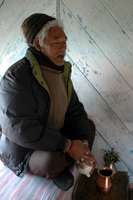
Recitation of oral texts by the late Latte Apa, senior ritual practitioner of the Thangmi community, India. Image credit: World Oral Literature Project
(PhysOrg.com) -- There are an estimated 6,500 languages in the world, with around fifty percent of them endangered and likely to cease to exist by 2100, but efforts are now being made to save them from extinction.
Languages are dying out around the globe through globalisation, social change, a shift in populations from rural areas to cities, and often well-intentioned education in national languages and national cultures rather than local indigenous languages and traditions. Of the 6,500 languages estimated by UNESCO to be still in use, only 11 are spoken by half the world's population, and 95 percent of the languages are spoken by five percent of the global population.
A new project, the World Oral Literature Project, led by anthropologist Dr Mark Turin of the University of Cambridge's Museum of Archaeology and Anthropology, aims to preserve the linguistic diversity being lost as elders die and young people turn to the national languages taught in schools and used by the media. The project is recording and documenting languages that face the prospect of dying out, with the goal of preserving their poems, chants, stories, and anything else that can be recorded.
Turin receives boxes of DVDs from small indigenous communities around the world, who hope the project will preserve their language and literature for future generations. The project uses a range of media including voice recorders, video cameras and other multimedia technologies, and is building a digital archive that will be accessible on demand both by academics and by people of the communities themselves.
An oral tradition is central for many of the groups, rather than a written tradition, and many communities have never had their songs and stories recorded by anyone. Groups collaborating with anthropologists to have their languages recorded for the first time are widespread, and include communities such as the Amurdag community in Northern Australia, the Maka in Paraguay, Chulym in Siberia, and the Kallawaya community in Bolivia.
The idea for the project began when Turin documented the language of the Thangmi community in Nepal for his PhD in endangered languages at Leiden University in The Netherlands. The choice of language was random, with Turin selecting the community from a map on his supervisor's study wall. The language was virtually unknown outside the tiny community, and was completely undocumented.
Turin's project eventually created a trilingual word list in Thangmi, Nepali, and English, that is still sold in the community and which is being used to teach children about their own language and heritage. Turin said he was amazed so few linguists are working on endangered languages, and people "do PhDs on the apostrophe in French," but no one knows precisely how many undocumented languages there are. When a language ceases to exist, so does its cultural world view, and much of the heritage of the community is lost.
The World Oral Literature Project has secured funding of £30,000 to aid communities in the recordings. Its first international workshop is to be held in Cambridge this week. Similar projects are being carried out by National Geographic and their Enduring Voices project, the Arcadia fund, and the Hans Rausing Endangered Languages Project. It is also worth noting that in Europe there are many languages in need of efforts to preserve them, such as Cornish in England, Gaelic in Scotland, and Breton in France.
More information: World Oral Literature Project
The World Oral Literature Project is currently seeking sustainable long-term funding to ensure that it can make a permanent contribution to the
urgent documentation of endangered traditions.
© 2009 PhysOrg.com
-
Investigating the world of languages
Sep 27, 2006 |
not rated yet |
0
-
Endangered languages threaten to disappear, researcher says
Jan 29, 2007 |
not rated yet |
0
-
Multilingualism brings communities closer together
Feb 10, 2009 |
not rated yet |
0
-
Probing Question: What is lost when a language dies?
Feb 15, 2008 |
not rated yet |
0
-
Babies able to tell through visual cues when speakers switch languages
May 24, 2007 |
not rated yet |
0
-
Engineers build first sub-10-nm carbon nanotube transistor
Feb 01, 2012 |
4.9 / 5 (31) |
30
-
Something old, something new: Evolution and the structural divergence of duplicate genes
Jan 31, 2012 |
4.6 / 5 (7) |
1
-
The hidden nanoworld of ice crystals: Revealing the dynamic behavior of quasi-liquid layers
Jan 30, 2012 |
5 / 5 (3) |
1
-
Stock market network reveals investor clustering
Jan 27, 2012 |
3.9 / 5 (23) |
8
-
Of microchemistry and molecules: Electronic microfluidic device synthesizes biocompatible probes
Jan 26, 2012 |
5 / 5 (1) |
0
-
Can I forget a language?
18 hours ago
-
The Biggest Lie Ever
Feb 09, 2012
-
What are the limits of learning?
Feb 06, 2012
-
Isn't that grammatically wrong?
Feb 06, 2012
-
What does it mean when traders are indifferent?
Feb 04, 2012
-
Peak of Our Civilization
Feb 04, 2012
- More from Physics Forums - Social Sciences
More news stories
A frank discussion of the power law and linking correlation to causation
(PhysOrg.com) -- Michael Stumpf a mathematics professor at Imperial College in London, and Mason Porter a lecturer at Oxford have teamed together to write and publish a perspective piece in Science regarding the in ...
Employers feel no love for unscrupulous practice of 'service sweethearting'
A new study led by two Florida State University marketing professors finds that some frontline service employees who are rewarded for hikes in customer loyalty and satisfaction also may engage in "service ...
Other Sciences / Economics & Business
15 hours ago |
4 / 5 (1) |
7
The question of life in the ancient world
Theres a general feeling that we dont get the Greeks ancient or modern. Many, including heads of state like Angela Merkel, visibly shake their head in exasperation, rightly or wrongly, at ...
Other Sciences / Archaeology & Fossils
20 hours ago |
1.3 / 5 (3) |
4
Sonic Cradle lands spot in TED exhibition
A Simon Fraser University graduate student project that melds music, meditation and modern technology has landed a rare spot as an exhibit at TEDActive 2012 in Palm Springs, California this month.
17 hours ago |
not rated yet |
0
Do we no longer care about the collective good?
The Transformation of Solidarity, a book co-edited by University of Queensland sociologist Dr Mara Yerkes, tackles the subject of globalisation of national economies and societies where we put a high value ...
Other Sciences / Social Sciences
Feb 06, 2012 |
3.9 / 5 (8) |
39
Anonymous knocks CIA website offline (Update)
The website of the Central Intelligence Agency was inaccessible on Friday after the hacker group Anonymous claimed to have knocked it offline.
New error-correcting codes guarantee the fastest possible rate of data transmission
Error-correcting codes are one of the triumphs of the digital age. Theyre a way of encoding information so that it can be transmitted across a communication channel such as an optical fiber o ...
Humans may have helped the decline of African rainforests 3000 years ago
(PhysOrg.com) -- Large areas of rainforests in Central Africa mysteriously disappeared over three thousand years ago, to be replaced by savannas. The prevailing theory has been that the cause was a change ...
Small modular reactor design could be a 'SUPERSTAR'
(PhysOrg.com) -- Though most of today's nuclear reactors are cooled by water, we've long known that there are alternatives; in fact, the world's first nuclear-powered electricity in 1951 came from a reactor ...
New power source discovered
(PhysOrg.com) -- Researchers at the Massachusetts Institute of Technology (MIT) and RMIT University have made a breakthrough in energy storage and power generation.
The power of estrogen -- male snakes attract other males
A new study has shown that boosting the estrogen levels of male garter snakes causes them to secrete the same pheromones that females use to attract suitors, and turned the males into just about the sexiest ...
Dec 14, 2009
Rank: not rated yet
Dec 14, 2009
Rank: 1 / 5 (2)
Dec 14, 2009
Rank: not rated yet
Dec 14, 2009
Rank: 1 / 5 (1)
Instead I'd like to thank the Greeks for keeping their language alive.
Dec 14, 2009
Rank: 1 / 5 (1)
But there are people who are interested in the past of humanity because they are interested in the future of humanity. They will continue to gather knowledge and they will continue to better understand past and future in order to teach those who want to know.
Dec 14, 2009
Rank: not rated yet
The modern Greek language is no more related to classical Greek than Italian is to Latin. The only similarity is the name.
Dec 14, 2009
Rank: 5 / 5 (1)
So I can somehow aovid my taxes and not fund this project?
Dec 14, 2009
Rank: 1 / 5 (1)
Dec 20, 2009
Rank: 5 / 5 (2)
Jan 05, 2010
Rank: 5 / 5 (1)