Sucker-footed bats don't use suction after all (w/ Video)
December 14, 2009
Sucker-footed bats don't use suction after all

Enlarge

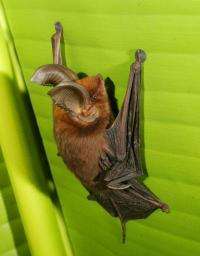
Brown University researcher Daniel Riskin has discovered how a species of bat in Madagascar roosts head-up. The bat uses wet adhesion, not suction, as previously believed. Credit: None

There are approximately 1,200 species of bats worldwide. Of that total, only six are known to roost with their heads pointed upward. Investigators did not know why, because they knew next to nothing about one key group.

The sucker-footed bats of , Myzopoda aurita, had rarely been seen in the wild and were listed as vulnerable to by the International Union for of Nature. But several years ago, biologists stumbled upon some colonies in a new-growth forest on the southeastern section of the island, opening the door to studies.

Daniel Riskin, a postdoctoral research associate in ecology and at Brown University, traveled last summer to Madagascar to study one of the two species of sucker-footed bats with biologist Paul Racey. In first-time experiments in the wild, the pair made a surprising discovery: The bats don't use suction after all. Instead, they use wet adhesion, secreting a fluid, possibly sweat, that enables the pads on the bats' wrists and ankles to attach to surfaces. The pair's findings are published in the Biological Journal of the Linnean Society.

This video is not supported by your browser at this time.

Scientists have learned that a species of bats in Madagascar, Myzopoda aurita, roosts head up by using wet adhesion -- not suction, as previously believed. Credit: Daniel Riskin, Brown University

While the finding settles the question of how the bats roost, it means science has misnamed the bat. "Myzopoda literally means 'sucker foot,'" Riskin, the paper's lead author, said. "You can't change Latin names, so it's stuck with it."

Riskin used a force plate he had built to determine how Myzopoda clung to surfaces. He placed the sucker-footed bats on the plates, first with evenly spaced holes and then with the holes covered by tape underneath the plate. In both instances, Myzopoda had no problem adhering to the plate, effectively ruling out suction as the adhesive technique. (Had suction been used, the holes would have prevented the bats from establishing a seal on the surface.)

Next, Riskin sought to understand how the bats roost head-up by testing how they detach their limbs from a surface. Holding the bat so it was head up-and in a vertical position, Riskin discovered that he could easily "unpeel" the bats' pads from the surface. He also encountered little resistance when pushing the bat in an upward direction. But when Riskin tried to drag the bat downward, the animal clung doggedly to the vertical surface. Through further investigation, Riskin figured out the bats detach themselves from their roosting position by using tendons in their wrists and ankles to decrease the pads' surface area of attachment. This explains why video footage shows the bats' pads peeling off the surface when they begin walking. It also explains why the bats would come unlatched if they tried to roost head down.

The finding helps scientists understand how Myzopoda lives in the wild. The bat, a small creature about two inches long and weighing one-third of an ounce, roosts on the slick surface of broad, fan-like leaves located high off the ground in an indigenous tree called Travelers' Palm (Ravenala madagascariensis).

The researchers' finding also settles speculation that Myzopoda differs from its head-up roosting alter ego, Thyroptera, which is a suction-footed species that lives in tropical climes in Central and South America. The question is, with two species living in similar tropical environments under similar competitive pressures, which adhesive technique came first?

Riskin believes that Thyroptera is a later stage of evolution of the two . Why? While Myzopoda, through wet adhesion, can only roost head-up, Thyroptera, using suction, can roost either head-up or head-down. In terms of evolution, Riskin noted, "It doesn't make sense to go through suction to get to wet adhesion, but it does make sense to go through wet adhesion to get to suction."

Source: Brown University (news : web)

4.3 /5 (3 votes)  

Rank 4.3 /5 (3 votes)
Related Stories
Relevant PhysicsForums posts
  • Homo Sapien vs. Chimpanzee - Divergence Timeline
    created5 hours ago
  • a single mRNA strand is attached to sevaral ribosomes?
    createdFeb 08, 2012
  • Oestrogen and FSH
    createdFeb 07, 2012
  • Linear Blood Vessel Network Examples in Animals or Plants
    createdFeb 07, 2012
  • Neuroscientists: What is a Principal Cell Layer?
    createdFeb 06, 2012
  • How does slime mould grow?
    createdFeb 04, 2012
  • More from Physics Forums - Biology

More news stories

Life in Antarctic lake? It's everywhere else

If scientists find microbes in a frigid lake two miles beneath the thick ice of Antarctica, it will illustrate once again that somehow life finds a way to survive in the strangest and harshest places.

Biology / Plants & Animals

created 1 hour ago | popularity 1 / 5 (1) | comments 0

Fruit flies drawn to the sweet smell of youth

Aging takes its toll on sex appeal and now an international team of researchers led by Baylor College of Medicine and the University of Michigan find that in fruit flies, at least, it even diminishes the come-hither ...

Biology / Plants & Animals

created 1 hour ago | popularity not rated yet | comments 0 | with audio podcast

Amazing skin gives sharks a push

Shark skin has long been known to improve the fish's swimming performance by reducing drag, but now George Lauder and Johannes Oeffner from Harvard University show that in addition, the skin generates thrust, ...

Biology / Plants & Animals

created 1 hour ago | popularity 4 / 5 (2) | comments 0 | with audio podcast

How the zebra got its stripes

If there was a 'Just So' story for how the zebra got its stripes, I'm sure that Rudyard Kipling would have come up with an amusing and entertaining camouflage explanation. But would he have come up with the explanation that ...

Biology / Plants & Animals

created 1 hour ago | popularity 4 / 5 (1) | comments 0

Judge tosses case seeking rights for orcas

(AP) -- An effort to free whales from SeaWorld by claiming they were enslaved made a splash in the news but flopped in court Wednesday.

Biology / Plants & Animals

created 1 hour ago | popularity 4 / 5 (1) | comments 0


Bonding out: Making companies pay up front for potential environmental disasters

Whether it’s building an oil pipeline, drilling for fuel in the ocean or “fracking” to flush natural gas out of the Earth, we’re often asked to believe the process is safe, when companies want to do something ...

Soraa LED light may dim 50-watt halogen rivals

(PhysOrg.com) -- Soraa, a Fremont, California company founded in 2008, this week launched its first product, a light that uses LEDS (light emitting diodes). The "Soraa LED MR16 lamp" is the "perfect" replacement for traditional ...

Facebook discloses details on bonuses

Facebook's top executives, including CEO Mark Zuckerberg, are eligible for twice-a-year bonuses of up to 45 percent of their base salaries and other earnings, according to a Wednesday regulatory filing.

Mexican experts excited to find ancient home ruins

(AP) -- The ruins aren't particularly impressive, just some stone and clay footings for houses that probably supported walls of wood or clay wattle. And it's that very ordinariness that has experts excited.

New study shows high cost of defensive medicine

Vanderbilt University Medical Center researchers estimate that U.S. orthopaedic surgeons create approximately $2 billion per year in unnecessary health care costs associated with orthopaedic care due to the practice of defensive ...

Management of TB cases falls short of international standards

The management of tuberculosis cases in the European Union (EU) is not meeting international standards, according to new research.